

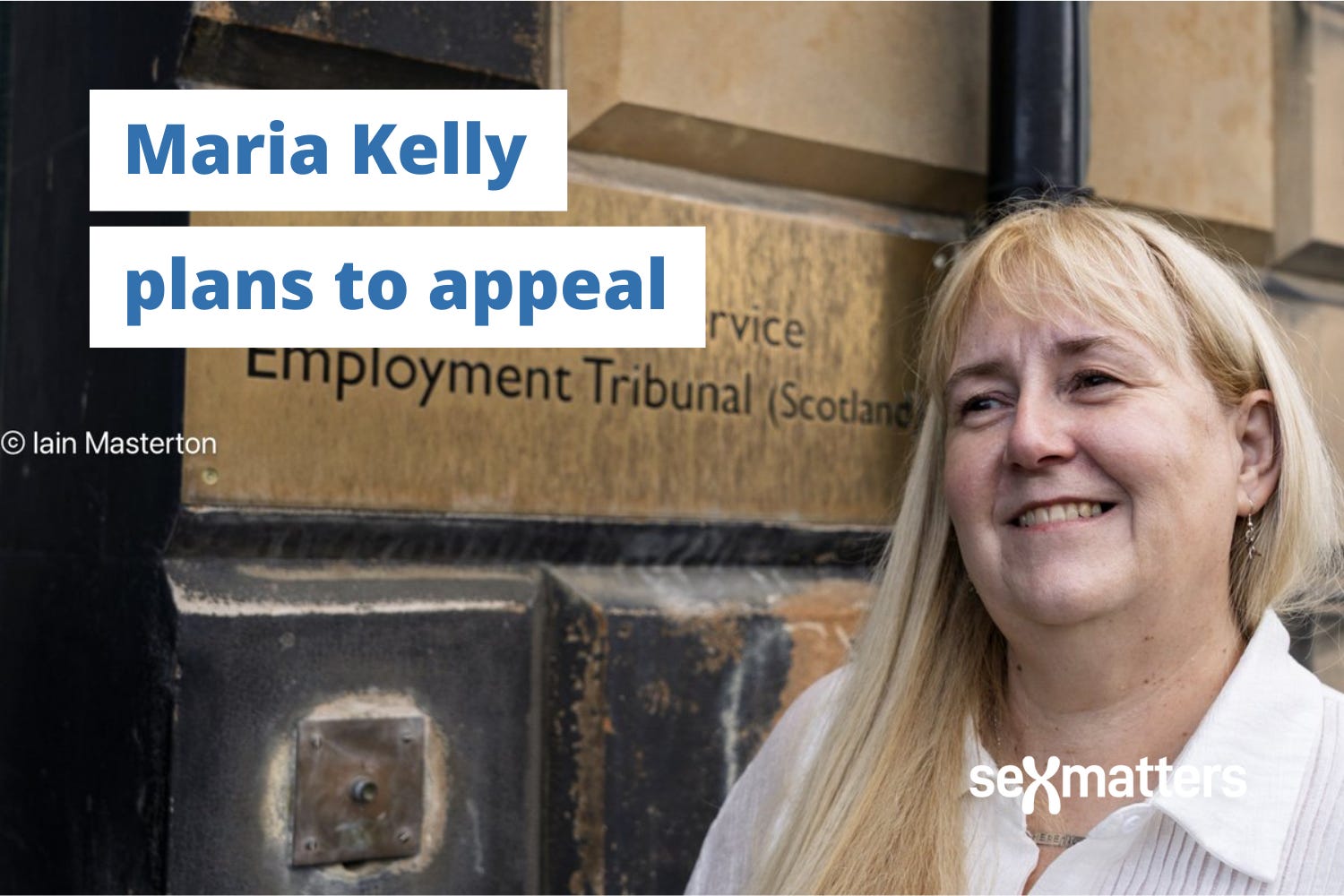
The judgment in the case of Kelly v Leonardo has been published, and it is bad news. This case involves Maria Kelly, who works at Leonardo UK Ltd, a global defence and security equipment company, at its site in Edinburgh. She brought a claim against her employer for sex discrimination and harassment for its policy of allowing trans-identifying male staff to use the women’s toilets.
Kelly’s case was heard in late September and early October 2025 – after the Supreme Court had made clear that the protected characteristic of sex in the Equality Act means biological sex.
It was therefore surprising that the judge, Michelle Sutherland, dismissed all her claims, finding variously that she had not suffered humiliating or degrading treatment by being forced to share the women’s toilets with three men; that she did not complain hard enough or quickly enough; that not enough other women complained about the policy; and that women had nothing to worry about anyway as the staff working at Leonardo were security-vetted.
The judge found that “a toilet access policy of permitting access based upon asserted gender rather than sex was an appropriate means to achieve the aim of an inclusive workplace environment”.
A judgment based on gender ideology
Maria Kelly has said that she is disappointed by the judgment, which she believes fundamentally misunderstands both the law and her case. She says:
“I intend to appeal, and I will ask the EAT to consider expediting my appeal, as the decision risks further confounding the already widespread misunderstanding and defiance of the Supreme Court’s judgment in For Women Scotland.”
With Kelly intending to appeal, other employers should be wary of following Leonardo’s lead and adopting policies that allow men to use women’s facilities.
This judgment, like that of Mr Justice Tayler, who got the law wrong in the Forstater v CGD Employment Tribunal in 2019, centres trans people’s desires and then bends the law to accommodate those desires.
The judgment says, in relation to the 1992 regulations on workplace toilets:
“Any requirement to control access to those facilities (presumably through effective and enforced policy) is limited to what is reasonably practicable for the purpose of ensuring health, safety and welfare (including their bodily privacy) and moral propriety between the sexes.”
Judge Sutherland then takes for granted that it is not “reasonably practicable” to set clear sex-based rules and expect all employees to follow them.
She also frames the judgment by defining “trans” and “transgender” in gender-ideology terms as “a person whose gender identity is at variance with their biological sex”.
The term “gender identity” appears 36 times in her judgment, but just once in the For Women Scotland judgment (FWS), where the Supreme Court says:
“We can see no good reason why the legislature should have intended that people with the protected characteristic of gender reassignment should be regarded and treated differently under the EA 2010 depending on whether or not they possess a (confidential) certificate, even though in many (if not most) cases there will be no material distinction in their personal characteristics, either as regards gender identity, or appearance, or as to how they are perceived or treated by others or society at large. The difficulty this interpretation would create for service-providers, employers and other organisations in applying equality law to these groups is obvious.”
The Supreme Court judgment was firmly based on the reality that humans come in two sexes, and that people can tell each other’s sex by using their eyes and ears. In contrast Judge Sutherland says:
“Workers are unlikely to know the biological sex of another worker but they may infer their gender identity from how they present.”
She rejects the Supreme Court’s reasoning that “man” and “woman” are coherent groups and that “women plus trans women” is an unworkable category for service provision because it is mixed sex. The Employment Tribunal turns the Supreme Court’s logic on its head, saying that since some males may pass as “putative” women, applying a sex-based criterion for workplace toilets:
“creates heterogenous groupings in practice such that women would mean putative women (biological women and biological men perceived to be female) rendering the distinction unworkable.”
She accepts that the part of the 1992 workplace regulations requiring physical provision of toilets (where Health and Safety Executive guidance specifies urinals for men and disposal bins for menstrual products for women) relates to biological sex, but reasons that employers must take a “modern” approach to enforcing rules preventing staff trespassing into facilities reserved for the opposite sex:
“Moral propriety is a social construct and standards of decency change over time, and accordingly it must be interpreted in a modern context.”
She dismisses Kelly’s claim that in her experience “trans women” are “readily discernible as men” and insists that, whatever she says, she in fact holds gender-ideology beliefs:
“The claimant is aware that trans women believe their gender identity is at variance to their sex whereas non-trans men (including transvestites) do not.
“The claimant is aware that trans women often undergo a process for the purpose of reassigning their gender identity (or their belief in it) which may entail medical advice, hormonal treatment, and/or endeavouring to live permanently as a female including modifying their appearance and presentation. The claimant is aware that a transvestite i.e. crossdresser does not undergo such a process and is merely engaged in a temporary modification of their appearance.
“It is not therefore accepted that the claimant believes that trans women are indistinguishable from men in practice.”
The “inclusive” policy
When Kelly became aware that three trans-identifying men had been using the female toilets on her floor at work, she didn’t challenge them directly or make individualised complaints about them; instead, she asked her line manager about the company’s policy. Her line manager said he did not know and neither did his line manager. Eventually, after much chasing, she was told by HR:
“We consider it is appropriate, and an inclusive approach, that anyone who is proposing to undergo, is undergoing or has undergone a process (or part of a process) for the purposes of reassigning their gender should use the toilet which is aligned to the gender to which they identify.”
She politely and insistently asked some more questions and was told:
“It is well-established that transgender employees are entitled to use the toilet facilities of the gender by which they identify. This means that a female transgender employee is entitled to use the female toilet facilities. There can be occasions when separate facilities need to be provided for a religious reason but these situations will be very limited and will be based on strict religious need.”
She brought a grievance about the issue and was told:
“Our clarification of the legislation is any individual, living in the gender with which they identify, even if they have not undergone or do not intend to undergo medical or surgical procedures, is entitled to access the facilities of the gender by which they identify. This includes toilets and changing rooms. Advice from our external legal counsel makes it very clear that any attempt by the company to refuse individuals access to use the toilets of their affirmed gender would be unlawful.”
She appealed that outcome in October 2024. Leonardo concluded that it had:
“acted lawfully in its position of defining toilet use by self-identified gender (and at any stage of transition whether or not intending to undergo surgery) as opposed to biological sex.”
All this happened before the Supreme Court clarified that “women” does not include biological males. But the judgment dismisses Kelly’s claims that women are less favourably treated by the policy; that it leads them to suffer unjustifiably; and that Kelly herself had experienced a hostile, humiliating or degrading environment as a woman.
Are “trans women” entitled to use female toilets?
The building where Kelly works is large and well-fitted with the usual combination of male and female toilet blocks and single-user unisex accessible toilets. It also has some additional stand-alone male and female toilets in the stairwell, which were later badged as single-user unisex loos.
There should be no problem communicating and applying sex-based rules. Any trans or non-binary colleagues who don’t wish to use the toilets for their own sex should be welcome to use the unisex options.
To reach its judgment that this is not reasonably practical the judgment places emphasis on the 2003 case of Croft v Royal Mail. But in that case the Court of Appeal found that the employer’s conduct in offering a unisex alternative for a transitioning employee was lawful.
However, it speculated that at some unspecified time in the employee’s future, it might become unlawful to continue to deny him access to the women’s facilities. In the Kelly ruling, Judge Sutherland jumps to the conclusion that a fixed date at which this would happen had thereby been established in law:
“The Court of Appeal in Croft held that whilst a trans woman (a biological man) who had completed the third stage of reassignment (2 years of living as a woman under professional supervision) had a right to use the female toilet, a trans woman who not completed that stage did not have that right and could be expected to use the disabled toilet instead.”
This is a misrepresentation. Employment cases are about particular facts. The Court of Appeal said:
“I see nothing unlawful, having regard to the stage reached by the applicant, that is the step of embarking on the ‘real life test’ expected by doctors usually to last for two years, in requiring the use of separate facilities.”
It did not conclude that after two years Croft, or any “transsexual”, would have the right to use opposite-sex facilities. And the Supreme Court in FWS said no such thing.
Employment Judge Sutherland goes on to say:
“The stage in the process approach adopted in Croft was then put on a statutory footing with the introduction of Gender Recognition Certificates.”
This is another misrepresentation. While the Gender Recognition Act requires two years’ worth of proof that a person has “lived in the acquired gender” (such as by changing their name and title), a gender-recognition certificate is not a legal permit to use services provided for members of the opposite sex.
As the Supreme Court noted, a gender-certified interpretation of the Equality Act “would undermine the very considerations of privacy and decency between the sexes” which the single-sex and separate-sex exceptions allow for.
Why can’t trans staff just use the unisex option?
The judge admitted that:
“Applying a gender certified interpretation to toilet access may cause significant distress and embarrassment to some non-trans users required to share toilet facilities with trans users of the opposite sex.”
But she added:
“Likewise applying a biological interpretation to toilet access may cause significant distress and embarrassment to trans women required to use the male toilet facilities.”
But requiring trans-identifying men to use the men’s is not the only alternative. There are unisex options available at Leonardo (which the employer deemed suitable and sufficient for Kelly and any other woman who did not want to share with male colleagues).
But the judge said that “applying a biological interpretation to any duty to control toilet access is unworkable” because:
“The biological sex of another toilet user is likely to be unknown and may be unknowable (because birth certificates may be updated with a GRC). This results in an incoherence between any requirement (toilet access based upon biological sex not gender identity) and the practice (toilet access based upon perceived gender not biological sex).”
This ignores the fact that we can generally tell other people’s sex using ordinary perception. Kelly’s concern about the policy was prompted by the presence of three individuals she and her colleagues readily identified as male.
It also ignores the fact that everyone knows their own sex and can be expected to follow health-and-safety rules.
The judge then falls back even further, on a selective reading of paragraph 56 of the Employment Appeal Tribunal in Croft:
“In the massively preponderant number of cases the employer will have no reason to distinguish between sex and gender. If such papers as a person discloses identify him as male and he ‘presents’ as male in the sense of dressing and appearing as a male, the employer can properly treat him as at law male as he will have no reason to think otherwise of him. So also in the corresponding case of someone presenting as a woman.”
And:
“An employer is to be expected to require those who are, or who are believed by him to be, at law males to use only the men’s facilities and those who are at law or who are believed by him to be females to use only the women’s.”
It is worth looking fully at what the Employment Appeal Tribunal says in Croft, at paragraphs 55 and 56. It doesn’t support Judge Sutherland’s reading at all, but instead supports the ordinary expectation that women are entitled to expect that their employer will tell male colleagues to stay out of the ladies’ toilets (emphasis added):
“55. The terms ‘men’ and ‘women’ were not defined in either the [Workplace Directive (89/654/EEC)] Directive or the [1992 workplace] Regulations but, as it seems to us, in 1989 and 1992 the references would be to those at law or believed by the employer to be male and female respectively. Moreover, it seems to us inherently improbable that the terms ‘men’ and ‘women’ should then be referring to the gender a person might choose for himself or herself as that interpretation would require contemplation of the shower rooms, similarly provided to be separate, nonetheless possibly having amongst their users, in the women’s facilities, persons still wholly anatomically male and, in the men’s, persons surgically adapted as far as possible to resemble females. Further, if the Directive was contemplating ‘men’ or ‘women’ as including persons asserting a gender other than congruent with their sex at law or that sex believed by the employer to be the appropriate sex at law, one could reasonably have expected provision to be made to exclude, for example, temporary masquerades, by referring to the steps taken to adopt the discongruent gender and as to its intended duration.
“56. If that is right then a woman finding a person at law male using the facilities separately assigned for use by women might not be asserting only a right to a conventional form of privacy or propriety but also a breach of Directive or Regulation. In the light of these workplace provisions ordinary good practice requires, as it seems to us, that an employer is to be expected to require those who are, or who are believed by him to be, at law males to use only the men’s facilities and those who are at law or who are believed by him to be females to use only the women’s. In the massively preponderant number of cases the employer will have no reason to distinguish between sex and gender. If such papers as a person discloses identify him as male and he ‘presents’ as male in the sense of dressing and appearing as a male, the employer can properly treat him as at law male as he will have no reason to think otherwise of him. So also in the corresponding case of someone presenting as a woman. The employer cannot be expected to test to verify whether those presenting as of one sex truly are of it when he has no reason for real doubt. Instead the employer will treat his employees and require them to behave consistently with what has to be taken to be their putative sex at law.”
Are there rules against trans people using accessible toilets?
Having argued that sex-based rules are unworkable, the tribunal then invents a new problem concerning use of accessible toilets:
“The indistinguishability problem also affects disabled access. The requirement to provide facilities for the disabled under the 1992 Regs applies to those who qualify as disabled under the Section 6 of EA 2010.”
This is another misdirection. What the 1992 regulations say about disabled persons is this:
“Where necessary, those parts of the workplace (including in particular doors, passageways, stairs, showers, washbasins, lavatories and workstations) used or occupied directly by disabled persons at work shall be organised to take account of such persons.”
The regulations do not require that accessible parts of the workplace are exclusively provided for people who qualify as disabled people as defined by the Equality Act. Building regulations do not require this either.
The tribunal continues to invent further tests concerning who can use the accessible toilets at work:
“Whilst a trans person suffering from gender dysphoria may be entitled to use the disabled facilities whilst they are undergoing gender reassignment treatment (per CofA in Croft), they may no longer qualify once that reassignment is complete (because there is no longer a marked incongruence between how they perceive themselves and how they present to others). Likewise a person suffering from psychological or psychiatric distress as a consequence of the toilet access policy may be entitled to use the disabled facilities. However any requirement to do so, particularly if a trans person no longer qualifies as disabled, is affected by considerations of illegality and would not fulfil the legitimate aims of treating trans employees inclusively, with respect and dignity according to the gender by which they have identified.”
There was no evidence presented that Leonardo limits the use of accessible facilities to those meeting the Equality Act definition of disability, and this is not a requirement of the regulations. Indeed, the company argued that the accessible unisex toilets were the most convenient for Kelly to use.
Meanwhile the tribunal dismissed Kelly’s evidence about why women don’t want to share toilets with men (such as modesty concerns and exposure to risk of sexual assault, exposure and voyeurism) as “generalities that do not apply in the context of their Edinburgh site”.
What happens next?
Transactivists will no doubt read this judgment as meaning that organisations can – and indeed should – adopt toilet policies based on “gender identity” without fear of liability for sex discrimination and harassment.
Sensible employers will be wary. This judgment is not likely to withstand appeal. An employer relying on the employment-tribunal judgment of Kelly v Leonardo for confidence that a toilet policy based on gender identity is “an appropriate means to achieve the aim of an inclusive workplace environment” in 2025 will be in very much the same position as one relying on the Forstater v CGD judgment that gender-critical beliefs are “not worthy of respect in a democratic society” would have been in 2019. As the EAT case of Croft, which this judgment relies on, says:
“In the light of these workplace provisions ordinary good practice requires, as it seems to us, that an employer is to be expected to require those who are, or who are believed by him to be, at law males to use only the men’s facilities and those who are at law or who are believed by him to be females to use only the women’s.”
Employers must be confident that their own policies are lawful. As we have written to Sir Chris Wormald, the cabinet secretary and head of the civil service, employees implementing an unlawful policy are liable for these contraventions unless they can rely on a statement by the employer that the policy is lawful. The employer commits an offence if it “knowingly or recklessly” makes a statement confirming the lawfulness of its policy “which is false or misleading in a material respect”.
This case underlines the need for clear guidance. Staff at Leonardo relied on guidance published by the Government Equalities Office, which was produced with an activist organisation, is wrong in law and has since been withdrawn. As a result, Leonardo is now faced with a long legal battle with a valued employee in the public eye.
The Women and Equalities Minister must replace the outdated code of practice for service providers, which has misled so many employers as to their legal duties, with new guidance. The Health and Safety Executive, which is responsible for the Workplace (Health, Safety and Welfare) Regulations 1992, should make clear in its guidance that communicating ordinary sex-based rules to employees, and expecting them to follow those rules, is basic good practice.