

Over the past 15 years, a misunderstanding of the Equality Act 2010 has been allowed to undermine safeguarding in schools. Charities have played a key role.
When Stonewall was established in 1989, it was one of a handful of civil-society organisations focused on sexual orientation. By 2015, the legal battles for gay rights had been won, and it started to campaign in the new field of transgender identity. In 2017, it published findings of an online survey of 11- to 19-year-olds which found that homophobic bullying in schools was decreasing, but children who identified as transgender were more likely to say they were being bullied than gay children were.
The government of the day provided millions of pounds of funding and endorsement for programmes to tackle “homophobic, biphobic and transphobic” bullying in primary and secondary schools, with the money being given to Stonewall and other LGBT charities. The charities offered schools advice, which they said was backed by the Equality Act, such as “people should always be referred to by the pronoun which matches their gender identity” and “young people have the right to access the toilet that corresponds to their gender identity”. By 2025, over 2,000 LGBT civil-society organisations were promoting a similar message.
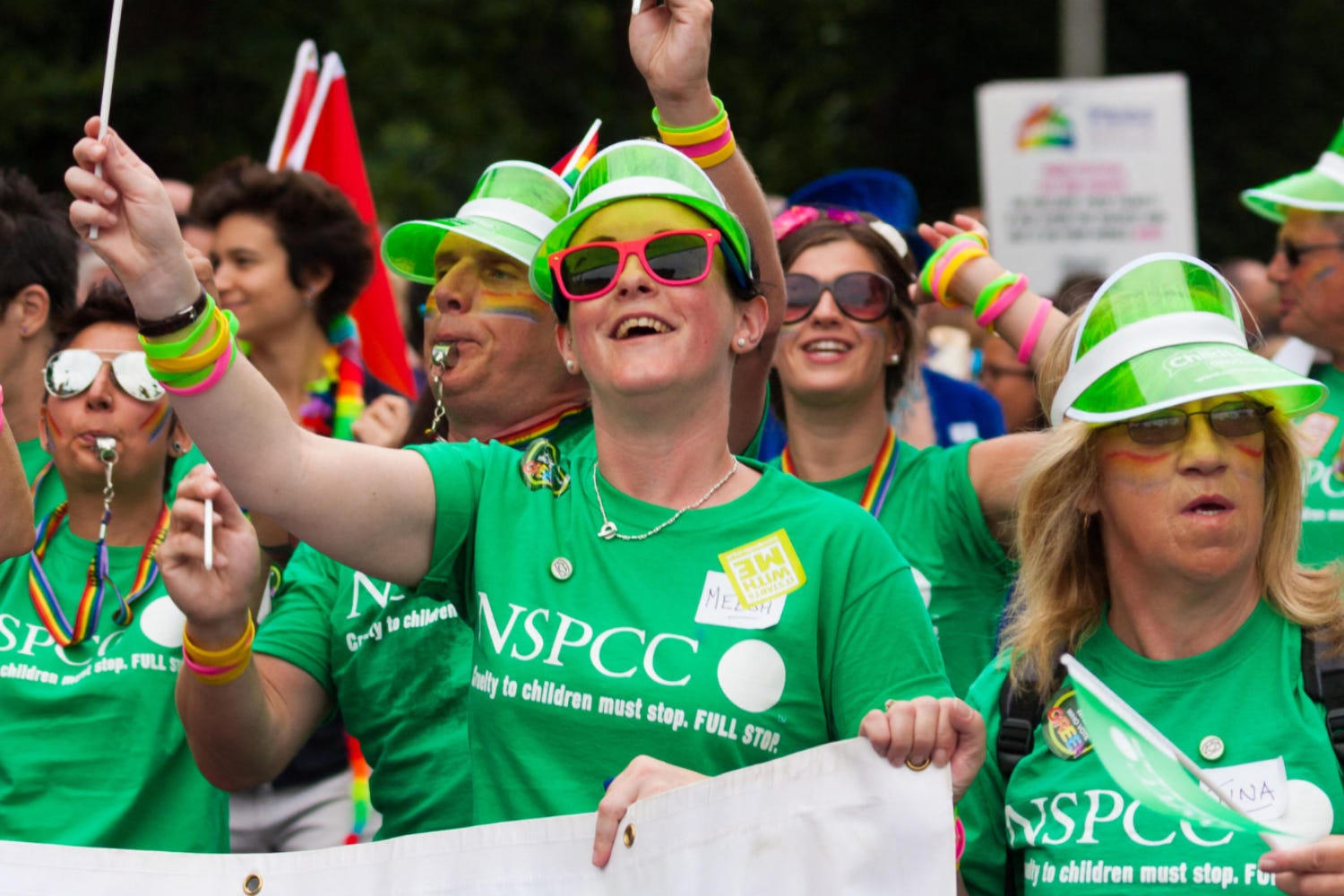
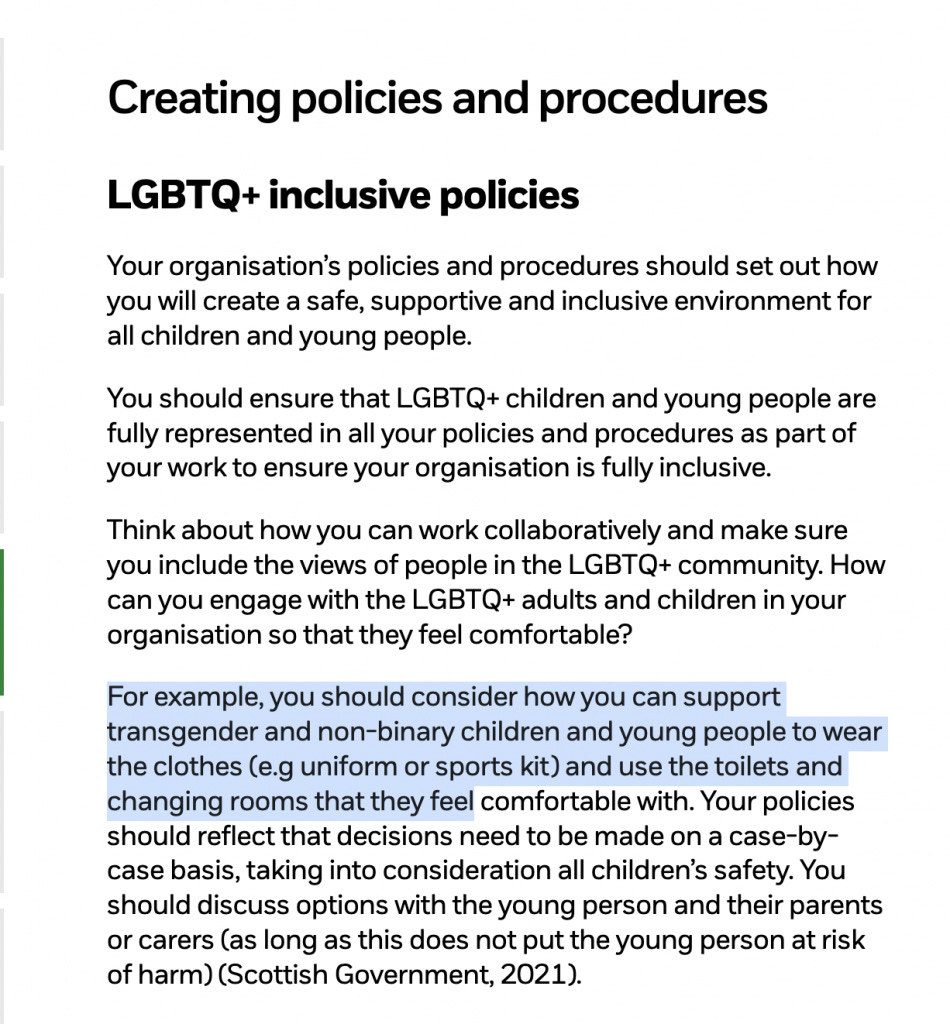
Their message was also taken up by mainstream children’s charities. Human-rights charities also became convinced that children could be “born in the wrong body” and should be facilitated to transition while at school. Amnesty International and Liberty advocated for children to be given puberty blockers. The NSPCC published advice that schools should allow “transgender and non-binary children and young people” to “use the toilets and changing rooms that they feel comfortable with”.
As the number of children identifying as transgender and non-binary in school and seeking referrals to gender clinics skyrocketed, people began to ask questions about whether all this was really safe, fair or wise.
The charitable sector banded together to coordinate a defence. In 2021, 33 organisations, including Stonewall, Mermaids, Gendered Intelligence, LGBT Consortium and Diversity Role Models, criticised the Equality and Human Rights Commission (EHRC) for supporting the legal case that “gender critical” beliefs are worthy of respect in a democratic society and should be allowed to be expressed. In 2022, after the EHRC had published a cautious position about the then government’s plan to ban “conversion therapy”, a coalition of charities including Liberty, Gendered Intelligence, Mermaids, Galop, LGBT Consortium, LGBT Foundation and LGBT Youth Scotland demanded that the regulator’s status as a National Human Rights Institution be downgraded. In 2023, another group of charities tried again.
In 2023, a charity fundraiser called Kevin Taylor-McKnight launched the “I Stand with Trans” campaign. On social media, the campaign declared that “It is not lawful to ACT on gender critical* (*transphobic) views in the workplace – ANY workplace, and we should have zero tolerance of hate in our sector”. Another post warned that “we hear it on good authority that people with gender critical beliefs are trying to infiltrate particular charities by becoming trustees, with the intent to influence policy. Be sure to do your due diligence when recruiting new trustees.” A total of 280 charity leaders signed the pledge against what the campaign called a “transphobic movement” of hate.
In December 2023, LGBT charities objected when the government released guidance for schools in England that took a step back from encouraging schools to enable children to “socially transition”. Mermaids said it found it “difficult to understand” how aspects of the draft guidance were compatible with equality law, including “automatically excluding trans pupils from facilities” [for the opposite sex], “sport bans” [excluding children from sports for the opposite sex] and “allowing students to be misgendered” [referring to their sex]. It told teachers to “disregard these discriminatory guidelines”. It said the approach was “unworkable, out of touch and absurd”. Stonewall said the draft guidance was “not fit for purpose”, “legally unworkable and contrary to existing equality law” and against the UN Convention on the Rights of the Child and the Equality Act 2010.
A group of 77 organisations, including Amnesty International, Liberty, Stonewall, LGBT Foundation, Gendered Intelligence, Galop, GIRES, the National Education Union and the Good Law Project, joined with Mermaids in May 2024 to launch the “Supportive Schools Campaign” objecting to the guidance, saying it was “exclusionary and unhelpful”. They complained that it would “seek to deny the existence of transgender pupils”, discourage those children from coming out as “their authentic selves” and lead them to “being forcibly outed to parents and teachers”.
Like the campaigns that preceded it, this extraordinary statement betrays a total disregard for the basic principles of safeguarding, and sets the signatories in opposition to the current statutory safeguarding guidance for schools.
Encouraging secrecy, undermining safeguarding
Parents have primary responsibility for their children. If a child is being encouraged (for example by talking to adults on the internet) to believe that being their “authentic self” requires them to deny their sex, seek to access facilities for the opposite sex, take off-label drugs, bind their breasts or aspire to be castrated, it is essential that their parents are told.
The LGBT charity campaigners view parents as “supportive” only if they support transition. By the notion of “forcibly outing” children, they mean two different things. In the first scenario, a child discloses something in relation to ideas about trans identity, and a staff member tells a parent. The second envisages a scenario where the parents and the school have agreed that the child will attend school presenting as the opposite sex and somebody reveals their actual sex to their teachers and peers.
Secrecy, lies and evasion about sex puts children at risk of abuse, exploitation and harm. This happens when an individual child’s sex is obscured or made unmentionable; it is also true when individuals and organisations are unwilling to clearly state and act on risk factors related to sex. This is not only about decisions on sleepovers or changing rooms: it is also about children and adults keeping secrets and engaging in inappropriate conversations.
Rather than challenge the approach of treating children who identify as trans differently, the chief executives of the major children’s charities – Barnardo’s, the Children’s Society, and the National Society for the Prevention of Cruelty to Children (NSPCC) – put out their own statement, which said vaguely: “We support an inclusive model of education that values difference and challenges all types of discrimination and bullying.”
The NSPCC’s guidance on safeguarding LGBTQ+ children and young people references three different Stonewall reports but does not reference the Cass Review.
Piling on international pressure
There were more howls of disapproval from the charity sector in 2024 when the Department for Education updated the statutory safeguarding guidance Keeping children safe in education (KCSIE) to say that “caution is necessary for children questioning their gender as there remain many unknowns about the impact of social transition”. The updated version highlighted vulnerabilities that may co-occur in a child questioning their gender, including mental-health issues, autism and ADHD.
This time international LGBT coalitions stepped in. The International Lesbian, Gay, Bisexual, Transgender, Queer and Intersex Youth and Student Organisation, IGLYO (whose UK members include Just Like Us, Mermaids, LGBT Youth Scotland and Diversity Role Models), issued a statement together with ILGA-Europe and Transgender Europe that described the guidance a “deeply worrying march toward the attack against trans people in the UK”. It called on the UK government to discard what it said were “dangerous changes” to the statutory safeguarding guidance.
But both the previous Conservative government and the current Labour government appear to have recognised that they should not bow to pressure from activists to abandon safeguarding principles.
The Supreme Court has now made clear that the charities were wrong about the Equality Act. Following the For Women Scotland judgment in April 2025, which confirmed that the Equality Act did not support the charities’ prescriptions, the government updated KCSIE, incorporating the approach of the draft guidance to which the charities objected, and finally giving schools in England official guidance. We recognised this as a big step forward. The guidance now makes clear that no child may be allowed to use opposite-sex toilets, changing rooms or dormitories, and that children seeking to attend school “in stealth” as the opposite sex are a safeguarding concern. This guidance is now mandatory.
Stonewall, meanwhile, had quietly closed its “Diversity Champions” programme for schools.
Defying KCSIE
Despite legal clarity and the unambiguous guidance in KCSIE, some charities have again doubled down, this time forming the Supportive Schools Campaign. Over the summer, they called on the government to “rethink its approach, and amend the KCSIE guidance”. They said that the new guidance is unacceptable because it:
treats “being trans+” as a problem to be managed rather than an identity to be respected
requires schools to involve parents by default whenever a child questions their gender, with a narrow exception only where doing so risks harm
mandates biological sex-based access to toilets and changing rooms with no exceptions “even for pupils who have socially transitioned in every other way”.
Treating safeguarding concerns as “an identity to be respected”, excluding parents and allowing ad hoc exceptions to rules are all indicative of institutional safeguarding failures.
After Girlguiding and the Women’s Institute returned to being female-only organisations earlier this year, a charity governance consultant called Kevin Taylor-McKnight launched a new campaign called Third Sector Against Transphobia. The campaign website says it is “a growing movement of charity professionals, volunteers, community organisations”. Its membership, said to be around 700 people, is secret and access is closely guarded.
The charities that are part of the Supportive Schools Campaign recommend that schools follow a model policy produced by an organisation called Trans and Non Binary Education, which says it is a “charitable trust”. TNB Education does not appear to be registered as a charity, or indeed incorporated at all. It is a small anonymous group of “trans, non-binary, and gender diverse” educators and their allies.
TNB Education’s model policy says that a pupil identifying as trans+ “is not inherently a safeguarding concern on its own”, but suggests that a parent “misgendering” a child is. The group says: “No teacher should be encouraged to automatically disclose a child’s gender identity to their parents, as doing so poses a significant safeguarding risk.”
Safeguarding guidance highlights potential areas of concern to determine an adult’s suitability to work with children. These include attitudes such as:
implying that adults and children are equal
lack of recognition or understanding of the vulnerability of children, or both
inappropriate idealisation of children
inadequate understanding of appropriate boundaries between adults and children
indicators of negative safeguarding behaviours.
The materials produced by this group of anonymous educators and endorsed by the Supportive Schools Campaign raise concerns in all of these areas.
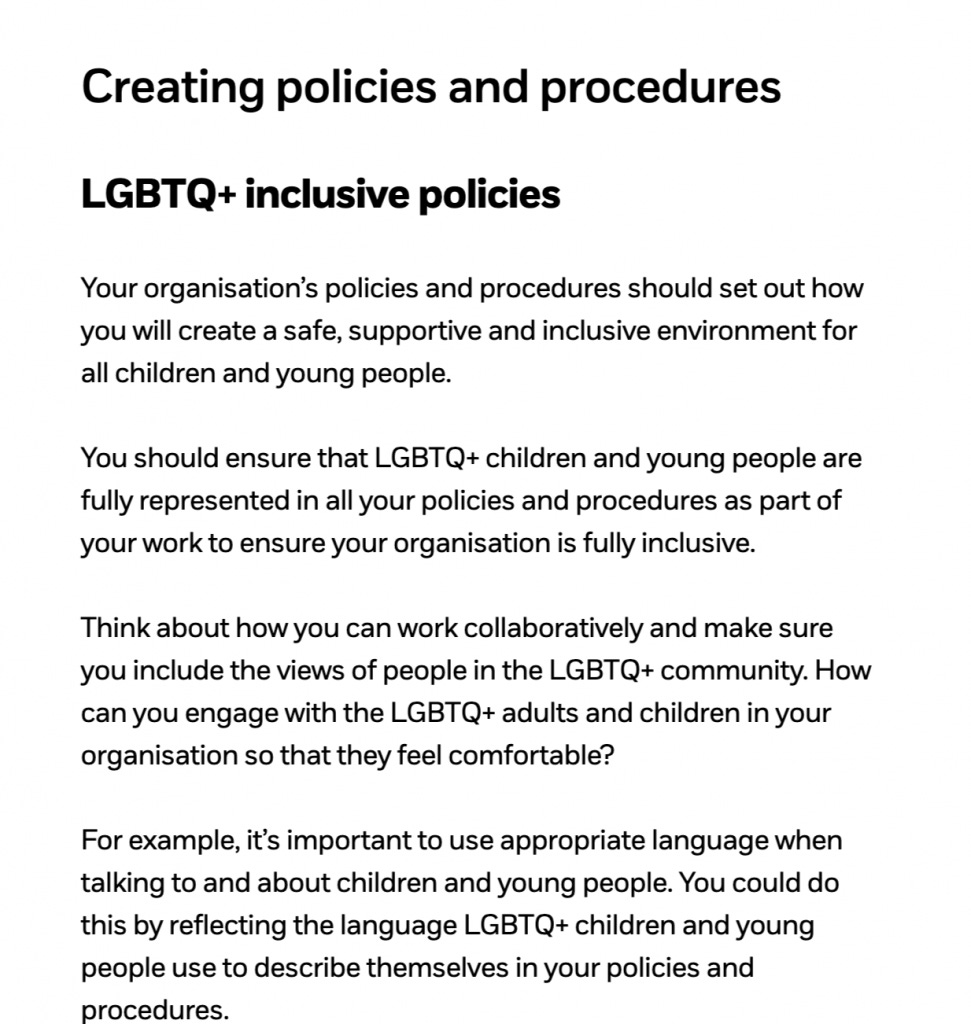
Larger charities such as the NSPCC should be admitting they made serious mistakes and warning against schools adopting fringe ideas from unregulated, anonymous groups. Instead, the NSPCC has simply updated its guidance on “LGBTQ+ children” and on changing rooms by quietly deleting sections that previously told schools to allow children to use opposite-sex facilities. There is nothing in the NSPCC’s guidance that makes clear that schools must not allow children to use opposite-sex facilities or be recorded or treated as the opposite sex at school.
Diversity Role Models, one of the smaller charities that works with schools, has been absorbed by Stonewall as part of a new approach to influencing schools: not to engage with school leaders by claiming to know how the law works, but to bring charismatic young influencers into schools to work directly with children and tell them to be “allies against unkindness”.
Conversion therapy and the charity complex
Instead of addressing the sector’s safeguarding problem, the charities have shifted their attention to campaigning to criminalise “conversion practices”. The government has published a draft bill which would target parents, teachers and therapists that do not affirm a child’s asserted gender identity. The evidence upon which the government relies to support the draft bill comes from online surveys from Stonewall and Galop.
TNB Education, however, describes conversion practices as including “misgendering”, confiscating or controlling access to pupil’s belongings, controlling and monitoring a pupil’s movements and restricting access to medicines. Thus it casts as abusive the behaviour of a protective parent who refuses to go along with a child’s asserted gender identity, such as monitoring online activity, confiscating a breast binder or hormones bought on the internet or preventing the child from associating with inappropriate groups of adults.
In July, Amnesty International published a report that smeared gender-critical groups as “anti-rights” and accused organisations that take a cautious approach to psychological care of undertaking conversion therapy. It later, under pressure, apologised and called this an “isolated error”.
The last time a UK government committed to ban what the activists call “conversion therapy”, in 2022, it engineered an external deadline by announcing an international conference called Safe to be me. When concerns about the impact on vulnerable children later led it to backtrack on the proposals for a ban, 100 LGBT+ charities threatened to boycott the summit, and it was cancelled.
The 2024 Labour government repeated the same move, committing itself (and now Andy Burnham’s government) to provide £21 million for charities promoting LGBT rights internationally, and committing the UK to hold a European LGBT+ summit in May 2027. The prospect of receiving some of this funding creates an incentive for charities to stick together, and the summit is a mechanism for government-funded charities to provide pressure to get the bill through Parliament. All of this creates a strong incentive not to look too closely at the charity sector’s promotion of practices that undermine safeguarding.
The Charity Commission has urged charities to follow the EHRC code of practice on the Equality Act 2010, but shows no sign of understanding the systematic safeguarding failure that was enabled by misunderstanding the act.
Organisations that tell schools to ignore statutory safeguarding guidance and principles have no place in schools. Any charity that does this should be reported to the Charity Commission. Any school that takes advice from such a charity should be reported to Ofsted.