

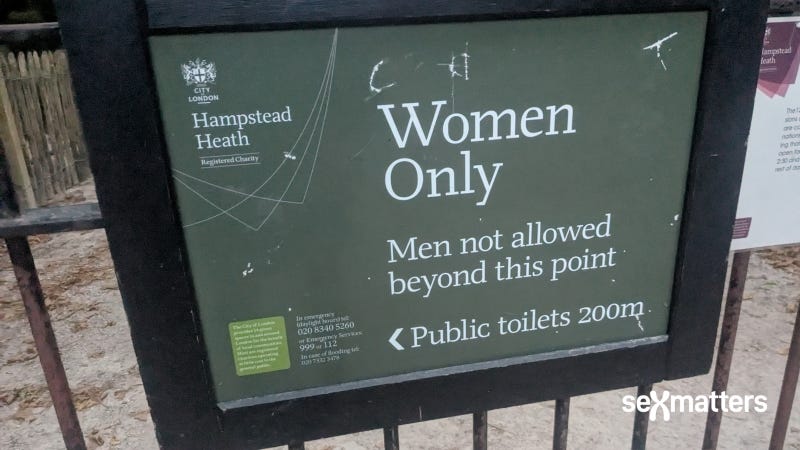
Sex Matters is going to court on 3rd and 4th November 2026 to argue our case about the Hampstead Ponds.
The City of London say the signs that say “women only” and “men not allowed beyond this point” refer to lived genders, not the two sexes.
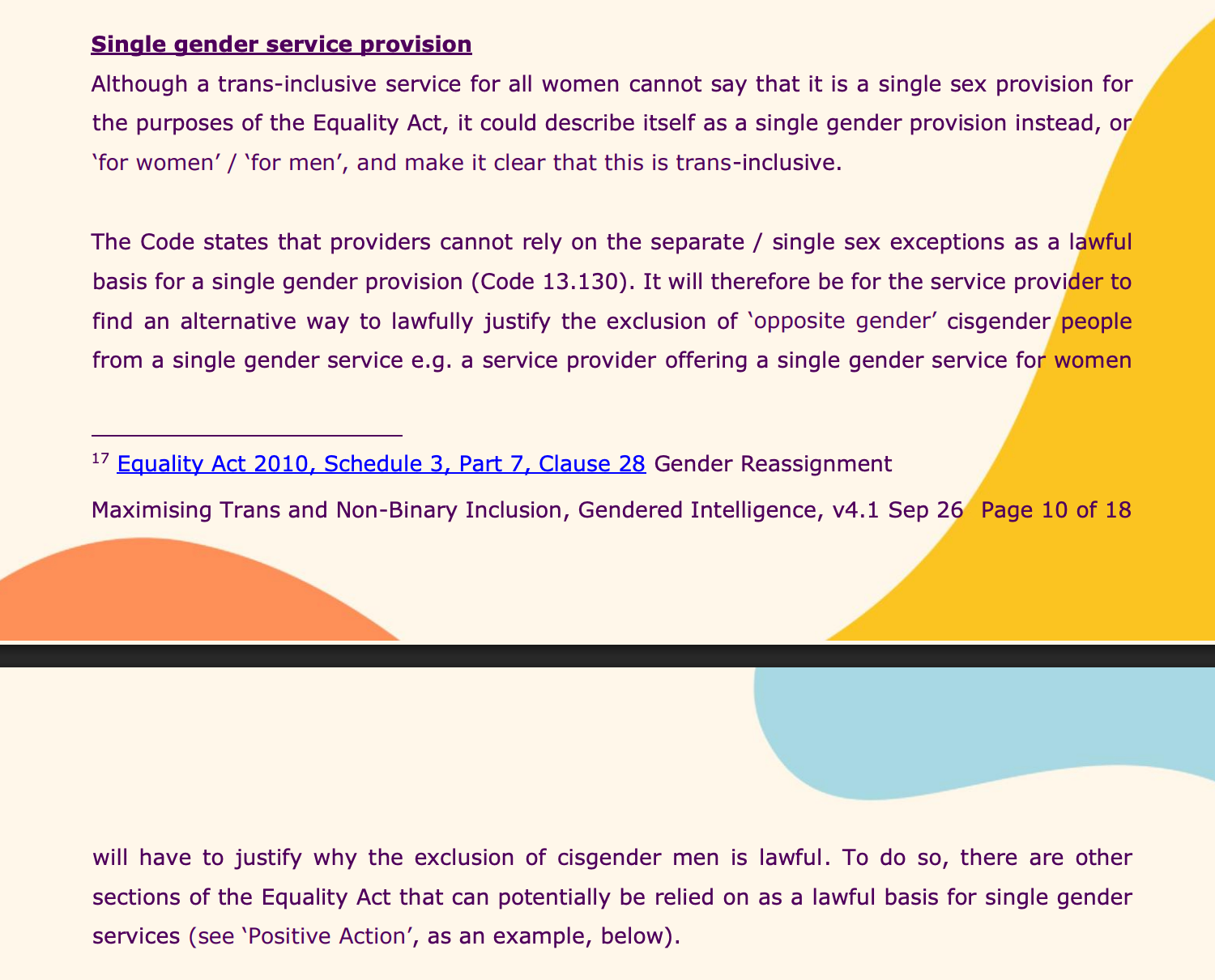
This reflects an approach promoted by Gendered Intelligence, a charity that the City of London both provides funding to (through the City Bridge Foundation) and pays to train its staff. Gendered Intelligence guidance advises that:
“Although a trans-inclusive service for all women cannot say that it is a single sex provision for the purposes of the Equality Act, it could describe itself as a single gender provision instead, or ‘for women’ / ‘for men’, and make it clear that this is trans-inclusive.”
It tells service providers that they don’t need to stop allowing men into women’s services, but can “update their reasoning” and and external communications to ensure “service users are able to make informed decisions”.
Our case against the City of London will test whether this approach is lawful.
Why did the City withdraw its 2019 policy?
The City’s previous Gender Identity Policy, which applied across all its services, said the Equality Act requires that people with the protected characteristic of gender reassignment “are able to access services aligning with their gender identity.”
On 30th September 2025, when the City launched its consultation on the ponds, it quietly said that it had withdrawn this policy. There was no public communication about why the policy was withdrawn. We have written about the murky saga of the City’s decision-making before. But we now have more information, following disclosures under the Freedom of Information Act.
On 27th August 2025, the City received a letter from the Equality and Human Rights Commission headed “Action needed – Compliance with the Equality Act 2010”. The EHRC told the City that its “Gender Identity Policy” misrepresented the Equality Act 2010 and was wrong to suggest that people have a legal right to access single-sex spaces and services according to their self-identified gender. The EHRC told the City:
“Your policy appears to be based on a concept of ‘self-identification’ as a criterion for admission to separate or single sex services. This fails to engage with sex and gender reassignment as separate and distinct characteristics and in our view your policy is likely to be unlawful as a result.”
Documents disclosed under Freedom of Information show the City’s gender identity working group had already shifted to saying that the ponds were not a single-sex service, but recognised that this was a problem:
“There is a big perception gap, as many users of the Bathing Ponds would consider them to be single sex facilities and would not be aware that the facilities are not operating as single sex facilities under the law.”
Our case challenges seven decisions by the City of London following the For Women Scotland decision, where the City dug in on its approach of operating the ponds based on gender identity, even while it was urgently withdrawing its old policy because the regulator said it was unlawful.
20th May 2025 Hampstead Heath Management Committee agrees to continuing with the gender identity policy and to undertaking a consultation.
16th July 2025 Meeting of the Hampstead Heath Committee agrees to consultation plan.
25th July 2025 City erects new signage at the Bathing Ponds.
29th July 2025 City posts notice on its website.
10th August 2025 posts further statement on its website.
12th May 2026 Hampstead Heath Management Committee agrees to continue the arrangements as reflected on the signage.
4th June 2026 Policy & Resources Committee agrees to continue the arrangements as reflected on the signage.
The City of London, which used to say that the Equality Act required it to adopt a trans inclusion policy, now argues the “Women only” and “Men only” ponds are simply not single-sex services because they are based on “lived gender”, not sex.
It disputes that arrangements which include allowing fully intact men to use communal showers and changing rooms with women and girls put women at a particular disadvantage.