

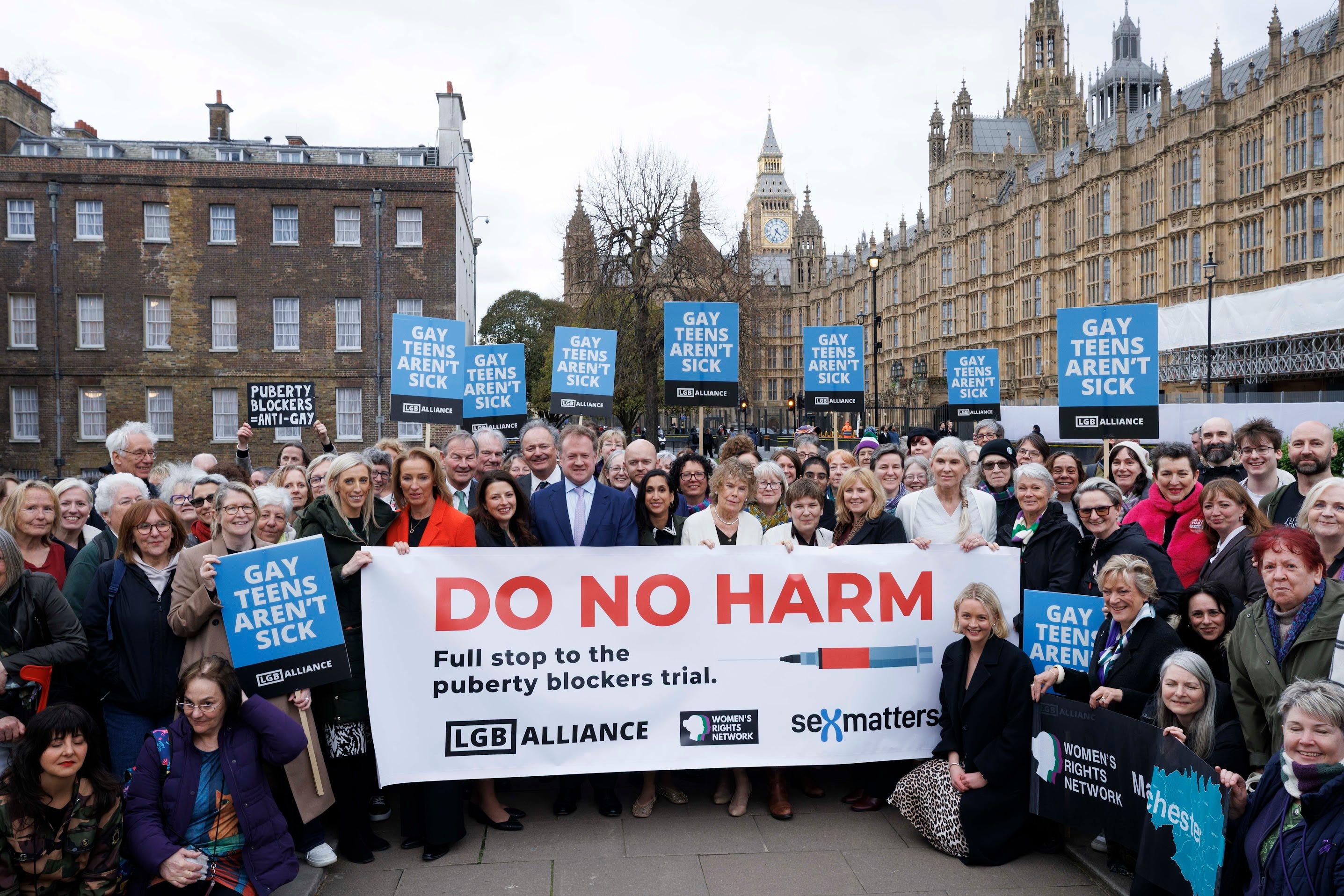
Since the surprise announcement last November that a trial of puberty blockers had been approved by regulators, there has been a vigorous campaign to get ethical approval revoked.
A petition attracted nearly 150,000 signatures, securing a Westminster Hall debate, which is scheduled for 23rd March. On 10th March dozens of MPs heard about their constituents’ concerns in a lobby day organised by Women’s Rights Network, LGB Alliance and Sex Matters (pictured above).
On 6th February detransitioner Keira Bell and therapist James Esses had applied for a judicial review. And on 20th February news broke that recruitment to the trial had been paused to give the research team at King’s College London time to respond to questions about serious physical risks to participants belatedly raised by the Medicines and Healthcare products Regulatory Agency (MHRA).
The latest development is another regulatory surprise: an immediate pause and proposed ban on NHS prescriptions of cross-sex hormones to under-18s announced on 9th March. At the moment, clinicians can prescribe cross-sex hormones from the age of 16. A 90-day public consultation is under way, due to close on 7th June.
The announcement was accompanied by the publication of systematic reviews of the evidence for using combinations of puberty blockers and/or cross-sex hormones for various combinations of patient populations (male or female) and desired outcomes (“binary” transition – that is, identifying as the opposite sex – “non-binary” – identifying as neither sex).
It found no evidence supporting the standalone use of puberty blockers for minors who identify as non-binary, and none for cross-sex hormones in combination with puberty blockers for minors who identify as either non-binary or the opposite sex. For standalone use of cross-sex hormones for minors who identify as the opposite sex, it found only weak evidence. The results are a shocking acknowledgement that for over a decade the NHS has routinely offered life-changing hormone treatments to distressed minors without sufficient evidence to justify doing so.
Delaying NHS treatment with cross-sex hormones from age 16 to age 18 further complicates any attempt to restart the puberty-blocker trial. Two of the concerns raised in the MHRA’s letter relate to the danger of being on puberty blockers for lengthy periods, and the harm blocking puberty does to children’s future fertility. The regulator suggested that these might be mitigated by setting a minimum age of 14 for participating in the trial, so that participants could be exposed to puberty blockers for a maximum of two years. (The current protocol merely requires children to have reached Tanner Stage 2, when pubertal changes start to become outwardly visible, usually around age 11 or 12.)
By limiting exposure to puberty blockers to a shorter period, the MHRA writes, the “potentially significant and, as yet, unquantified risk of long-term biological harms” will be lessened. One of these is early osteoporosis: puberty is a period when calcium is laid down in bones and blockers interrupt this process. But if the NHS does indeed raise the age for cross-sex hormones to 18, many trial participants are likely to be exposed to puberty blockers for four years, rather than at most two.
As for infertility, puberty is when boys’ testicles become capable of producing viable sperm and girls’ ovaries become capable of producing viable eggs. Children who take puberty blockers are likely to grow up to have impaired fertility, especially if they proceed to cross-sex hormones, as almost all do. The idea is that by waiting till age 14, most participants in the trial will be physically mature enough that their ovaries or testes will be able to produce viable eggs or sperm, which can be collected and frozen.
This suggestion is problematic on its own. For girls the procedure is unpleasant and invasive, and egg-freezing is still quite experimental. For both boys and girls it requires engaging with the biological reality of their sex, which is precisely what they are trying to flee from by entering the trial. Experience in gender clinics around the world suggest that when fertility preservation is offered, hardly any children take it up.
More fundamentally, although the stated rationale for the puberty-blocker trial is to relieve children’s short-term distress, most participants are surely motivated by the desire to avoid sex-differentiated physical development. But a child who is mature enough to produce viable eggs or sperm will also have developed noticeable secondary sexual characteristics: there is no magical moment when fertility preservation is possible but the child still looks pre-pubescent.
These uncoordinated attempts to continue offering puberty blockers and cross-sex hormones despite no evidence of benefit and significant evidence of harm has brought the NHS to a point where its attempts at mitigation are mutually incompatible, especially when you consider why children want to go on blockers in the first place, which is to enable them to live “in stealth” – that is, with their true sex concealed from those around them. The most recent draft of official safeguarding guidance from the Department for Education, Keeping children safe in education (KCSIE), recognises that this is not possible for schools to accommodate safely and fairly.
Somehow, children are supposed to wait to start blockers until they are mature enough to produce viable eggs or sperm, remain on them for only a short period, not proceed to cross-sex hormones until they turn 18 – and simultaneously start blockers early enough that they don’t develop secondary sex characteristics. All this while they continue to be recognised and treated as their actual sex at school.
Surely it’s time to acknowledge the central problem – that puberty blockers are not a treatment but a human-rights abuse – and to call the trial off.
Timeline of puberty blockers and cross-sex hormones for children
My impression is that virtually no children who are prescribed puberty blockers cease taking them in time for the ability of a normal puberty to resume to be tested. In other words, is there any actual evidence that puberty blocking is reversible, as is frequently claimed?
Hasn't Helen Webberly been struck off?
As soon as you started talking about the "wrong puberty" I knew you were a wrong 'un :-)
Gillick competency has to be used with caution in patients with mental health disorders and gender dysphoria is a mental health disorder. Many of the children who present with this are also autistic. Doesn't that make you stop and think?