


The Crown Prosecution Service (CPS) has been consulting on a new edition of the Code for Crown Prosecutors, the document every prosecutor in England and Wales must follow when deciding whether to charge someone. The consultation closed on 8th November, and we have responded.
Read our response to the CPS consultation.
The current code was in place on 1st December 2018, when police arrested Kate Scottow for posting messages on Twitter about a trans-identifying man, including calling him a “pig in a wig”.
She was charged under Section 127(2)(c) of the Communications Act 2003, which covers persistently using a public network to cause annoyance, inconvenience or needless anxiety. In February 2020 she was found guilty.
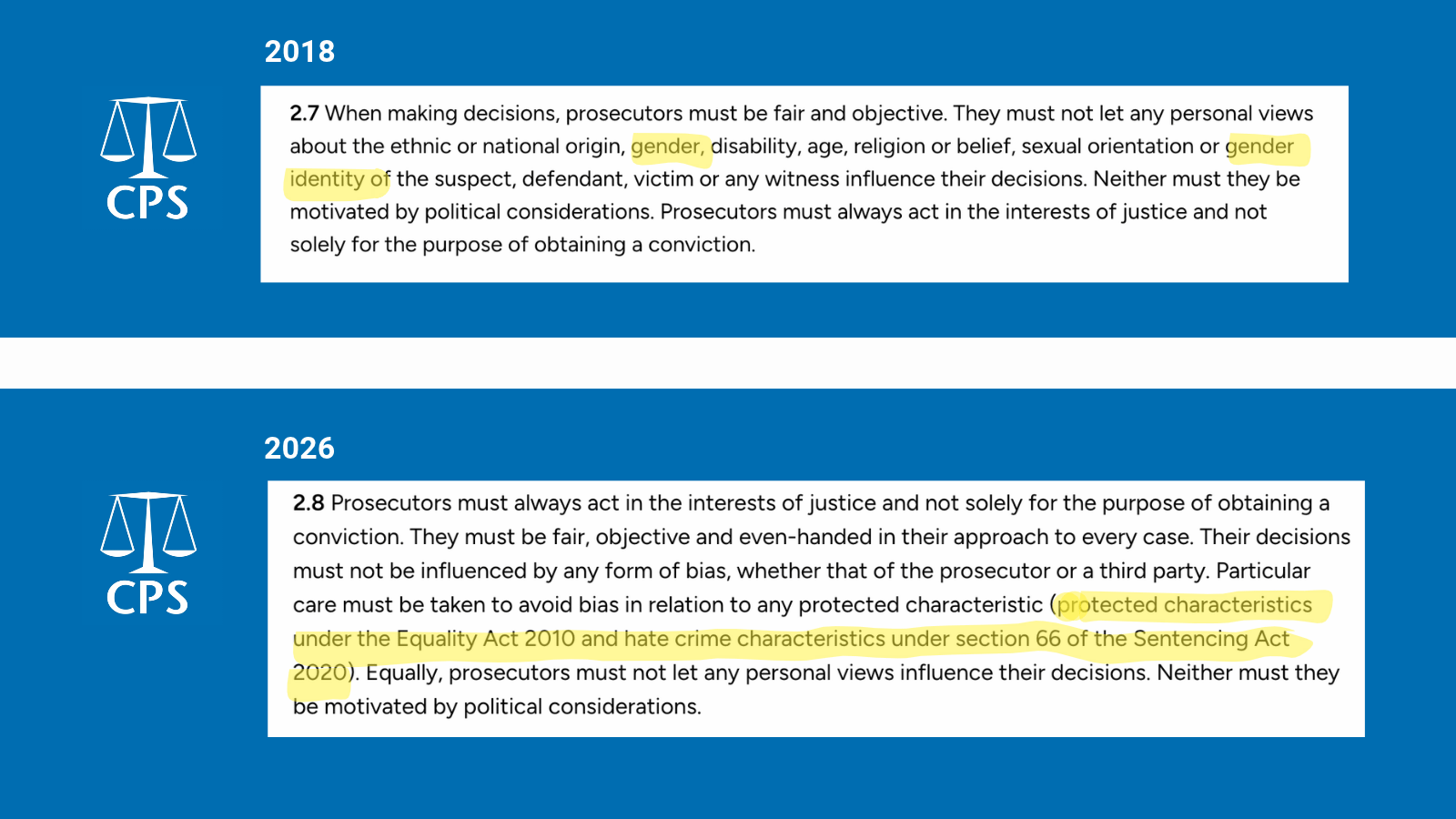
The code that the CPS was following at the time told prosecutors not to allow personal views about a person’s “gender” or “gender identity” to influence their decisions, and said that a prosecution was more likely where an offence was motivated by prejudice against someone’s gender identity.
A prosecutor reading the code may have regarded this as a warning that they had to guard specifically against prejudice towards “gender identity”, with no equally clear signal warning them to guard against prejudice towards people who disagreed with the very idea of “gender identity”.
On 10th December 2020, two years after her arrest, the Divisional Court quashed Scottow’s conviction. Its judgment found that the prosecution had not considered whether it was necessary and proportionate to prosecute her, and that prosecuting her had been a “grossly disproportionate and entirely unjustified state interference with free speech”.
Out with “gender”
The words “gender” and “gender identity” have been removed in the new draft code, probably as a result of the Supreme Court’s ruling in For Women Scotland that “sex” in the act means biological sex.
But instead of adding in the plain word “sex”, the draft replaces the old list with a reference to “any protected characteristic”, which it defines as a mix of the Equality Act characteristics and the hate-crime factors that are listed in Section 66 of the Sentencing Act 2020.
These are different things with different purposes. The Equality Act places duties on public bodies, including the CPS, to avoid discriminating against or harassing people based on protected characteristics, to advance equality of opportunity and to foster good relations.
The hate-crime provisions tell courts to treat proven hostility based on race, religion, disability, sexual orientation or transgender identity as an aggravating factor when sentencing. These features overlap with the Equality Act characteristics, but are defined differently. “Transgender identity” goes beyond gender reassignment, while philosophical belief is left out. Sex will be added to the list when the relevant provisions of the Crime and Policing Act 2026 come into force.
A bigger problem is that it is inappropriate to offer hate-crime legislation as a framework for professionals on treating people equally and without bias. The law on hate crimes is not relevant in this context. Laws against discrimination are (but they are not the only factors that risk bias; fame, power, politics and family connections are other examples, as the updated draft recognises).
Placing the hate-crime factors alongside the equality characteristics puts prosecutors on the defensive, and points them towards seeing some groups of suspects as likely victims and deserving of greater sympathy. This is the opposite of avoiding bias.
This pattern was remarked on in the judgment in our recent case on the CPS’s guidance on sex by deception. The High Court said the section on “Trans and non-binary persons – experiences” read “as though its subject were a vulnerable person in need of protection, rather than a suspect whose conduct is under scrutiny”. Although the court did not find the guidance unlawful, it invited the CPS to reconsider it.
“Protected characteristics” is a shorthand used in the Equality Act to avoid repeating sex, age, race, disability and so on hundreds of times. But people often assume wrongly that the phrase means some people are more protected than others. In fact everyone has several protected characteristics.
This guide for prosecutors should be clear and simple, and avoid encouraging “two-tier” justice. We have proposed that the code say that prosecutors must not let personal views about anyone in a case influence their decisions, “including views about features such as their race, sex, disability, age, religion or belief, sexual orientation, gender reassignment, social status, wealth, fame, power, popularity, political views, or any cause they support”.
The most important thing for everyone involved in the justice system to remember is that treating people without fear or favour is an overarching principle, which is not confined to a limited list of characteristics.
A thumb on the scale
The draft says that for “all hate crime offences” there is a strong public interest in prosecution, and that a prosecution will usually follow. Elsewhere the code asks prosecutors to weigh five questions, each framed as making prosecution “more likely” or less so. A blanket statement for hate crime upsets that balance.
We are not asking prosecutors to ignore hostility. Evidence of hostility should make prosecution more likely, as other factors do. But an accusation of hostility can attach to a low-level communications offence that is really a disagreement about belief. In recent years many people have been investigated, and some prosecuted, for saying, in effect, that sex matters.
The draft also widens “harm” to include harm to the economy, public health, the climate and biodiversity. It says a community can be harmed by “widespread fear, distress or a sense of insecurity”. Diffuse and partly subjective harm of this kind could end up weighing as heavily as direct harm to a victim, or being counted twice alongside the hate-crime line.
We have asked the CPS to:
use the “more likely” formulation for offences involving hostility, rather than a presumption
keep harm to a victim separate from wider harm, and require reliable evidence of harm to a community
say expressly that prosecutors must consider freedom of expression under Article 10 of the European Convention on Human Rights, and freedom of belief under Article 9.
The CPS is already bound to respect these rights under the Human Rights Act 1998. Saying so in the code would remind prosecutors that speech does not lose protection because it offends, shocks or disturbs, while leaving them free to prosecute threats, incitement and harassment.
A code that is meant to remove bias should not build a new one in. Prosecutors should treat everyone the same, whichever side of a debate they are on.
Read our full response to CPS Code consultation.
Related content
Excellent work Sex Matters. Thanks for all that you do. When will this madness and deliberate obfuscation re. Sex and Gender in the legal world ever end??