

The Crime and Policing Bill is currently going through the House of Lords. It includes a clause that amends the exposure offence (“flashing”) in the Sexual Offences Act (2003) to capture a broader range of intentions by perpetrators.
Currently the offence of exposure requires that the perpetrator intends that someone will see their exposed genitals and will be caused alarm or distress. Evidence submitted to the Law Commission in relation to cyberflashing suggested that this was too narrow. It highlighted that the desire for sexual gratification or to humiliate the victim were both key drivers of exposure behaviour. These are included in the new clause 85.
“(1) A person (A) who intentionally exposes A’s genitals commits an offence if—
(a) A intends that someone will see the genitals and be caused alarm, distress or humiliation, or
(b) A exposes the genitals for the purpose of obtaining sexual gratification and does so—
(i) with the intention that someone will see them, and
(ii) being reckless as to whether someone who sees them will be caused alarm, distress or humiliation.
(1A) But where A intends only that a particular person, or particular persons, will see A’s genitals, A does not commit an offence by virtue of paragraph (b) of subsection (1) unless A is reckless as to whether that person, or at least one of those persons, will be caused alarm, distress or humiliation.”
Sex Matters welcomes this clause, which recognises these important features of this criminal behaviour.
The offence of voyeurism in the Sexual Offences Act is not changing. It is made out if a person observes another person doing a private act, and does so for the purpose of obtaining sexual gratification, and knows that the other person does not consent to being observed for the observer’s sexual gratification.
The definition of a private act includes something where a person’s genitals, buttocks or breasts are exposed or covered only with underwear, or they are using a lavatory in a place which would reasonably be expected to provide privacy.
Single-sex spaces combat exposure and voyeurism
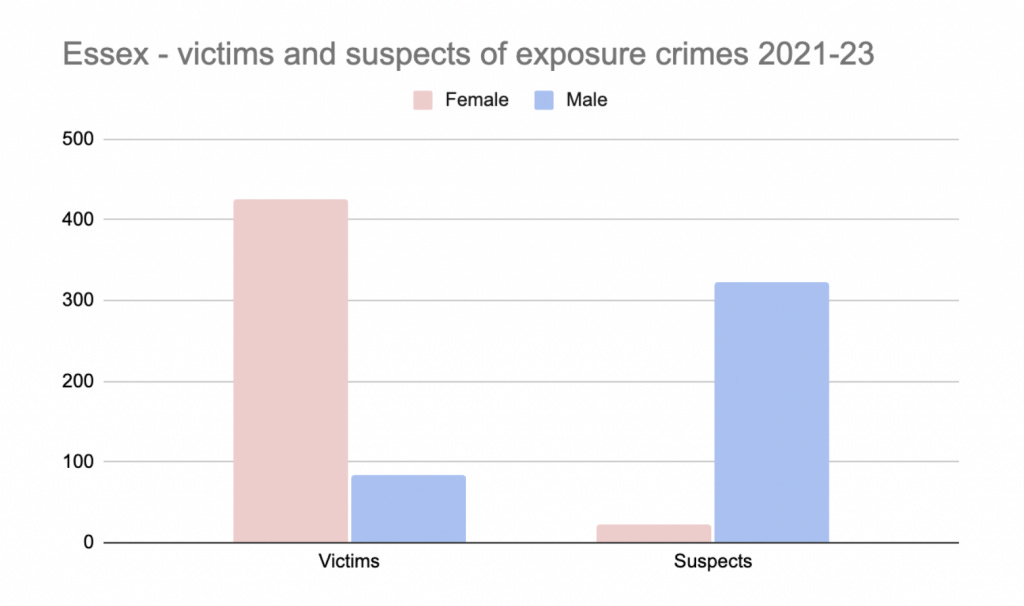
Exposure, voyeurism and non-consensual touching are predominantly male crimes, and the victims tend to be women and girls, as data from Essex Police illustrates.
These crimes may be committed opportunistically, and under the cover of plausible deniability – such as by a toilet door swinging open, a person “accidentally” opening a curtain to a cubicle, a man leaving his trousers undone and allowing them to fall open, or a man groping a woman when queuing in a confined space. Victims of these crimes may suffer a long-term impact on their wellbeing including trauma and feelings of isolation and shame. Victims may find it difficult to feel confident in public places.
As the Supreme Court recognised in For Women Scotland, the Equality Act allows sex-separated infrastructure in situations such as toilets, changing rooms, showers and sleeping accommodation to allow people to feel safe and comfortable and protect their privacy and dignity. The Health and Safety at Work regulations require adequate provision of facilities that secure propriety for women and men.
These spaces are typically designed with two or three physical layers of obstruction between a person doing a “private act” and members of the opposite sex. Showers are in cubicles inside a communal shower room which is accessible by going through a larger changing room, which has two sets of doors to get in. These layers of built-in privacy are by design, to prevent men loitering near places where they may be able to see and humiliate women, or “accidentally” expose themselves.
Such considerations are commonplace, and the risks and nature of exposure offences are well understood. The Human Rights memorandum for the Crime and Policing Bill considers whether the changes to the definition of exposure infringe on Article 7 (no punishment without law). It concludes:
“The elements of the offence are clearly set out in the clause and we consider the general public will have a good understanding of what it means for a person to intentionally expose their genitals with intent to cause humiliation or for sexual gratification while reckless as to whether someone who sees them will be caused alarm, distress or humiliation… the public will have sufficient familiarity with the concepts in the offence to identify the kinds of behaviour that would fall within it.”
There is no mention of chromosome tests, difficulty telling men and women apart (or defining them), sex being “assigned at birth”, a spectrum, the possibility of a “woman” having a penis or any of the other wild reaches of gender ideology. Nor does it suggest that service providers need to wait for EHRC guidance on the Equality Act to know whether a man sneaking into the women’s showers is doing something wrong.
Section 26 of the Equality Act defines the civil harm of harassment as unwanted conduct related to a relevant protected characteristic, that has the purpose or effect of violating a person’s dignity, or creating an intimidating, hostile, degrading, humiliating or offensive environment for them.
A man intentionally entering a space which has been designated “female” and which is provided as a place for women to change, wash, use the lavatory or sleep is undertaking conduct which could reasonably be experienced as creating an intimidating and hostile environment. This can be true even where there are curtains or cubicles.
One of the reasons why it is intimidating is that a woman in this situation does not know what the man will do next. He has already gone past several layers of physical boundary, such as signs and doors, as well as social taboos, and he may be about to breach another.
There are many single-sex spaces where full or partial nudity or exposure of genitals can be normal, as long as single-sex rules are observed. Examples include single-sex communal changing rooms and showers, and single-sex saunas. But the possibility of exposure to male genitals is likely to be enough to create an intimidating and hostile environment for women.
Even in ordinary situations like toilets there are different norms for men and women. These two toilet rooms at the Department for Education were rebadged from men’s and women’s to “unisex”. It then had to add a sign on the cubicles to tell men to close the door when urinating.
Sex matters when it comes to bodily privacy
As the Supreme Court ruled, the meanings of “man” and “woman” in the Equality Act are clear:
“The words ‘sex’, ‘woman’ and ‘man’ in sections 11 and 212(1) [of the Equality Act] mean (and were always intended to mean) biological sex, biological woman and biological man.”
Men who identify as women are not women. Words, pronouns, clothing and hairstyles don’t change a person’s biology. A person’s sex is generally readily perceptible, and the presence of a man wearing women’s clothing in an intimate “female-only” facility may be no less humiliating, alarming, distressing or degrading to women than the presence of any other man.
Yet many organisations are continuing to resist providing clear single-sex spaces following the judgment. They are exposing women to risk of harassment and exposure, and men to risk of being accused of harassment or crime. For example:
The City of London has maintained its practice of “trans inclusion” at Kenwood Ladies’ Pond, including allowing fully intact males to shower naked in the communal women’s showers. We are seeking to challenge this in a judicial review.
The Society of Friends (Quakers), which runs the large Friends House conference centre in London among other venues, has rejected calls to provide single-sex toilets but instead says that its toilets (including urinals) are not single-sex spaces but are “trans inclusive”. In response to concerns about men in the women’s toilets the organisation responded that “referring to trans women as men is transphobia”.
NHS England has not yet revised its “Annex B” policy which allows men who identify as women or non-binary to be housed in female-only accommodation under the single-sex wards policy.
Allowing men into female spaces is not “kind”
It should be clear to all men that women using female facilities have not consented for them to come in, and that they are likely to feel humiliated if they do. People who go into spaces where members of the opposite sex are undressing may find themself accused of civil harassment, or the crimes of voyeurism or exposure.
If a man enters a female-only space and a crime is reported his motives will need to be investigated: was he seeking sexual gratification? Was he intending to humiliate? Exposure and voyeurism are crimes where a conviction or a caution leads to someone being registered as a sex offender.
Telling men and boys who have gender dysphoria or autogynephilia or express an alternative gender identity that it is acceptable to try to invade women’s spaces in order to relieve their feelings or express their identity is not kind. Nor is it kind to tell women and girls they can identify into spaces provided for men’s privacy.
The Equality Act 2010 (Disability) Regulations 2010 specifically provide that a tendency to exhibitionism and voyeurism are excluded from being considered impairments in relation to the protected characteristic of disability. People with gender-related mental-health issues ought to be just as capable as others of following rules intended to protect others from humiliation, alarm and distress.
Encouraging people to wave a card saying it is a breach of the European Convention on Human Rights to expect them to comply with sex-based rules ignores the fact that Article 8 is a qualified right.
![BREACH OF EUROPEAN CONVENTION ON HUMAN RIGHTS – ARTICLE 8
You have challenged my use of facilities appropriate to my gender.
I am aware of the UK Supreme Court ruling in For women Scotland v Scottish Ministers [2025] UKSC 16.
However, this ruling is incompatible with the European Convention on Human Rights which the UK ratified in 1951, in particular Article 8 'Respect for private and family life'.
This was decided in the case of Goodwin v UK. [2002] 35 EHRR 447 which provided that contracting states must have an effective method of acknowledging gender-change.
If you are to continue to deny me use of facilities appropriate to my gender I will require your name, the name of your organisation and details of the policy or instruction you are following as the denial is likely to be the subject of litigation.](https://substackcdn.com/image/fetch/$s_!z5t7!,f_auto,q_auto:good,fl_progressive:steep/https%3A%2F%2Fsubstack-post-media.s3.amazonaws.com%2Fpublic%2Fimages%2F8d500a5e-519a-42df-8c7d-77f12cb4b5f2_1024x585.png "BREACH OF EUROPEAN CONVENTION ON HUMAN RIGHTS – ARTICLE 8
You have challenged my use of facilities appropriate to my gender.
I am aware of the UK Supreme Court ruling in For women Scotland v Scottish Ministers [2025] UKSC 16.
However, this ruling is incompatible with the European Convention on Human Rights which the UK ratified in 1951, in particular Article 8 'Respect for private and family life'.
This was decided in the case of Goodwin v UK. [2002] 35 EHRR 447 which provided that contracting states must have an effective method of acknowledging gender-change.
If you are to continue to deny me use of facilities appropriate to my gender I will require your name, the name of your organisation and details of the policy or instruction you are following as the denial is likely to be the subject of litigation.")
This means it can be interfered with in accordance with the law where it is necessary in a democratic society, including for the “prevention of disorder or crime, for the protection of health or morals, or for the protection of the rights and freedoms of others”. Rules which clearly and unambiguously protect women and men’s bodily privacy are exactly this type of situation.
If someone does not wish to be reminded of their sex, it is up to them to avoid using facilities provided on a sex-separated basis. Activists, lawyers and clinicians suggesting otherwise are telling people to flout the law.