

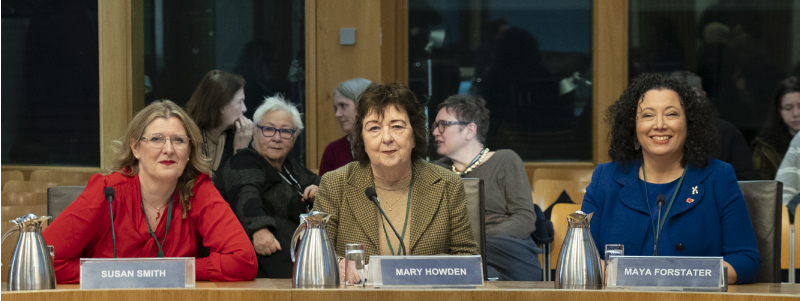
L to R: Susan Smith, Mary Howden and Maya Forstater. Credit: Iain Masterton
I have been in Scotland giving evidence at the Scottish Parliament, together with Susan Smith of For Women Scotland and Mary Howden of WRN Scotland. We were being asked about the implementation of the EHRC Code of practice for services, public functions and associations.
My fellow panelists were eloquent, at times angry, and on point about the failure of the Scottish government to follow the law and protect women and girls. Susan, who is also a trustee of Beira’s Place, the rape crisis centre funded by JK Rowling, spoke passionately about the parts of the women’s sector in Scotland that never gave up on providing women-only services.
The For Women Scotland Supreme Court judgment relies on the constitutional principle that the Equality Act is outside the Scottish parliament’s legislative competency. But I got the distinct impression that some members of the committee were using “talking about the code” as a means to air their dissatisfaction with the judgment.
On the day of the Supreme Court ruling, Katie Hagmann MSP, now convener of the committee, posted on Facebook that she was “hugely concerned” by the ruling “as a Woman and trans-ally”, calling it a dark day for equality. She also posted that for her, the issue was personal. Her sibling, she wrote, “was a trans women and she isn’t here to fight this battle. So for her, her memory and my trans friends, please know I’m standing firm right here with you.”
The clerks to the committee were helpful and welcoming, and staff in Holyrood have been forbidden from wearing rainbow lanyards. But I wonder whether the convener should have recused herself from chairing a committee where she had declared that she was acting in such a deeply personal capacity, and where she has taken such a personal stand against legislation which is outside the competency of the Scottish parliament.
The three of us appearing before the committee shared a single, overarching message: the Equality Act protects everyone. The law is clear, and the code provides guidance. The excuse of waiting for the code was always just an excuse and now there is no reason for delay. It shouldn’t be hard to provide services that are clearly either mixed-sex or single-sex.
I mentioned a project Sex Matters is working on: an online tool to enable people to crowdsource and share reports of compliance and non-compliance with the code. (It’s coming soon; watch this space.)
I also raised the alarm about the bill to criminalise “conversion practices” undergoing pre-legislative scrutiny in Westminster and likely to be picked up again in Scotland. If the bill becomes law, it will mean that people acting in ways that are permitted and sometimes required by the Equality Act, such as recognising that an individual is a man or woman and excluding them from opposite-sex sports, jobs, services and facilities, will face police investigation.
Hagmann mentioned a new Stonewall report which claims that 21 percent of “trans+” people have been questioned when using single-sex spaces (it doesn’t say whether that is single-sex spaces provided for the opposite sex or their own sex). Stonewall has come out as saying that the EHRC code (for which we can read the Equality Act) is “unworkable”. It says it will “advocate for legislative changes which will reinstate dignity, equality and safety for all”. If your workplace is taking advice from Stonewall on how to comply with the law, it is long past time it stopped.
It was great to spend time with the Scottish Terven, and I was pleased to meet with Russell Findlay, Meghan Gallacher and Rachael Hamilton of the Scottish Conservatives, and with Amanda Lindsay of Reform. Michael Marra of Labour and Alex Cole-Hamilton of the Liberal Democrats weren’t available on the day but expressed themselves willing to meet on another occasion, as did government officials.
So I’ll be back!
Help stop the Conversion Practices Bill
The deadline for submitting evidence to the parliamentary committee scrutinising the bill is 5pm today.
There are 16 questions, but you do not have to answer them all. We suggest that you answer three short questions that are relevant for everyone, and then pick one question where you can give a bit more detail from personal experience. If you haven’t had time yet, please do it over the weekend – in just 15–30 minutes you can make a difference.
Download the pdf guide
Or read the even shorter webpage.
It explains the three short questions and one long question that everyone can answer, and how to write and submit your evidence.
Use the template to write your evidence
You don’t need to do lots of research, just answer from your experience.
Download the Word document
Or make a Google document.
Go to the call for evidence, read the instructions and submit your evidence.
Media coverage
Scale of conversion therapy ‘vastly overestimated’
“It’s a scandal that the original, inflated numbers are being used as evidence for the draft Conversion Practices Bill.” - Fiona McAnena
Daniel Martin • The Telegraph
Psychotherapists tell MPs: We’ve had no complaints about conversion therapy
In an article on clinical psychologist Dr Anna Hutchinson’s evidence to the conversion practices bill committee, Sapphire Hope and Simon Johnson for The Telegraph mentioned Fiona McAnena’s warning that the government was “massively overestimating”.... - Fiona McAnena
Sapphire Hope, Simon Johnson • The Telegraph
Fiona McAnena vs Peter Tatchell: Conversion Practices Bill | BBC Radio 5
Stephen Nolan • BBC Radio 5

Trans law must not silence parents, says children’s tsar
“This bill is drafted so broadly that a parent, grandparent or sibling… could be reported to the police and to social services.” - Fiona McAnena
Daniel Martin • The Telegraph
Labour MPs urge Burnham to scrap trans bill
“As well as causing widespread havoc across society, businesses and the justice system, the bill could override every win for common sense from the past several years in the fight against gender ideology, including my own court victory and the... - Maya Forstater
Daniel Martin • The Telegraph
Akua Reindorf KC on the draft Conversion Practices Bill
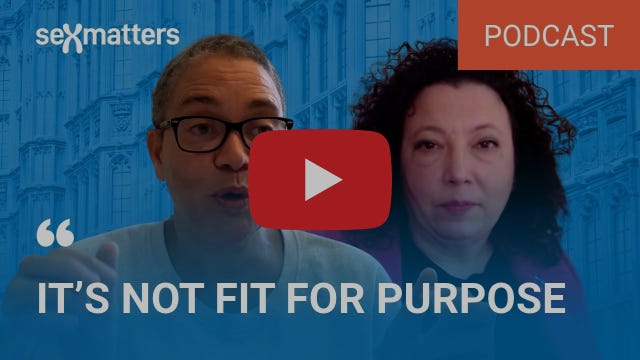
On this week’s podcast, Maya Forstater talks to Akua Reindorf KC, barrister and former commissioner at the Equality and Human Rights Commission. With Baroness Kishwer Falkner, she has written a new Policy Exchange report on the draft Conversion Practices Bill.
The report concludes that the draft bill leaves key terms undefined and risks criminalising ordinary parenting, teaching and pastoral care.
Conversion Practices Bill should be tougher, supporters say

On Monday 3rd November, the joint committee of MPs and peers examining the draft Conversion Practices Bill held its second evidence session. It heard from two witnesses, both speaking in favour of the bill: Jayne Ozanne, a deputy (elected member)...
12th November 2026
Find out more
First evidence session – Criminalising parents who don’t affirm
Building in bias

The Crown Prosecution Service (CPS) has been consulting on a new edition of the Code for Crown Prosecutors, the document every prosecutor in England and Wales must follow when deciding whether to charge someone. The consultation closed on 8th November, and we have responded...
10th November 2026
Read our response to proposed new CPS guidance.
In other news
National Lottery funds website with puberty blockers guide
“This so-called guide is reckless and irresponsible, using playful graphics to present misleading and harmful information, and promoting barely-legal ways to bypass the UK medical system and obtain puberty blockers.” - Fiona McAnena
Gordon Rayner • The Telegraph
Tavistock scandal ‘would have been suppressed by new trans law’
“The Government seems to think that provisions in employment law will protect people from criminal charges. This is nonsense.” - Helen Joyce
Hayley Dixon • The Telegraph
If you’d like this memo in your inbox every Friday at 5pm, join our mailing list now.
Sex Matters survives on your support.
Without it, we simply wouldn’t exist.
Sex Matters can deliver essential research and analysis, help shape the debate, and empower people with clear, published guidance on their rights – but only with your support. Please contribute what you can to keep us going.