

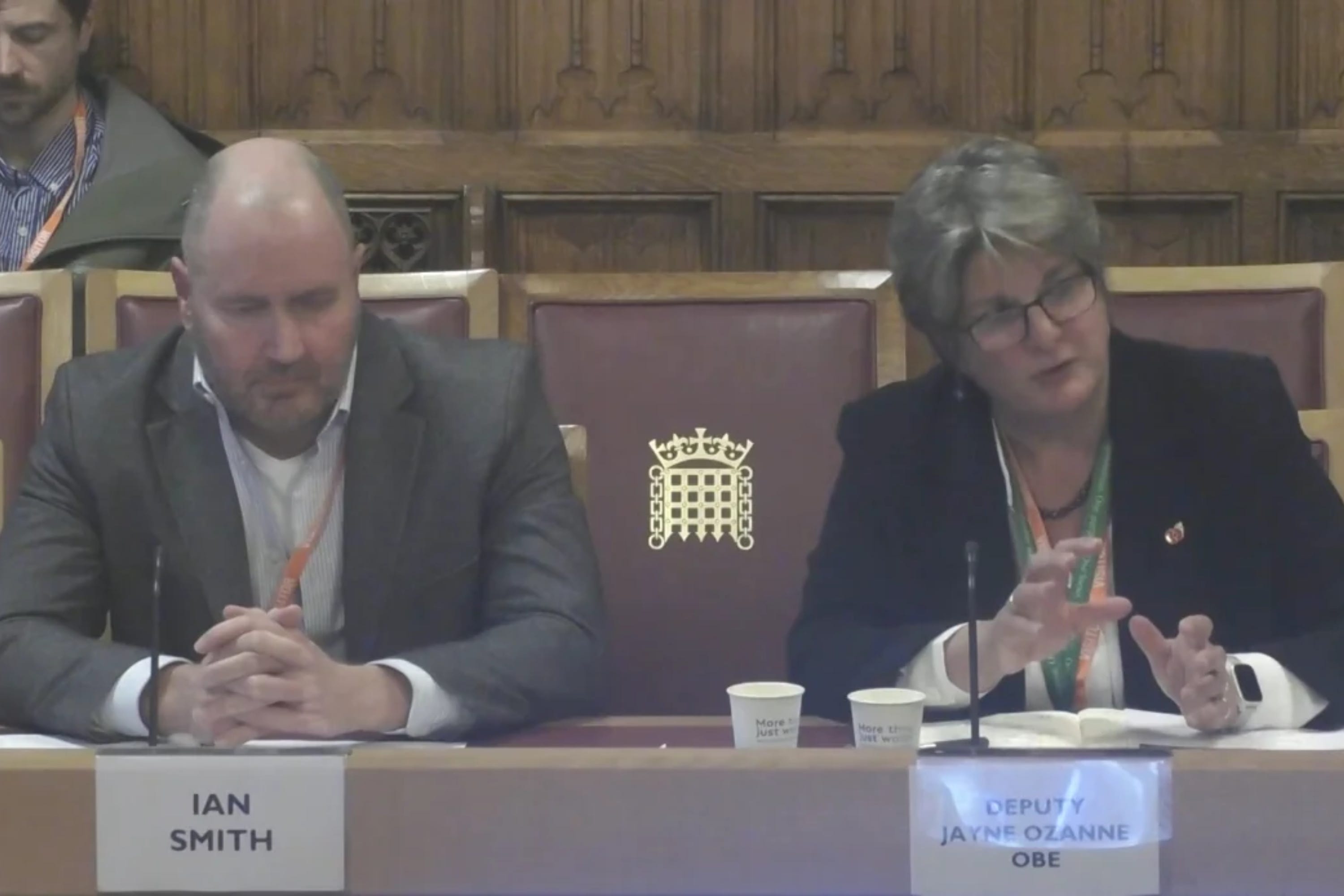
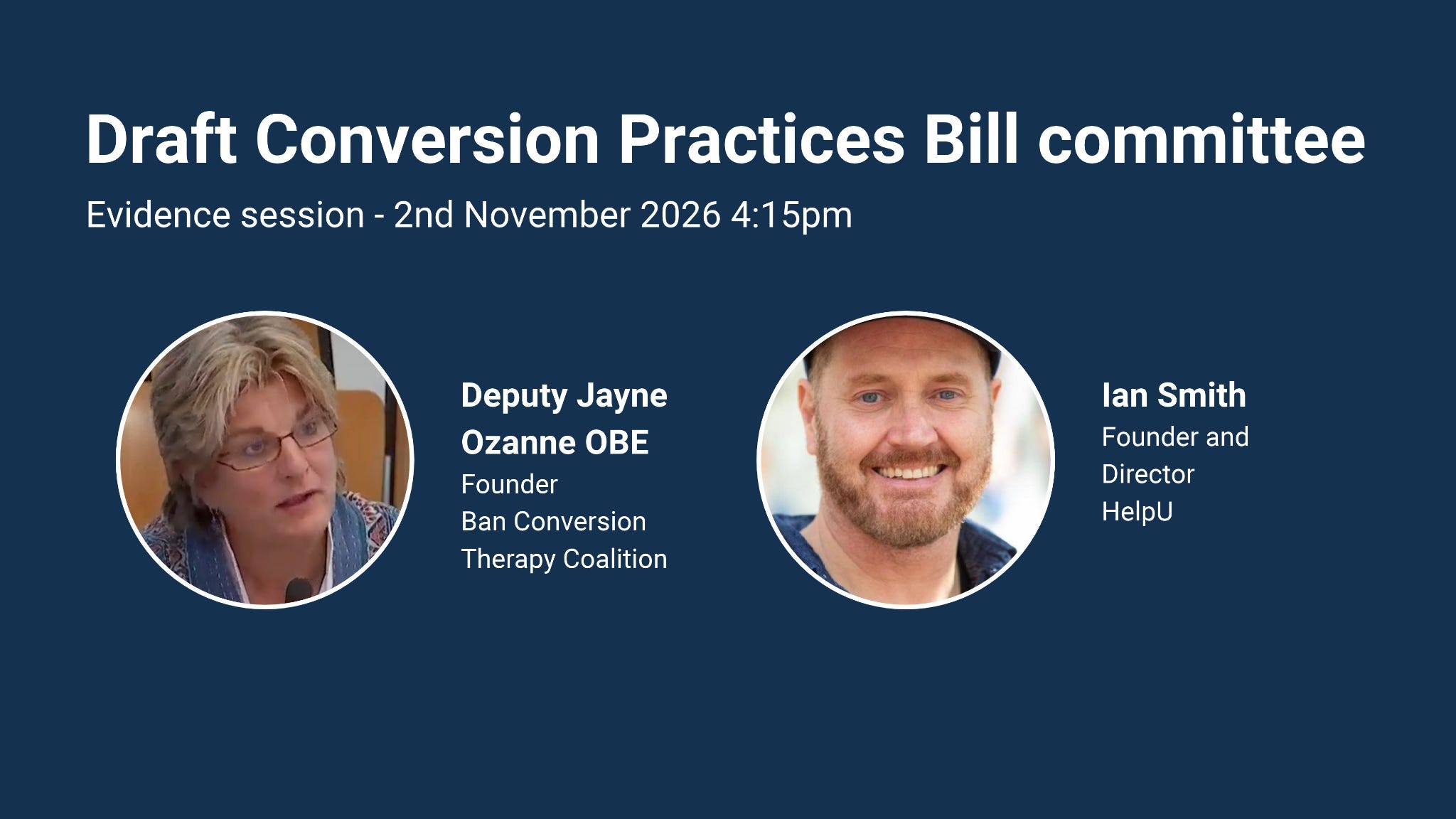
On Monday 3rd November, the joint committee of MPs and peers examining the draft Conversion Practices Bill held its second evidence session. It heard from two witnesses, both speaking in favour of the bill: Jayne Ozanne, a deputy (elected member) of the parliament of Guernsey and founder of the Ban Conversion Therapy (BTC) coalition, and Ian Smith, founder and chief executive of Helpu Cymru, a Welsh men’s mental-health organisation.
Ozanne is a lesbian who spent 20 years in therapy and counselling and receiving prayer aimed at changing her sexual orientation. Smith is a gay man who also underwent exorcism and prayer aimed at changing his sexuality. Both drew on these experiences of trying to reconcile their religious faith with their sexual orientation to explain why they support a law criminalising conversion practices, including practices relating to children and gender identity.
No such thing as a “non-abusive” conversion practice
Ozanne described sessions of prayer and therapy she had sought out and paid for as a successful businesswoman and member of the Church of England’s General Synod. She said she had “gone through all sorts of things that many now would say was very clear abuse”.
She called for the harm threshold in the bill to be lowered and the distinction between abusive and non-abusive practices to be removed. “I think that all forms of conversion practices are abusive,” she said, “because by their nature they are telling you that who you are is less than and that there is something wrong with you.”
When asked about the consequences of this for parents and pastors, she said she did not think “small cases” would be prosecuted, and that the cases “likely” to be prosecuted would involve a course of conduct in a large institution.
Criminalise, but don’t prosecute
Asked whether a single episode of prayer should be criminalised, Ozanne replied: “Would I prosecute after one little prayer? No; I would have a word. That is why we have the law.” She added: “To be clear, I still think we would criminalise, but whether we prosecute is a different question.”
Baroness Prentis replied that this was “not something within our gift, because we are not the DPP [Director of Public Prosecutions] or the CPS [Crown Prosecution Service] or, indeed, the police.”
When Naz Shah MP asked whether a parent refusing to buy a breast-binder for an 11-year-old could be termed abuse, Ozanne said it was too difficult to answer in the abstract. “I cannot give you a direct answer,” she said. She added that she thought the bill needed a reasonableness defence: “I am sure that we need to do so in the Bill — reasonableness is key.” There is no such defence in the draft bill.
Smith had less to say. He wanted the bill to deliver “preventive optics” and to send a message:
“If as a country we are saying that we value individuals and that we value their liberty over the liberty of the institutions that have carried out this abuse, then that makes me happy.”
Both witnesses spoke about the personal turmoil of holding a religious faith at odds with their sexual orientation. Smith said: “I know it is anecdotal, but between us we have had how much prayer — 10, 20 or 30 years? This omnipotent, all-powerful God did not change our sexuality.”
Smith also raised the involvement of young people in group prayer, describing a group praying over a young person in a church: “You have young children praying over other individuals…. We are talking about developing brains.”
In an exchange with Danny Beales MP, Ozanne said prayer in this context “has to be directed at a person”.
On trans-identifying children, Ozanne said:
“Most trans children I am aware of have known from the very get-go, and their parents deep down have known too, from the moment the child has picked up a toy. I do not want to stereotype, but often people have known for a long period that they feel trapped in the wrong body; it is not just a fad that is gone through. That is where we have to trust our therapists and our counsellors, because I think they do know the difference.”
This was the second evidence session of the joint committee. The first, on 27th October, is covered here.
So “they’re telling you that there is something wrong with you”. Boy picks up a toy that is stereotypically a girls toy…” oh there’s something wrong with you, you’re obviously born in the wrong body”.
Do they not see the blatant contradictory bullshit??!
Pathetic evidence and a completely captured pair. Their vocabulary is straight from Stonewalls playback.