

Update from Maya
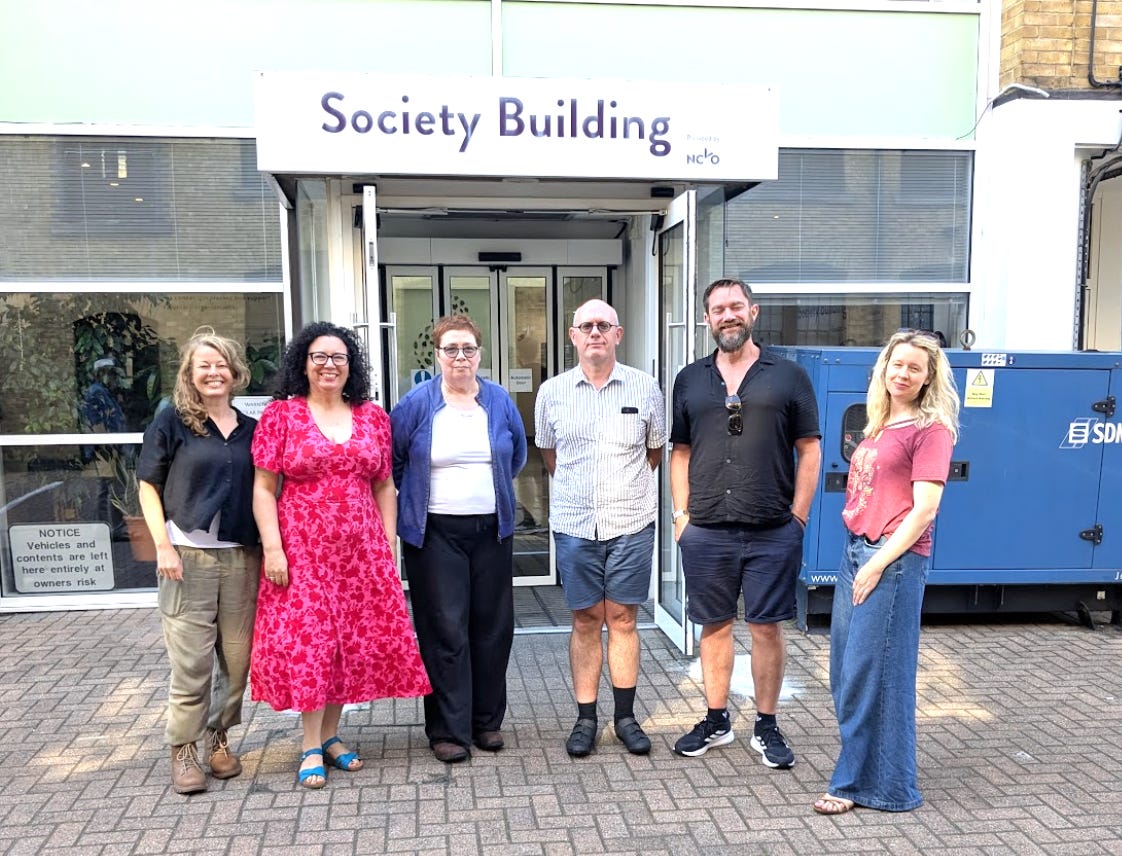
Dr Emma Hilton (chair), Maya Forstater (chief executive) and board members Anya Palmer, Professor Michael Biggs, Simon Knapp and Rebecca Bull at the National Council for Voluntary Organisations offices
Last week Sex Matters’ board (who are my collective bosses and have fiduciary duty for the charity and responsibility for making sure it stays on mission) met to talk governance. As for every charity, it is the board’s role to approve strategy in line with our charitable purposes, scrutinise and agree the budget, think about risk, ensure there are policies and systems in place to manage it, and support the team and me to deliver our strategy.
As a young organisation in an extremely challenging environment, we have had to do a lot of learning about the nuts and bolts of being an organisation while also working at top speed. The expression “building the plane as we are flying it” is one we often use.
The board thanked Charlotte Cadden, who has been elected as a Conservative Councillor in Bolton and will therefore be stepping down. Charlotte has been a huge asset to Sex Matters, bringing to the board her calm, curious and pragmatic style, and frontline experience from her role as a police officer for 30 years in Greater Manchester Police.
The trustees agreed on Dr Emma Hilton as permanent chair. Emma has been on Sex Matters’ board since the organisation was founded. She is an expert on biology and sports and is frequently consulted for her expertise. Since December 2025 she has been interim chair, and she is principled, open, careful and collaborative in that role. It has been a pleasure working with her over the past six months and I look forward to continuing to work with her.
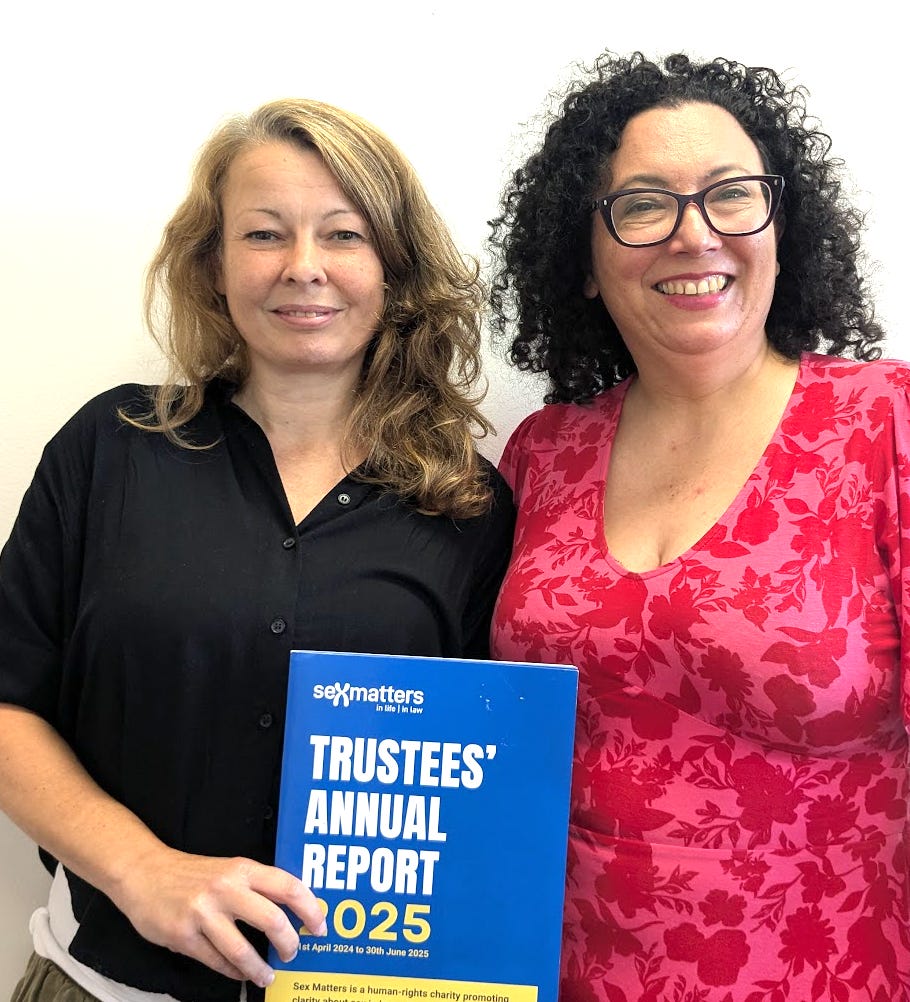
The board also welcomed Simon Knapp, our new treasurer.
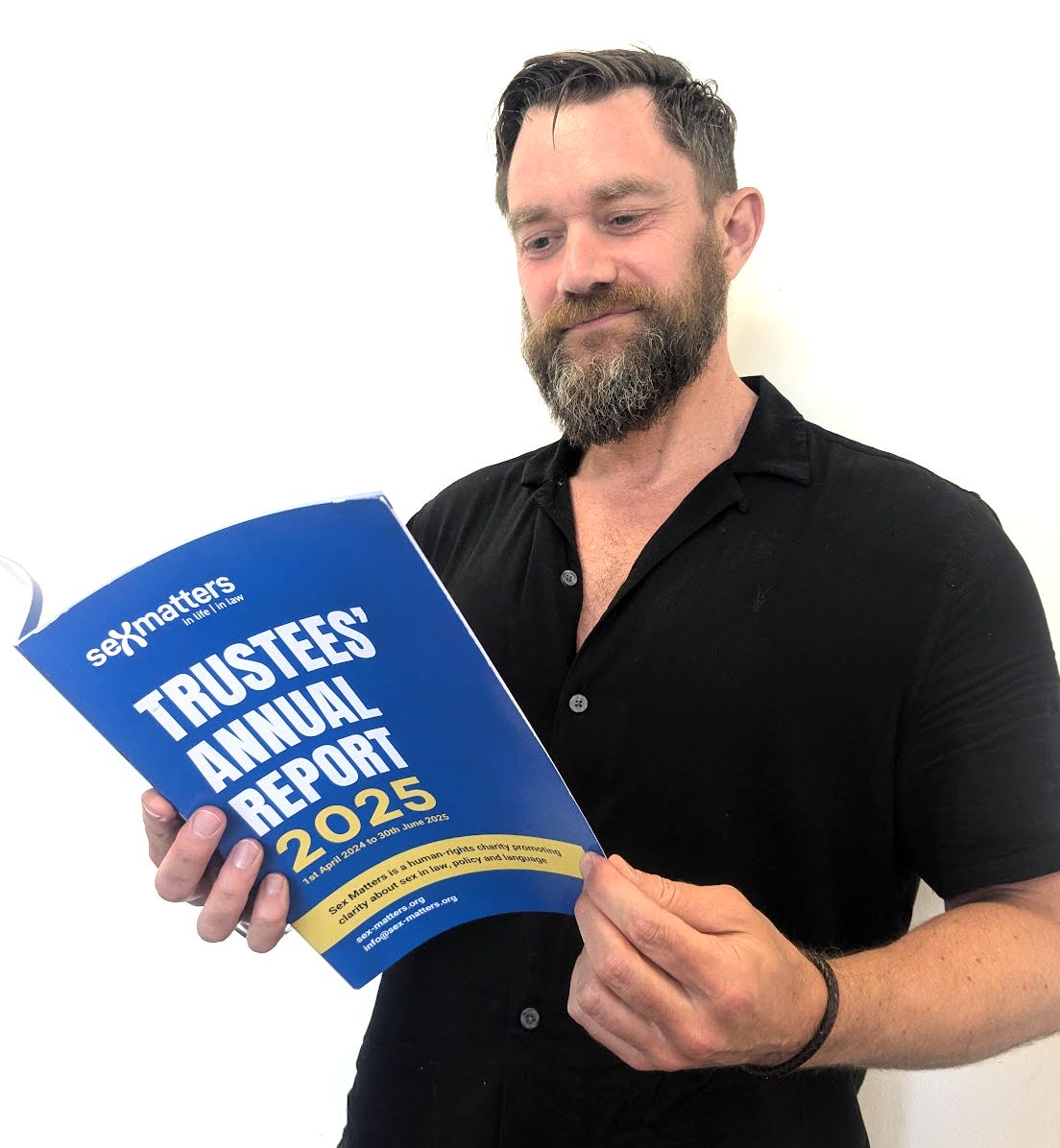
In the coming weeks Sex Matters will be seeking new applicants to join the board of trustees. The board would particularly like to hear from you if you have experience as a charity trustee or chief executive, or as a non-executive director on the board of a mission-driven business or social enterprise (read Sex Matters’ annual report and look out for a separate email with details of how to apply).
This weekend I am looking forward to speaking at the Women’s Rights Network national conference in London. I am on a panel with Professor Jo Phoenix, Akua Reindorf KC and Susan Smith of For Women Scotland. Our session is on Women and the law: Is the social contract between women and the state broken? Unfortunately Naomi Cunningham, who was supposed to be on the same panel, can’t make it as she is tied up with the ongoing Tempest v DEFRA tribunal concerning the gender-critical SEEN civil-service network.
Among the other speakers are Julie Bindel, Rosie Duffield, Tracy Edwards MBE, Maeve Halligan, Dr Emma Hilton, Cathy Larkman and Connie Shaw. Down the road will be the CAN-SG conference Rethinking youth gender medicine, which runs on to Monday. Among the expert speakers are Professor Alice Sullivan, Zhenya Abbruzzese, Dr David Bell, Sex Matters board member Professor Michael Biggs, Stephanie Davies-Arai of Transgender Trend, Dr Anna Hutchinson and Dr Stella O’Malley of Genspect.
Helen Joyce will be at the CAN-SG conference both days; Fiona McAnena is splitting her time between the two events. We are looking forward to seeing so many brilliant friends, and making new ones. Do come up and say hello if you’re attending.
Sex Matters is one of a band of organisations in the UK and internationally that have bootstrapped themselves into existence in order to combat the harm and injustice caused by gender ideology. We have gone about it in different ways, with different strategies, focusing on different aspects: medicine, children, LGB people, free speech, feminism, the law, the civil service, sport and more.
Sex Matters is a single-issue, non-partisan human-rights charity. We campaign for clarity about sex in law and policy in the UK. We do this because sex matters for fairness and safety for women, for children to grow up secure in their bodies and for institutions to work for us all. We think it is important for people to be able to talk about the two sexes so they can argue about what the social contract should be (that’s what being “worthy of respect in a democratic society” is about). My job is to lead in shaping our strategy and building a team that can deliver it. Thank you for your support: we couldn’t do without it.
Conversion Practices Bill targets parents
Draft bill threatens families, free speech and religious rights
In this week’s episode, Helen Joyce speaks to Dennis Kavanagh, director at the Gay Men’s Network and non-practising barrister, about the legal minefield that is the draft Conversion Practices Bill.
Dennis examines the low threshold for criminality in Clause 1 of the bill, which states that “any conduct” can be a conversion practice and risks putting parenting on trial and breaching human rights.
Helen and Dennis speak about the potential for transactivists to use the bill to suppress discussion of trans ideology and the harms of gender-affirming care.
Victory in the US Supreme Court
Those fighting to protect sport for women and girls in the USA won a major victory on 30th June when the Supreme Court declared, in a robust and thorough judgment, that state laws restricting female sport to those born female are lawful. The verdict on this point was unanimous: 9–0. A separate legal argument on whether transgender identity should be nominated for special consideration (by being granted “equal protection” status under the constitution) was rejected 6–3.
Sex Matters provided input – “amicus curiae” briefs are the US equivalent of intervening in the case.
Find out more
Podcast – Helen and Fiona discuss the case when it was heard in January
Sex Matters on the significance of the interpretation of sex in the Equality Act
Media coverage
Helen joined Julia Hartley-Brewer on Talk TV to discuss the news.
Debunking fantastical claims about conversion therapy
The government launched its draft conversion-therapy bill saying it has found evidence that 75,000–93,000 people each year experience abusive conversion practices each year in England and Wales.
It suggests this can be stopped at minimal cost (45 minutes of familiarisation for each police officer, social worker and other public-sector worker who needs to know about the new law), and that the ban would prevent tens of thousands of cases of clinical depression.
Every piece of this reasoning (which starts with taking seriously a Stonewall survey that found there are some 25,000 gay exorcisms each year) is fantastical.
In 2022 the Government Equalities Office established a national conversion-therapy helpline which ran for three years at a cost of £360,000. It has released no details of how many (or few) calls it received. A report published by LGBT charity Galop, which operated the service, appears to suggest that no more than a handful of callers reported conversion practices each year.
Find out more
Read our blog post on the £360,000 helpline that didn’t ring
Read our report examining the lack of evidence
Watch Baroness Cash, shadow minister for equalities, raise our analysis in the House of Lords.
Media coverage
The Telegraph (Daniel Martin) quoted analysis by Sex Matters showing that most of the cases presented by LGBT charity Galop to back its claim that a law against conversion practices is needed concerned actions that are either already criminal or else concern private and family life, such as a parent refusing to use a child’s “preferred pronouns”.
In other news
The Ministry of Defence (MoD) has told army chiefs to assess whether trans-identifying soldiers can use opposite-sex facilities on a “case-by-case basis” while a new policy is being developed following the Supreme Court ruling. The Sunday Telegraph (Sabrina Miller) quoted Maya as saying that the MoD is exposing female service personnel to an officially endorsed policy of harassment and discrimination by allowing male soldiers into women’s showers.
West London NHS Trust has told patients that they can use single-sex facilities based on their “legal gender”, meaning that hospitals will still allow men to use female-only wards and toilets more than a year after the Supreme Court ruling. The Telegraph (Michael Searles) quoted Fiona as saying that the term “legal gender” has no basis in law or medicine.
Two much-anticipated reports into NHS maternity failings by Baroness Amos and Donna Ockenden came under criticism this week by referring to “birthing people” rather than “women”. The Daily Mail (Shaun Wooller) and Daily Express (Hanna Geissler) quoted Fiona as saying that shoehorning “birthing people” into both reports, presumably so as not to offend the trans lobby, shows shameful disregard for the mothers and babies let down by NHS trusts across the UK.
A GCSE revision guide by Pearson instructs Spanish language students using phrases about how they “follow/admire” someone who “fights/fought for transgender rights”. The Telegraph (Albert Tait) quoted Helen as saying that this example reveals how extensive and subtle the indoctrination of children in schools is.
Queen Camilla’s meeting with JK Rowling was criticised by transactivists. Maya was interviewed by Nana Akua on GB News and Helen was interviewed by Mark Dolan on Talk TV.
If you’d like this memo in your inbox every Friday at 5pm, join our mailing list now.
Sex Matters survives on your support.
Without it, we simply wouldn’t exist.
Sex Matters can deliver essential research and analysis, help shape the debate, and empower people with clear, published guidance on their rights – but only with your support. Please contribute what you can to keep us going.