

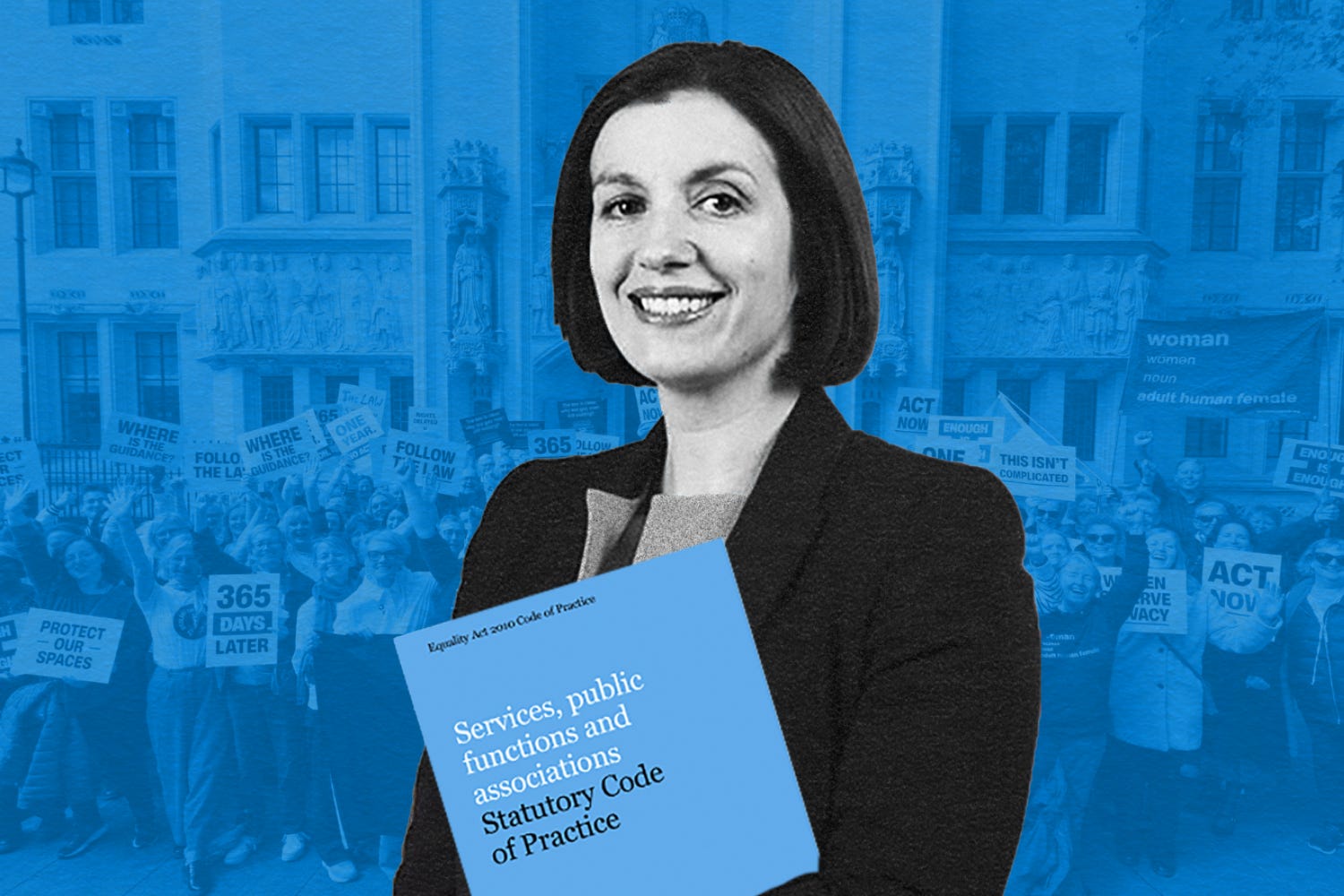
The Minister for Women and Equalities, Bridget Phillipson, has said that the government intends to lay the updated draft Code of practice for services, public functions and associations before Parliament in May. If she is to meet this deadline, the most likely time for this to happen is 18th–21st May.
What you need to know
Download this briefing as a PDF.
What is the code?
The code is prepared and issued by the Equality and Human Rights Commission (EHRC). It covers discrimination, harassment and victimisation in services and public functions, and by associations, as set out in Parts 3 and 7 of the Equality Act. It does not apply to employers or to education, which are covered by other parts of the act.
Does the code change the law?
No. The code does not impose legal obligations. Only the courts and tribunals provide authoritative interpretations of the law. Its main purpose is to provide a detailed explanation of the Equality Act to help those who need to apply the law and understand its technical detail. It can be used in evidence in legal proceedings.
Is the code about single-sex services?
The overall guidance is around 300 pages long and covers all nine protected characteristics. It explains the unlawful conduct of discrimination, harassment and victimisation, and the exceptions that apply in different situations. About 20 pages are specifically relevant to sex, gender reassignment and single-sex services. The relevant parts of the guidance are:
Chapter 2, which defines the different protected characteristics, including sex – which was clarified by the Supreme Court in April 2025 to mean biological sex.
Chapter 12, which covers associations is relevant to women-only and men-only associations.
Chapter 13, which covers exceptions, including those that enable the provision of single-sex and separate-sex services broadly, and competitive sport and shared accommodation specifically.
What will the code say?
The previous code (published in 2011) contained a significant error. It said, at paragraph 13.57:
“If a service provider provides single or separate sex services for women and men, or provides services differently to women and men, they should treat transsexual people according to the gender role in which they present. However, the Act does permit the service provider to provide a different service or exclude a person from the service who is proposing to undergo, is undergoing or who has undergone gender reassignment. This will only be lawful where the exclusion is a proportionate means of achieving a legitimate [aim]”.
This was clearly wrong before the Supreme Court judgment in For Women Scotland v Scottish Ministers. The judgment put beyond doubt that it was wrong for GRC-holders as well. In the new draft code, it will be replaced by guidance in line with the judgment, which made clear that the Equality Act provides for services to operate lawfully on the basis of sex, not gender roles.
The final draft has not yet been published, but a consultation draft was published before the Supreme Court judgment. Together with case law, including the High Court’s judgment in January 2026 endorsing the EHRC’s interim update published in June 2025, this suggests that the version laid before Parliament will make clear that provisions for single-sex and separate-sex services relate to biology, not identity.
Why is the code significant?
Many organisations have misunderstood and been misadvised about the law, and have operated single-sex services and facilities on the basis of gender identity as a result. Many (including in relation to their responsibilities as employers, which are not covered by this code) have been relying on the fact that the previous code remained in force as an excuse to delay rather than bringing their policies in line with the law as clarified by the Supreme Court last year. The publication of the statutory guidance will remove this excuse. Gender self-ID was never the law.
What happens after the code is laid?
Like most statutory instruments, the code is subject to agreement by “negative procedure”. This means that it will have legal effect 40 days after it is laid before Parliament, unless either the House of Commons or the House of Lords passes a motion to annul it. The last time the House of Commons annulled a negative statutory instrument was 1979.
Where can I find more information?
The code will be published on the Parliament website. As soon as possible after that, Sex Matters will publish analysis.
Was the bit about trans people being allowed to enter opposite sex services written when the ex CEO of Stonewall was in charge?
Thanks, guys. We wait with bated breath!!
Have cross posted
https://dustymasterson.substack.com/p/lonely-are-the-brave
Dusty