

Update from Maya
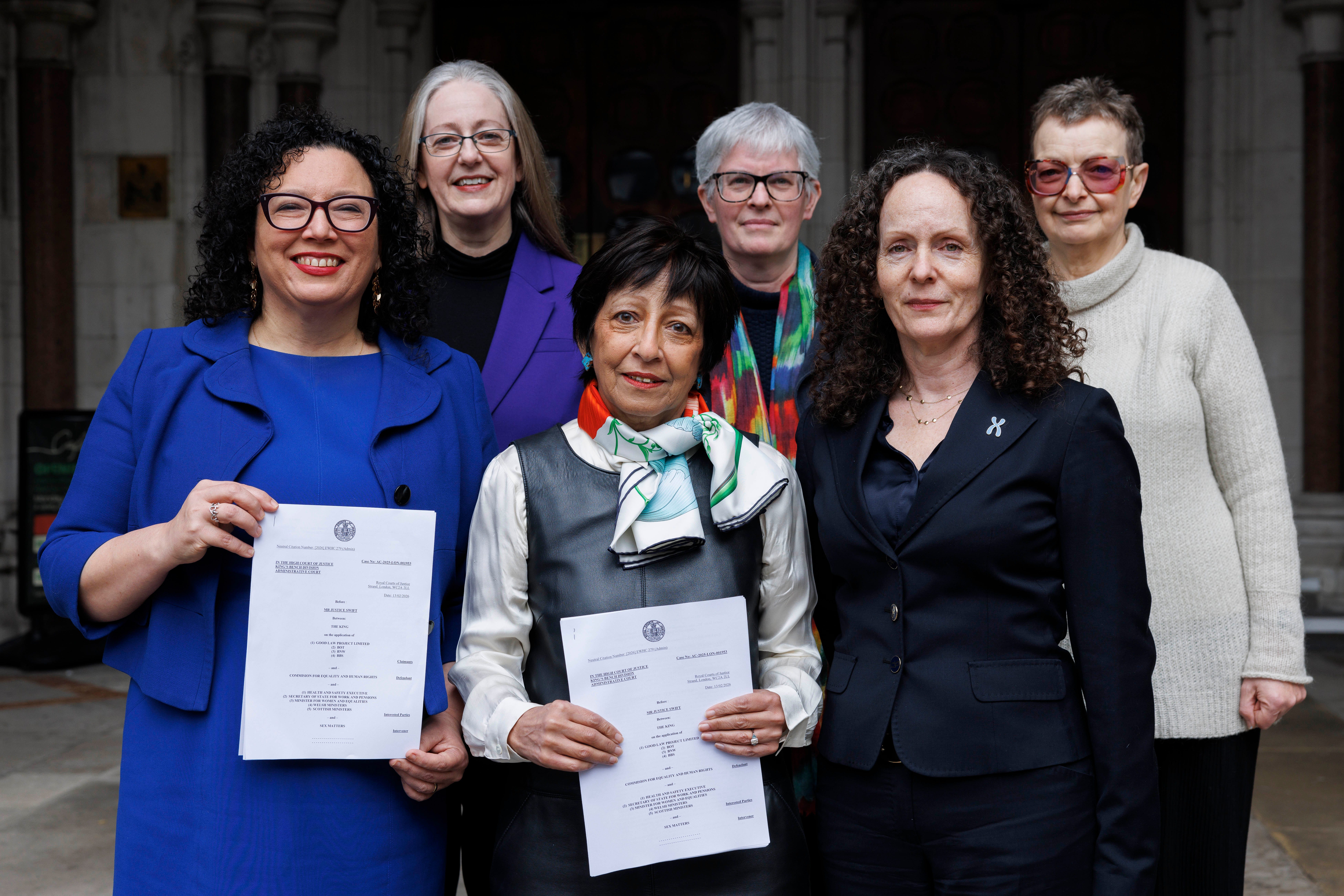
Left to right: Maya Forstater, Helen Joyce, Baroness Kishwer Falkner, Naomi Cunningham, Fiona McAnena and Monica Kurnatowska. Photo: Belinda Jiao
On 13th February Mr Justice Swift delivered a judgment that comprehensively vindicated the Equality and Human Rights Commission’s clear, practical interpretation of the law, which it published just a few weeks after the For Women Scotland Supreme Court judgment in April last year.
The EHRC had said (in short) that women’s toilets are for women, men’s toilets are for men and where facilities are available to both men and women, trans people should not be put in a position where there are no facilities for them to use. “Where possible, mixed-sex toilet, washing or changing facilities in addition to sufficient single-sex facilities should be provided.”
Transactivist campaign group the Good Law Project (GLP) claimed that this was not accurate, or that if it was then the Equality Act breached the European Convention on Human Rights. It sought permission to take a judicial review of the EHRC guidance. It said the workplace regulations which require employers to provide facilities for men and women merely require rooms with signs on the door, not staff to follow the rules. Mr Justice Swift said this “places form over substance” and disregards the “obvious purpose” of the workplace regulations, which was “the provision of private space for each sex for reasons of conventional decency”.
The judgment is 59 pages long, and very tightly and clearly reasoned. It doesn’t swerve GLP’s (and the Secretary of State’s) arguments that sought to contradict the Supreme Court judgment: it takes them apart one by one.
It tells the three anonymous claimants who expressed deep personal upset at being expected to follow the rules at work that their human rights had not been breached by being told not to use facilities provided for the opposite sex: “Up to a point, being the subject of comment by others is burden that anyone can expect to bear from time to time, and ought not to be a foundation for legal redress.”
Sex Matters had intervened to make sure that there was evidence from women about why everyday privacy, dignity, safety and propriety matter. Mr Justice Swift accepted all of that as conventional common sense.
The practical guidance the High Court endorses can now be boiled down to eight words: “Have clear rules and policies that everyone understands.”
This is how institutions keep people safe and respect their rights.
The day before the GLP judgment was released, the Secretary of State for Education, who is also the Minister for Women and Equalities, published the draft of new statutory safeguarding guidance for schools in England. It is not so clear.
It is a big step forward that the guidance on “gender questioning” children has been integrated into statutory safeguarding guidance, after having been handed around between departments and repeatedly restarted and abandoned during the past eight years. But the overarching motivation of the draft seems to be to avoid judicial review. It therefore skirts around some difficult questions.
The guidance says that children must not be allowed to use toilets, changing facilities or sleeping accommodation for the other sex (when the word “must” is used in statutory guidance, the people or organisations covered have no choice but to do what it says). So far so good. But it also says that schools should consider requests for other aspects of “social transition” on a case-by-case basis. And it doesn’t fully spell out what those aspects are – apart from saying that sport may be one, provided that safety is not at issue. And it leaves the phrase “social transition” undefined, for headteachers to stumble over and negotiate with anxious or ideologically committed parents, distressed children and activist teachers.
The guidance is now open for a 10-week consultation. Unless it is improved (and probably even if it is, one way or another) it is going to end up in court.
Ultimately it cannot only be judges who play the role of strict-but-fair headteacher. But for now it seems they are the only ones willing to do so.
Thank you to everyone who has contributed to support our work, which has allowed us to make the legal arguments and gather and present the evidence.
Maya Forstater
For Women Scotland returns to court
Judicial review of Scottish Prison Service policy
In this week’s episode of the Sex Matters podcast, Helen Joyce is joined by For Women Scotland’s co-director, Susan Smith, to discuss its most recent case against the Scottish Government concerning prison guidance.
For Women Scotland has brought forward a judicial review of the Scottish Prison Service Policy for the Management of Transgender People in Custody, which permits prisoners with the protected characteristic of gender reassignment to be housed in a prison of the opposite sex. The hearing was held in the Court of Session Outer House from 3rd to 5th February 2026.
For Women Scotland’s account of the hearing.
Tell MPs you oppose the puberty-blocker trial
Tell your MP that children deserve better – join us at Westminster on Tuesday 10th March.
If you are concerned about the planned puberty-blockers trial, sign up for our lobby day.
Together with LGB Alliance and the Women’s Rights Network, we are planning a lobby day at Parliament to support people to talk to their MPs, and encourage them to understand the concerns about the trial.
A lobby day is when people go to Parliament together to speak to their MPs. You write to your MP in advance to tell them you are coming and ask for a meeting. We go into Westminster together to meet MPs and “green card” those who have not responded to a meeting request to see if they are available.
Organisers from Sex Matters, LGB Alliance and the Women’s Rights Network will be there to support you with advice for your meeting, briefings about where to go and what to do, and materials to give your MP. You’ll need to make your way to the Houses of Parliament in Westminster for the afternoon of Tuesday 10th March.
We will send you everything you need, starting with an email to your MP asking to meet on the 10th.
Help us make the law work!
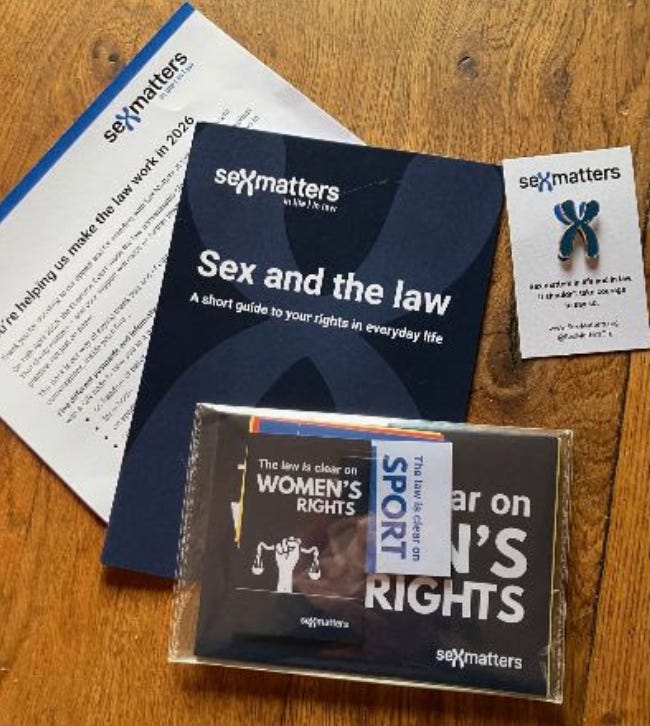
If you donated to our December campaign, you should have had your campaign pack in the post in the last couple of weeks.
Not had a pack? Look for an email with the subject Your Sex Matters receipt to check that your donation got to us. If it did, but you haven’t had your pack, contact Emma at info@sex-matters.org.
When workplaces don’t comply with the law
We have updated our advice after recent court cases. Use our responses to these excuses if you need to complain to your employer about single-sex workplace facilities.
How the City of London allowed the consultation on the ponds to be hijacked

Can it be true that 20,821 people have swum in the Hampstead Ponds in the last three months? And that swimmers are 4.5 times more likely to be lesbian, gay or bisexual than the rest of the population? We crunched the numbers from the City of London Corporation’s consultation and found them unconvincing.
Guidance released on “gender-questioning” children

On 12th February, the government finally published its guidance on guidance for schools on “gender questioning” children. We were pleased to see this incorporated into the statutory safeguarding guidance for schools and colleges, but it still has major flaws.
High Court rules: EHRC guidance lawful
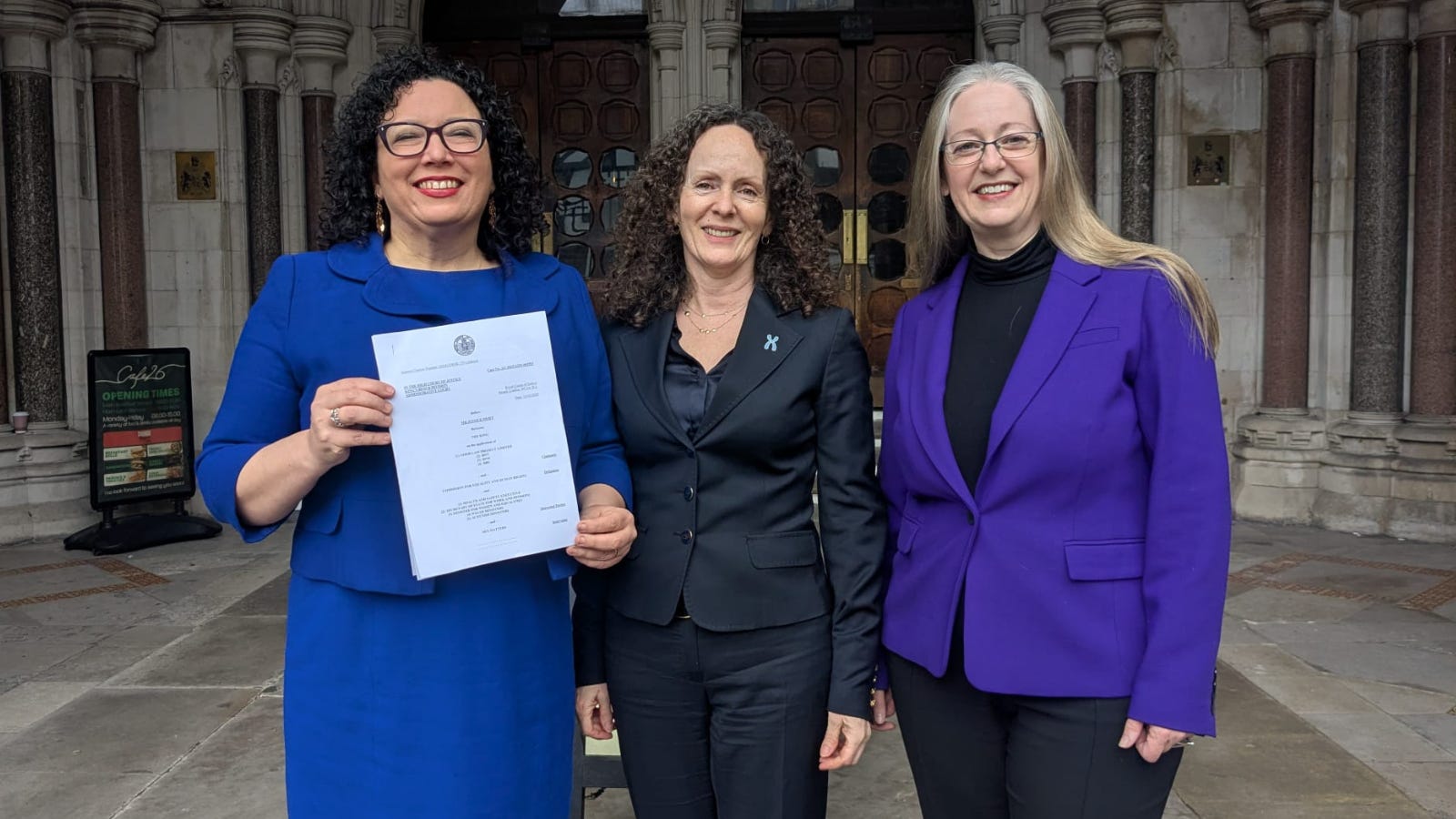
The High Court has dismissed a legal challenge from the Good Law Project and three anonymous claimants against the EHRC’s interim guidance on single-sex services published last year.
In the news
The government’s new draft schools guidance on “gender-questioning” children protects single-sex sports, spaces and data, but retains references to “social transition” without defining what this means. Its release was widely covered, including by Branwen Jeffreys and Nathan Standley for BBC News, Camilla Turner and Daniel Martin for The Telegraph, Geraldine Scott for The Times and Aine Fox for PA Media, as published by The Independent among others. Maya welcomed its integration into the statutory safeguarding framework, but warned that “social transition” has no basis in law or reality, and undermines safeguarding.
Maya’s comments featured on ITV’s Good Morning Britain, BBC Radio Four’s Today and Times Radio, and she was interviewed on GB News. Helen was interviewed on TalkTV and Times Radio, and Fiona was interviewed on GB News and TalkTV.
During a meeting with nurse Jennifer Melle, the minister for Women and Equalities, Bridget Phillipson, clarified that the much-anticipated EHRC guidance is intended for service providers rather than employers as part of her defence against concerns about its delay. As quoted by Sean O’Neil for The Courier and Martin Beckford for the Daily Mail, Helen pointed out that many employers have used the upcoming guidance as an excuse to delay action and that as long as Phillipson fails to lay it before Parliament, anyone who wants to ignore the law has a convenient excuse at hand.
The news that Good Law Project lost its legal challenge against the EHRC over its draft code of practice for service providers was covered widely. Sex Matters intervened in the case in support of the EHRC, and Maya was quoted in articles by Daniel Martin for The Telegraph, Libby Brooks for The Guardian and Millie Cooke for The Independent as saying that the judgment vindicates the EHRC’s swift action in publishing interim guidance weeks after the Supreme Court judgment.
David Thompson from The Newsletter covered the news that Northern Ireland is undertaking a review with Baroness Hilary Cass in a step towards aligning “gender services” with England in order to participate in the widely criticised puberty-blocker trial. Fiona said that studies should be carried out on the estimated 2,000 children who have already been given puberty blockers and urged NI health minister Mike Nesbitt to rethink.
If you’d like this memo in your inbox every Friday at teatime, join our mailing list now.