

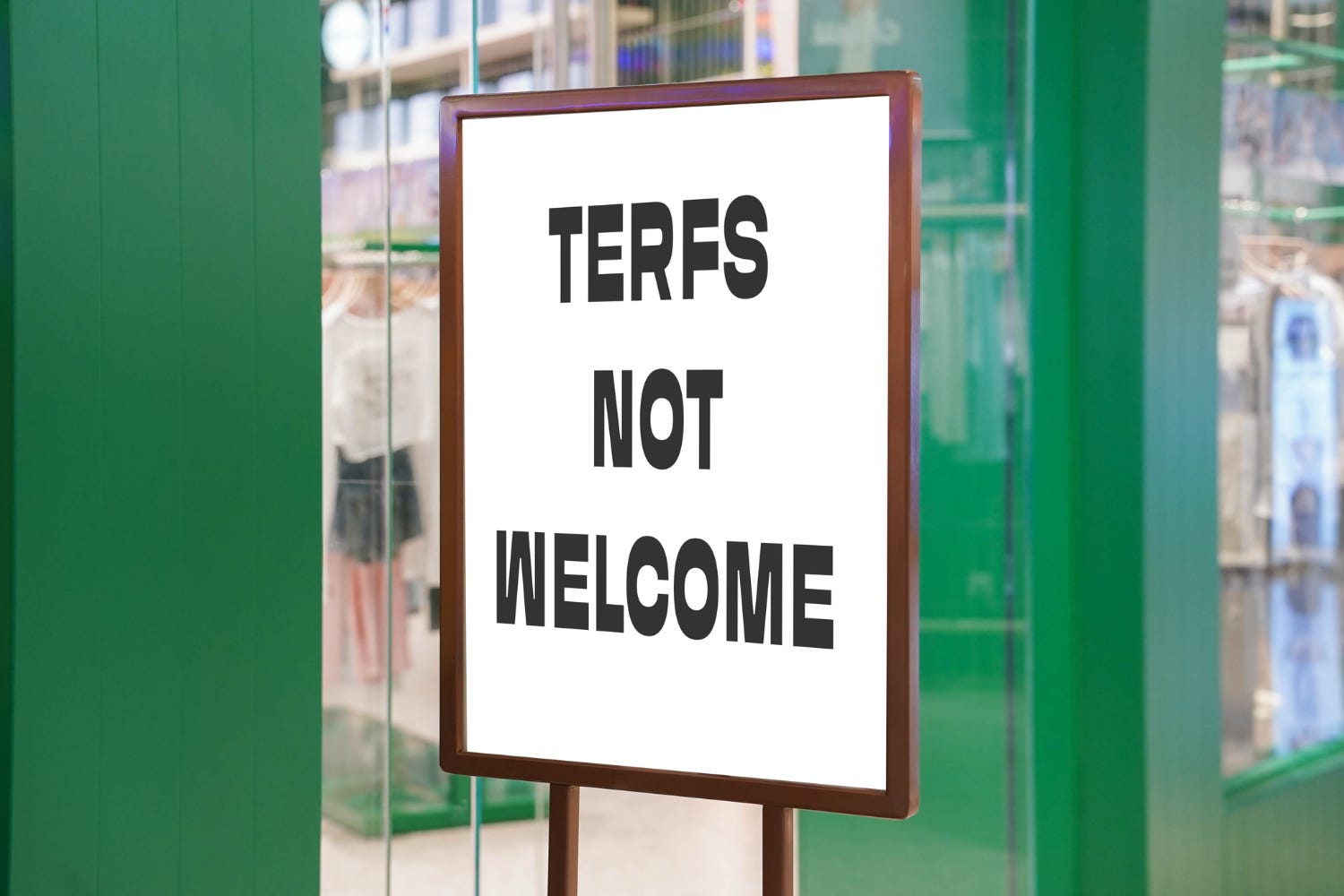
Most of the high-profile gender-critical belief-discrimination cases to date have related to workplaces. But gender-critical belief discrimination is unlawful in services, too – and now that Bridget Phillipson, the Minister for Women and Equalities, has finally published the updated Code of practice for services, public functions and associations, anyone who experiences this sort of discrimination by a service provider can cite it when complaining or seeking legal redress.
Examples of such discrimination include being refused service in a pub, barred from a gym or forced to leave an event because you are known or suspected to hold gender-critical beliefs (or to be associated with someone who does). This may happen because you take gender-critical positions publicly, because you are known to the person committing the discrimination or because you have manifested your protected belief by complaining about the organisation’s policy of allowing people to use single-sex spaces based on gender identity, or about a person of the wrong sex in a single-sex space.
The Supreme Court judgment of April 2025 had already made clear that when it comes to single-sex provision, “single sex” must mean what it says. But many organisations delayed fixing legally flawed self-ID policies, citing the excuse that they were waiting for the updated code. Now that it has been published, that feeble excuse no longer exists. When you complain, you can point to sections of the new code which spell out that discrimination on grounds of gender-critical belief is unlawful, and that trans-identifying people must not be granted permission to use opposite-sex spaces.
Quoting the code
Here are the most relevant sections of the new code to cite when a service provider discriminates on the basis of gender-critical belief (emphasis added).
4.91 Less favourable treatment which is either because a person holds a religious or other protected belief, or because they have expressed such a belief, will normally constitute unlawful direct discrimination. This is the case even if the service provider, body exercising public functions or association, or a third party, objects to the belief or expression of the belief.
The code makes clear that discriminating against someone because of a negative stereotype of people who share their belief is direct discrimination. This includes the stereotype that it is “transphobic” to hold or express “gender critical” beliefs:
4.100 Examples of stereotypes in relation to religion or belief are that persons who hold or manifest certain gender-critical beliefs necessarily have negative attitudes towards trans people…. The judgment explains that: ‘it may be that some persons who hold / manifest such beliefs have such animus, but it is stereotyping to assume that all do.’
Service providers cannot lawfully permit trans-identifying people to use spaces or services for the opposite sex:
13.130 If a service provider… admits trans people to a service intended for the opposite sex, then it can no longer rely on the [single-sex and separate-sex exceptions]. This means that if a service is provided only to women and trans women or only to men and trans men, it is not a separate-sex or single-sex service under the Equality Act 2010.
13.131 A service like this is very likely to amount to unlawful sex discrimination against the people of the opposite sex who are not allowed to use it. A service which is provided to women and trans women could also be unlawful sex discrimination or lead to unlawful harassment against women who use the service. Similar considerations would apply to a service provided for men and trans men.
13.107 …It is likely to be reasonable for a woman to object to the presence of a man if she will be getting undressed or in a vulnerable situation when she is using the service.
Service providers may be legally liable for gender-critical belief discrimination committed by staff:
3.50 Service providers… need to take steps to ensure that discrimination, harassment and victimisation is not occurring.
3.51 A service provider… will be liable for unlawful acts committed by their employees unless they have taken reasonable steps to prevent such acts.
Prejudiced and proud
That gender-critical beliefs are protected under the characteristic of “religion or belief” in the Equality Act was established in 2021 in the precedent-setting case of Maya Forstater v CGD Europe and others. This means that subjecting someone to discrimination, harassment or victimisation for holding or manifesting gender-critical beliefs is unlawful, just as it would be if the person held some other protected belief such as, say, humanism or Judaism. But after years of gender-critical beliefs being widely presented as bigoted and “transphobic”, many people think otherwise.
Being targeted by someone prejudiced, based on negative stereotypes about people who share your belief, is deeply upsetting. But the good news is that compared with other forms of unlawful discrimination, the evidence may be easy to gather. Unlike other forms of discrimination, discrimination against gender-critical people is often overt, even proud. The person or organisation involved may see it as a virtue (and might even wrongly think that the Equality Act requires them to exclude you). They may be willing to tell you in front of witnesses or in writing why they acted as they did.
When belief discrimination happens at work, the victim must take a case to the employment tribunal.
For a case to do with services the correct jurisdiction is the county court. If the facts are complicated or disputed it is always worth talking to a lawyer, but if they are straightforward you may be able to use the small claims process to take action effectively.
Thanks, guys
Very useful indeed
have cross posted
https://dustymasterson.substack.com/p/all-quiet-on-the-western-front
Dusty
Was “waiting for the code” ever a legal justification to allow use by men of female facilities? For local sites to allow such use? It was a delaying tactic. I had assumed to allow time for the law to be changed, explicitly allowing self ID. But, the national mood has changed as the wider public has become aware, so it was decided now is not the time. I’m certain they haven’t given up on this.