

Update from Maya
This week I was in court with our legal team for the two-day hearing in the case of Good Law Project and others v Equality and Human Rights Commission.
Following the Supreme Court judgment in April, the EHRC issued an admirably clear interim update on single-sex facilities. It said that women’s toilets are for women, men’s toilets are for men, and anyone who doesn’t wish to use the correct toilet for their sex should use the unisex option. It reassured employers and service providers that if they offer all three options and have clear rules, they can be sure they are meeting everyone’s needs and not breaching the law.
This advice was challenged by the Good Law Project (GLP), which said it was “transphobic”, wrong in law and breached trans people’s human rights. Together with three anonymous individuals who say they felt upset when this policy was explained to them, GLP brought a claim for judicial review.
In court this week the Health and Safety Executive, which regulates workplace standards, was missing in action. The Minister for Women and Equalities, Bridget Phillipson MP, disappointingly declined to back the EHRC. Instead she entered a “neutral” plea on the question of whether the regulator’s advice was correct in law.
Legal submissions on behalf of the minister appeared to be a desperate search for a loophole that would allow service providers and employers to continue to authorise trans-identifying men to use women’s spaces. Counsel for the minister, Zoë Leventhal KC, put forward an argument that there could be a reading of the Equality Act where “you would be entitled to provide your trans-inclusive provision in the way that the claimants have suggested”. Depressingly, and in defiance of the Supreme Court ruling, the government seems to be trying to bring back the gender self-ID “case-by-case” approach, whereby service providers are expected to separately consider each individual request by a trans-identifying person of one sex to access provision for the opposite sex rather than simply say No to all such requests.
GLP’s own arguments bounced around: perhaps toilets and other facilities should be organised based on gender-recognition certificates and birth certificates, or “acquired gender”, “lived gender”, surgery and hormones or “living as a woman”? The trans-identifying man among the three individual claimants said he was continuing to use women’s toilets.
We were in court to provide evidence and arguments about why toilets are spaces where sex matters (especially for women) and why access must be governed by clear, simple rules. My witness statement drew on evidence from many women who have told us why single-sex services matter to them. Elaine Miller’s provided lessons on the practicalities of female biology and Michelle Shipworth’s was a harrowing description of her experience of male violence in a women’s toilet.
Our legal arguments (from the excellent Rupert Paines of 11KBW) included tracing legal requirements concerning workplace toilets to 1938 and pointing out that employers and employees have responsibilities in relation to health, safety and welfare compliance. Under those responsibilities employers do not (indeed cannot) guarantee that no man ever enters women’s facilities (or that no woman ever enters men’s facilities), but may not authorise men to enter them, including men with the protected characteristic of gender reassignment (and vice versa for trans-identifying women and men’s facilities).
The judge, Mr Justice Swift, seemed to have a good grasp of the Supreme Court ruling and asked lots of sensible questions. Towards the end of the hearing he asked: “Under the workplace regulations, how do you provide separate rooms containing conveniences for men and women unless you say that one’s for the men; that one’s for the women?”
It was exhausting and dispiriting to see a government minister and her legal representatives, all paid from the public purse, adding layers of complication to this simple point, and to continue to treat facilities provided for women’s privacy, dignity and safety as an adventure safari for men and their gender identities.
Thank you for all your support for this important case and all our work. It really matters!
Maya Forstater
Tell organisations that programmes and prizes for women and girls must be based on sex
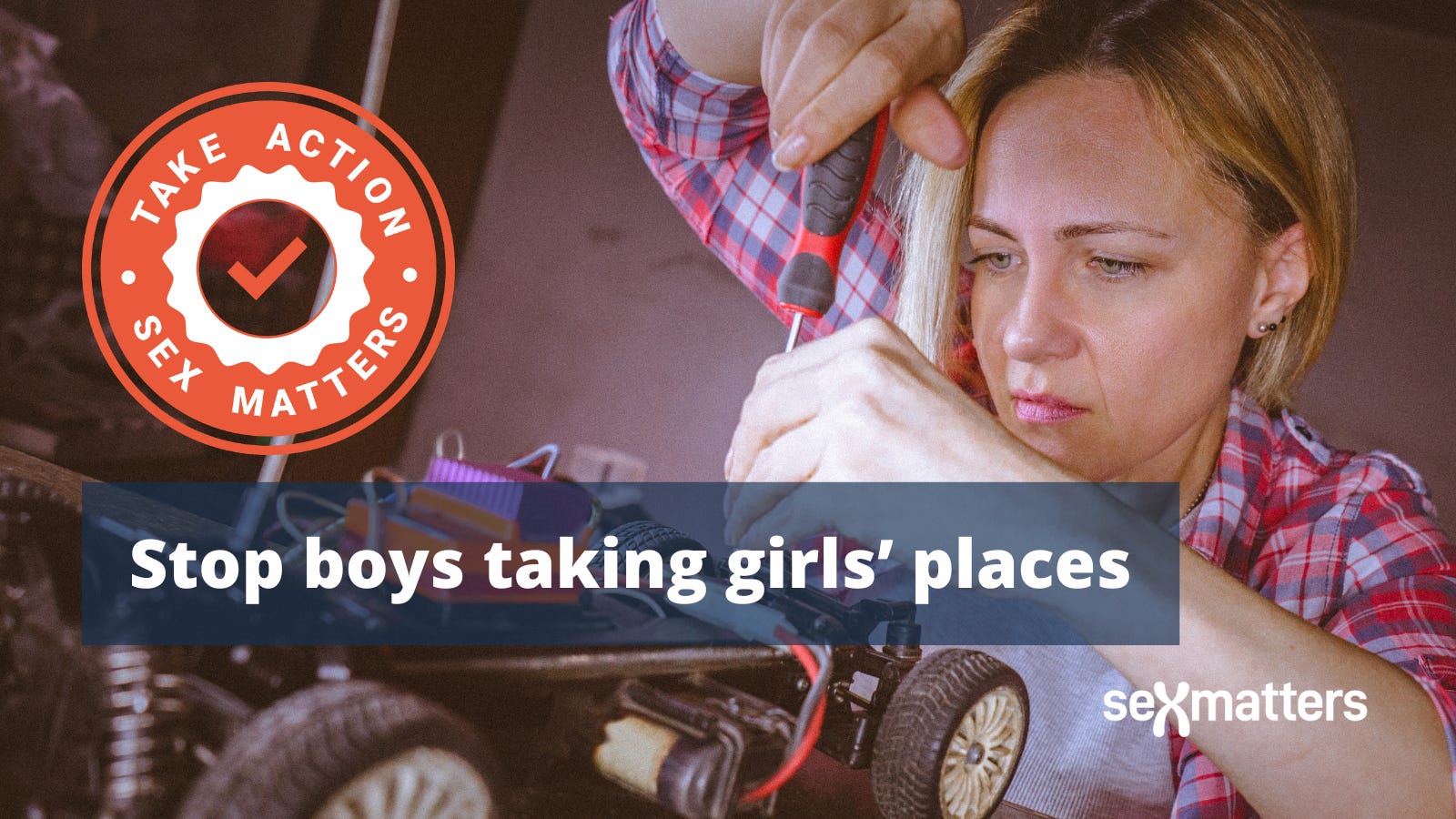
In male-dominated areas such as science, technology, engineering and maths (STEM), you’ll sometimes see opportunities for women and girls that aim to close the gap. But if these are advertised as being for anyone who “identifies” as female, they are not lawful as positive action. This has been common for years, and it is now clearly unlawful after the For Women Scotland Supreme Court judgment. We have a template email that you can use to raise concerns and explain the law if you see an example.
When will the BBC face up to the truth?
On the same day as The Telegraph reported on a leaked dossier revealing the BBC’s one-sided reporting on sex and gender, as well as biased coverage of Donald Trump and the war in Gaza, Sex Matters wrote to the BBC’s board. We asked for a commitment to:
root out the oppressive influence of transgender ideology in the organisation
replace activist language with normal language
stop normalising transgender ideology in BBC output
ensure that all BBC journalists can tell the unvarnished truth without fear
retrain staff on core facts.
Three days later Tim Davie, director-general, and Deborah Turness, chief executive of BBC News, resigned.
In the news
The resignations of Tim Davie and Deborah Turness, amid chaos at the BBC over biased reporting including sex and gender, dominated news coverage this week. Sam Merriman for the Daily Mail quoted Maya Forstater in an article on a BBC producer’s attempt to block JK Rowling from appearing on Newsnight, while Sanchez Manning for The Times quoted Cath Leng as saying that Sex Matters was among organisations that seemed to be blacklisted. Fiona McAnena was interviewed by Josh Howie on GB News’ Free Speech Nation shortly after news of the resignations broke:
Sex Matters’ letter to the BBC board this week was covered exclusively by Daniel Martin at The Telegraph. Maya was quoted as warning the board that the BBC’s normalisation of transgender ideology has caused real-world harms, including children feeling pathological anxiety about normal puberty and increased demand for harmful puberty-blocking drugs. Later in the week Daniel revealed that news boss Richard Burgess had admitted to staff that the BBC has not got its coverage of trans issues right over the past decade, and quoted Helen Joyce as saying that this was a significant admission after several days during which the BBC sought to downplay the demonstrable bias in its coverage of sex and gender.
In other news, Jamie Gardner for PA Sport, as published in the Irish Independent and other outlets, covered the news that the International Olympic Committee is moving towards banning trans-identifying males from all female events. Fiona said that every international sports body must now fall into line. Suzanne Moore for The Telegraph highlighted the work of Sex Matters trustee Dr Emma Hilton in bringing this about.
The Sunday Telegraph quoted Maya in a report that Blackpool council spent £35,000 on a rainbow road crossing, while Jill Foster for The Telegraph quoted Fiona in an investigative feature on trans lobby group Gendered Intelligence. Kristina Wemyss for the Daily Mail quoted Helen on the news that more than 500 trans-identifying male patients diagnosed with an enlarged prostate and other men’s issues have been recorded as women by the NHS.
Sex Matters’ intervention in GLP’s high-court challenge against the Equality and Human Rights Commission was quoted by Alison Holt and James Melley for BBC News. Fiona was quoted by Ben Rumsby for The Telegraph on GLP’s legal action against the England and Wales Cricket Board on its trans-inclusion policy, and Gabriella Swerling for The Telegraph quoted Maya on the news that Girlguiding faces legal action from a parent over its trans inclusion policy.
Want to get our weekly email update? Sign up now!