

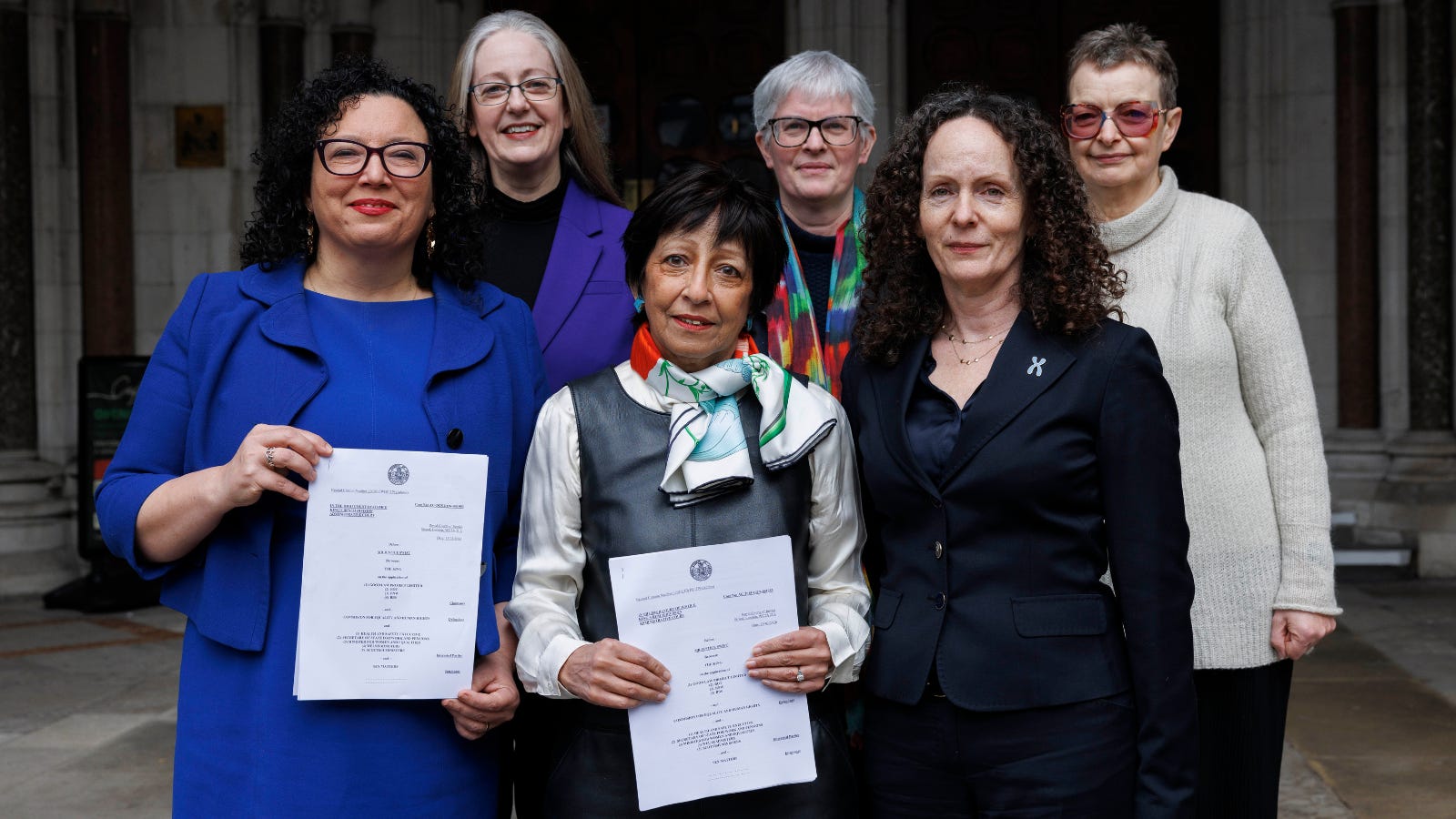
The Court of Appeal has refused permission to the Good Law Project (GLP) to continue to challenge to the Equality and Human Rights Commission (EHRC)’s interim guidance on single-sex facilities.
In February the High Court refused GLP permission to bring its claim for because it lacked “sufficient interest” to standing, and rejected a claim brought by the three individual claimants that the EHRC’s update was unlawful. It upheld the lawfulness of the EHRC’s interim update. Sex Matters intervened in the case in support of the EHRC.
Lady Justice Andrews has now refused Good Law Project (GLP) permission to appeal and adjourned the three individual claimants’ application to an oral permission hearing.
Read our briefing on this case.
What the Court of Appeal decided about GLP
Lady Justice Andrews held that an appeal against the decision on standing has “no reasonable prospect of success”, and that there is no other compelling reason for the Court of Appeal to hear it.
She gave several reasons. Whether GLP had a sufficient interest was a value judgment for the High Court judge, of a kind an appeal court will rarely disturb. He applied the correct legal test, and he was entitled to conclude that a campaigning body not directly affected by the guidance did not have a sufficient interest. And the presence of three directly affected claimants, who were able to bring the challenge and did, reinforced his conclusion.
The order notes that a refusal of permission on the papers is final. GLP’s appeal is over.
The case brought by the three individual claimants
The three individual claimants were given permission for judicial review, but their claim was dismissed on every ground. They are appealing this.
In the High Court Mr Justice Swift in February 2026 held that none of the following points in the EHRC update misstated the law:
Workplaces
(i) Single-sex lavatories must be provided in workplaces.
Services
(ii) So far as concerns provisions on services in EA 2010, there is no requirement to provide single-sex lavatories.
(iii) Provision of a single-sex lavatory is permitted by the EA 2010 if that is a proportionate means of achieving a legitimate aim.
(iv) Failing to provide a female single-sex lavatory could comprise indirect sex discrimination against women.
Workplaces and services
(v) Single-sex lavatories will cease to be single-sex if transsexual persons are permitted to use them other than in accordance with their biological sex.
(vi) If trans women are permitted to use a single-sex female lavatory, all biological males must be permitted to use that lavatory.
(vii) In some circumstances equality law may permit transsexual persons to be excluded from single-sex lavatories that correspond to their biological sex.
(viii) Lavatories in lockable rooms used one person at a time can be used by anyone.
(ix) If you provide single-sex lavatories do not fail to make provision for transsexual persons.
(x) If you provide single-sex lavatories (or other facilities), where possible also provide a mixed-sex facility.
Lady Justice Andrews has adjourned the application for an appeal to an oral hearing, which she expects to take no more than half a day. The hearing will decide only whether permission is given.
Lady Justice Andrews said she was not currently persuaded that any ground of appeal has a real prospect of success, and that the judge’s reasoning, particularly at paragraph 79, appeared compelling. Paragraph 79 said “A requirement to state the law accurately is not the same as a requirement to give a comprehensive statement – to include everything that could possibly be said.” It ended:
“The guidance in the Interim Update was directed to the provision of single-sex facilities. This was the matter that the judgment in For Women Scotland had affected and the EHRC did not act unlawfully by addressing only this in the Interim Update rather than more general issues relating to the gender reassignment protected characteristic.”
In the interests of fairness and open justice, she said the applicants should have the chance to persuade the court orally.
She also raised a question about whether the case merits the Court of Appeal’s time at all. The interim guidance was removed from the EHRC’s website before the High Court heard the claim, and the new statutory Services Code of Practice came into force on 5th August 2026. If, as the claimants suggest, the alleged errors have been carried into the Code, she said, the correct course is to challenge the Code rather than debate guidance that has been superseded. GLP is supporting a legal challenge to the Code by a trans person and an organisation, who have sent a pre-action letter to the government and the EHRC.
What this means for single-sex services
The High Court’s judgment that the interim guidance stated the law accurately remains in place. Among other things, Mr Justice Swift held that a single-sex lavatory stops being single-sex if people of the opposite sex are permitted to use it. He also held that an employer who provides separate facilities for men and women, and in good faith applies a policy that they are used by people of that sex, does what the Workplace (Health, Safety and Welfare) Regulations 1992 require.
Sex Matters produced an easy-read version of the interim update which remains useful although it has overtaken by the statutory Services Code of Practice.
The oral hearing of the three anonymous claimants is still to come. But employers and service providers do not need to wait for another round of litigation. The law on single-sex spaces rests on a Supreme Court judgment, and they are required to follow it.