

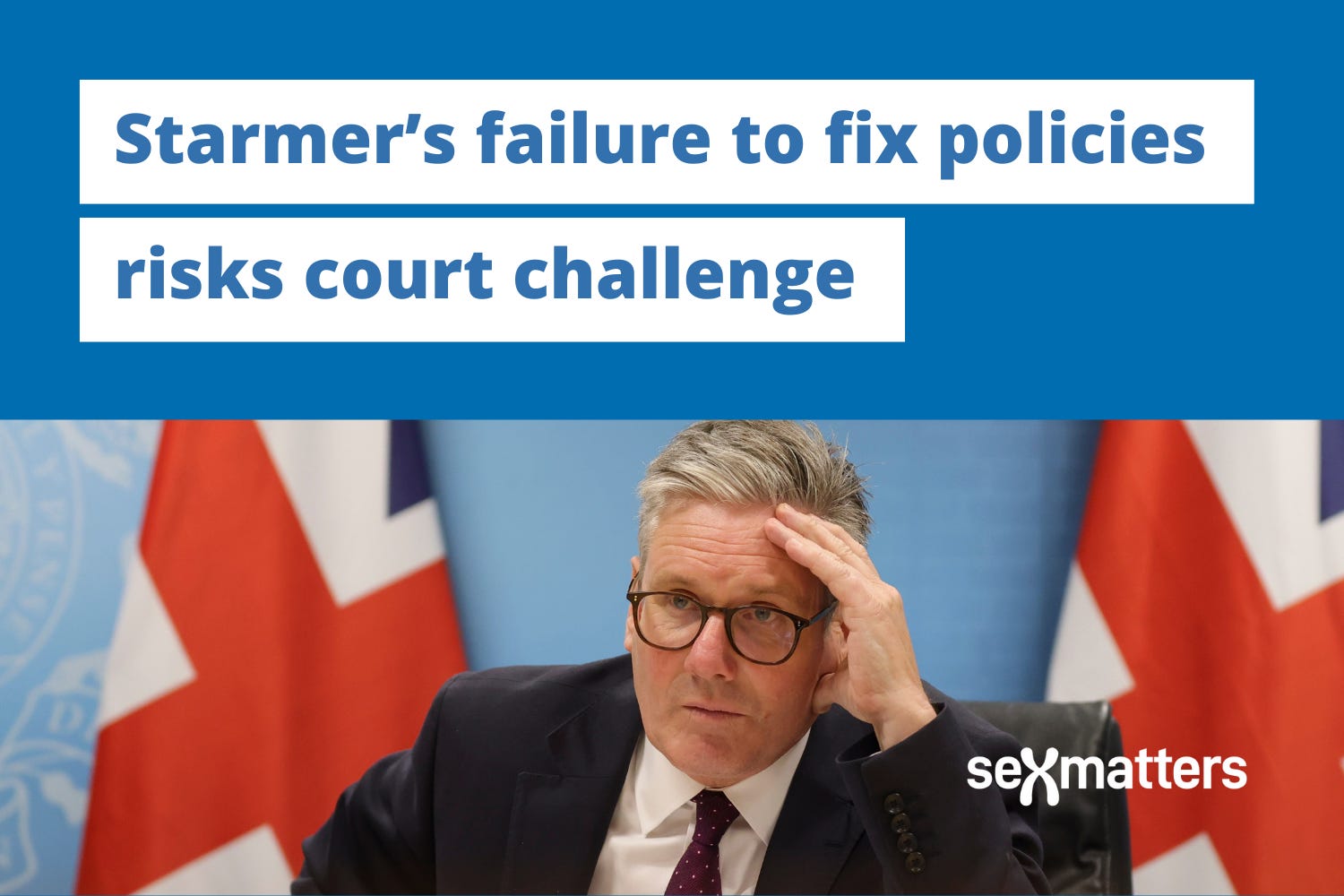
At the end of last year the government published its strategy for halving violence against women and girls. The prime minister said: “Everybody in public service knows, the work we do together can make or break a life.”
Civil servants make decisions: about schools, about policing, prisons and probation, about healthcare, safeguarding, charities and the women’s sector, and about data collection and personal identification. Civil servants advise ministers and provide services directly to the public in a wide range of locations: job centres, prisons, probation and at borders. Often they are dealing with people who are vulnerable, dangerous or both.
Members of the public depend on them acting with integrity, honesty, objectivity and impartiality, and in line with the law. Recognising that men are not women, keeping accurate records and setting, communicating and complying with lawful sex-based rules and policies should be a basic expectation.
The prime minister said he is leading a “whole-of-government, whole-of-society effort to tackle violence against women and girls… prioritising prevention, tackling the root causes of violence, while relentlessly pursuing its perpetrators and supporting its victims and survivors.” He said:
“We must address the misogyny and inequality that are the root causes of violence against women; and part of that is articulating a positive, aspirational vision for boys and men in Britain today.”
But civil-service departments have adopted a policy in their own offices which is based on gender self-ID and a misunderstanding of the Equality Act. They allow employees to access opposite-sex workplace facilities and tell colleagues and line managers that it is “transphobia” and bullying to question this.
This policy is not in line with the law, and it embeds gender ideology at the heart of government thinking and operations.
Over a year ago civil servant Eleanor Frances received a six-figure settlement from the Department for Culture, Media and Sport (DCMS) and the Department for Science, Innovation and Technology (DSIT) when she alleged that she was discriminated against after complaining about the policy. The settlement came with promises to return to impartiality and to revise the workplace policy.
In November 2025 Sex Matters wrote to Sir Chris Wormald, cabinet secretary and then head of the civil service, calling for urgent action to withdraw the policy. We reminded him that duty bearers under the act are required to comply with the law right now; they do not have the option of waiting for guidance from the Equality and Human Rights Commission before coming into compliance with the law.
At the end of December 2025 we received an extraordinary response from Catherine Little, the civil service’s chief operating officer and Cabinet Office’s permanent secretary.
» Read the reply from the Cabinet Office on civil-service policy »
She said that her team is still “reviewing the 2019 policy to ensure it remains legally compliant”. Referring to the EHRC code of practice for services, public functions and associations, she claimed that it is “important that we do not preempt the CoP, in determining the outcome of our review”. She said:
“The Cabinet Office will not be withdrawing the policy, or suggesting that departments should consider withdrawing theirs, until an updated version is finalised.“
She also said that (emphasis added):
“In the interim, departments have been advised to seek HR and legal advice if considering amending, implementing or applying the current policy or devising their own policy and for any complex issues, such as access to workplace toilets and/or changing facilities, so that particular concerns raised by any member of staff can be properly addressed.”
This is a recipe for chaos. The model policy remains in place, but the head of the civil service is refusing to provide any assurance that it is lawful. Every department is being advised to seek its own legal advice if it is considering either following the model policy or rejecting it. This is gridlock, with everyone frozen and hoping that if they do nothing responsibility will not fall on them. It is the opposite of a whole-of-government, whole-of-society approach to respecting and protecting women’s rights.
On 29th December we wrote to the prime minister, who is the ultimate head of the civil service, calling on him to withdraw the unlawful workplace policy.
It should be obvious that services for women and girls – including facilities for everyday privacy, such as changing rooms, showers and toilets, whether at work or in public places, as well as girls schools, women’s sports, charities, women’s refuges, rape crisis centres and prisons – are for women (often at their most vulnerable). They are not facilities for men, even cross-dressing men or transsexual men.
No service user or staff member should face abuse, hostility or discipline for being clear about this.
This is not a “complex issue”, but a straightforward question that deserves a straightforward, consistent whole-of-government answer.
The government is making a mess of responding to the Supreme Court judgment by passing the buck to every department to come up with its own approach.
If Sir Keir Starmer does not recognise the need for urgent leadership on this issue, he will undermine confidence in his own flagship strategy for women and girls, and will have to answer in court for the government’s irrational decision-making in relation to the Equality Act.