

Update from Maya
Sex Matters filed our legal case against the City of London Corporation over the Hampstead Ponds in August 2025. We had a one-day “permissions hearing” in December and have been waiting since then to hear whether the case could go ahead.
On Thursday morning, 29th January, that waiting was over. We heard the bad news that the High Court had turned down our application for permission for a judicial review of the City of London Corporation’s decision to allow men into the women’s bathing pond, and women into the men’s.
This was a decision based on procedural arguments (if you didn’t read the update we sent out to people who donated to support the case on the day, you can catch up here). The City of London said that it hadn’t yet made a decision about the rules at the Hampstead Ponds following the Supreme Court judgment last April, even though it decided in July to put new signs up that expressed a policy different from that written down. So the City said there is nothing to judicially review yet, and the court accepted that.
The judge said that the City should be allowed to conduct a consultation with all options on the table, and that if it ends up adopting an option that is alleged to be unlawful, “then that will be the time to challenge”.
On the same day as the High Court’s decision, the City of London released its consultation findings, which unsurprisingly found strong views on both sides. It says the current arrangements “will remain in place until Members have considered the findings and made final decisions” (members means the elected councillors). There was no indication of when that might be.
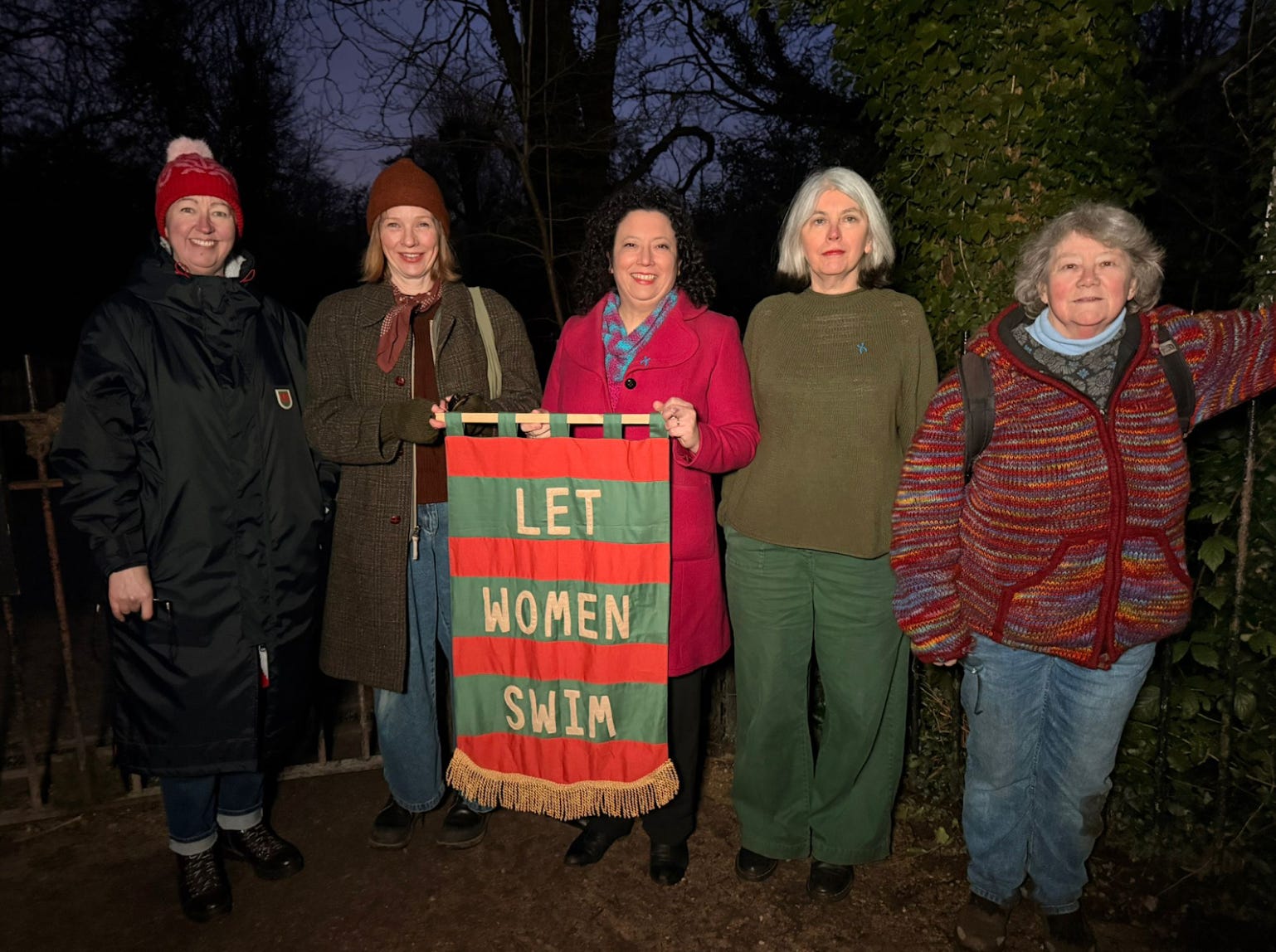
On the day of the decision, I went to Kenwood Ladies’ Pond in the evening to commiserate with some of the women who had provided witness statements for the case, and to record a soundbite for ITV.
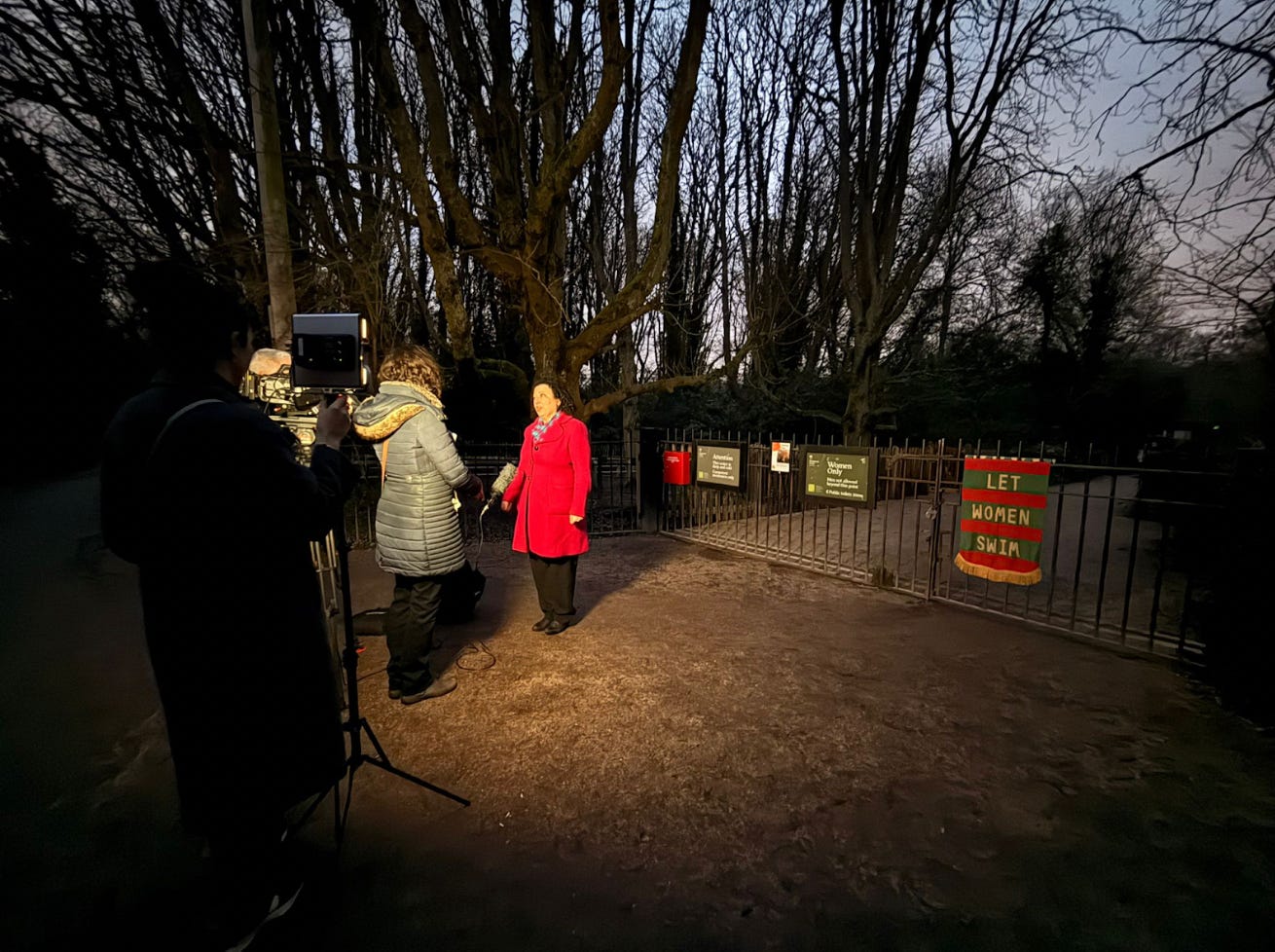
There has been lots of press coverage of the case, with the useful result that some people are hearing about it for the first time.
The City’s delay in making a decision mirrors the inaction by the Minister for Women and Equalities, Bridget Phillipson, in failing to lay the Equality and Human Rights Commission’s guidance on single-sex facilities before Parliament.
Meanwhile, staff at the Hampstead Ponds – and at all other services where women are undressing – don’t have months in which to make decisions. They have to decide on the spot whether to let someone into a service marked “women only” or whether to exclude them because they are clearly male. Without clear rules and the ability to say no, they put women and girls at risk.
The most concerning thing about the judgment is that it suggests that when it comes to upholding the Equality Act, claims must be brought by individuals in the County Court, and not as judicial reviews by groups acting in the public interest. The judge took the viewpoint that courts will need to take a close look at particular facts involving individuals, whereas we think that in situations like the Hampstead Ponds, it’s a basic question of whether it is lawful to operate a “women only” service which excludes some men but allows in others.
We are still talking with our lawyers about what to do next, and you can hear some of our thinking in the latest edition of our podcast.
Thank you to everyone who contributed to the case. The fight to protect women’s rights, and ensure the Supreme Court judgment is obeyed, continues. We’re not giving up, and we’ll keep you posted!
Maya Forstater
Hampstead Ponds court challenge
In this week’s episode of the Sex Matters podcast, Helen and Maya discuss the decision in the High Court to refuse Sex Matters permission for judicial review of the “trans inclusive” policy at the Hampstead Ponds.
The ruling was made on procedural grounds, and didn’t even get to the point of considering whether that policy was lawful – a disappointing and frustrating outcome, but certainly not the end of the fight to protect single-sex spaces for both men and women, and to ensure that the Supreme Court judgment in the case of For Women Scotland translates to facts on the ground (and in the water).
Protecting children from trans ideology
We combined forces with Athena Forum to ask you to email UK delegates to the Council of Europe about a transactivist policy that criminalises professionals who do not affirm a child’s self-declared trans identity. Thank you to all those who did this (and apologies for the technical blips).
The resolution was framed as banning “conversion practices” but in fact pushed a transactivist framing of gender identity as a self-identified characteristic that cannot be questioned. As expected, the resolution passed. But Athena Forum, Sex Matters and other groups were able to raise the alarm across Europe, briefing MPs, writing articles and sharing analysis on social media.
As Athena Forum says, this vote is not the end of the story. It marks the beginning of our efforts to push back in Europe after transactivist organisations have had a head start. “That era is over. The spotlight is on. We are just getting started.”
In the news
Missing from last week’s roundup, Daniel Martin and Dominic Penna for The Telegraph broke the news that the Cabinet Office is hiring a senior civil servant to “lead on trans equality”, while refusing to withdraw a 2019 self-ID policy on toilets. Maya was quoted as saying that Sex Matters will be considering its legal options. Maya wrote a separate article saying that this reveals the civil service’s flawed approach of creating insider-advocates for interest groups.
This week, Jacinta Taylor for the Mail on Sunday broke the news that some NHS midwives are still being asked to record the “gender identity” and sexual orientation of newborn babies. This comes two years after NHS bosses called the issue an “error” in the £450 million Epic patient data software that would be corrected. Fiona and Maya were interviewed by TalkTV on the story.
Sanchez Manning for The Times revealed that Thea Sewell, one of the founders of the Cambridge University Society of Women, is threatening legal action against the Prince of Wales pub in Clapham for refusing to serve her because of her views on sex and gender. Helen said that the case should ring alarm bells for pub owners, shopkeepers and others that it is not lawful to behave in this bigoted manner towards people who hold ordinary, factual beliefs.
Fiona wrote for the Daily Express, saying that following the judgments in the cases of Jennifer Melle, the Darlington Nurses and Sandie Peggie, ideological capture in the NHS must be fixed from the top down, and that it’s past time for Health Secretary Wes Streeting to end the madness.
Samuel Montgomery for The Telegraph and Jon King for the Daily Express reported that Norfolk Constabulary are allowing detainees to be recorded according to gender identity rather than sex. Helen said that men commit far more crimes than women, especially violent and sexual crimes, meaning that even a small number of men recorded as female seriously skews crime statistics.
The news that the High Court has not permitted Sex Matters to pursue a judicial review against the City of London over its policy to allow trans-identifying men to use Kenwood Ladies’ Pond was covered widely by the national media. Print and online coverage included BBC News, Sanchez Manning for The Times, Gabriella Swerling and Tom McArdle for The Telegraph and PA Media as published by The Guardian, as well as local outlets such as Holly Brencher’s article for Ham & High. It was also covered widely by broadcast media including ITV’s Good Morning Britain and BBC London.
Maya was interviewed by ITV News and Talk TV, and Fiona was interviewed by LBC, Talk TV and GB News. In The Telegraph, Jill Foster wrote about women’s frustration about this continuing failure to protect single-sex spaces, quoting Fiona as saying that after For Women Scotland the law is clear and “we shouldn’t be having to debate this and relitigate this over and over.”
ITV’s Good Morning Britain referenced Sex Matters’ opposition to a resolution in the Council of Europe to call on member states, including the UK, to outlaw so-called conversion practices.
Would you like this memo in your inbox every Friday at teatime? Join our mailing list now.
Sex Matters survives on your support.
Without it, we simply wouldn’t exist.
Sex Matters can deliver essential research and analysis, help shape the debate, and empower people with clear, published guidance on their rights – but only with your support. Please contribute what you can to keep us going.