

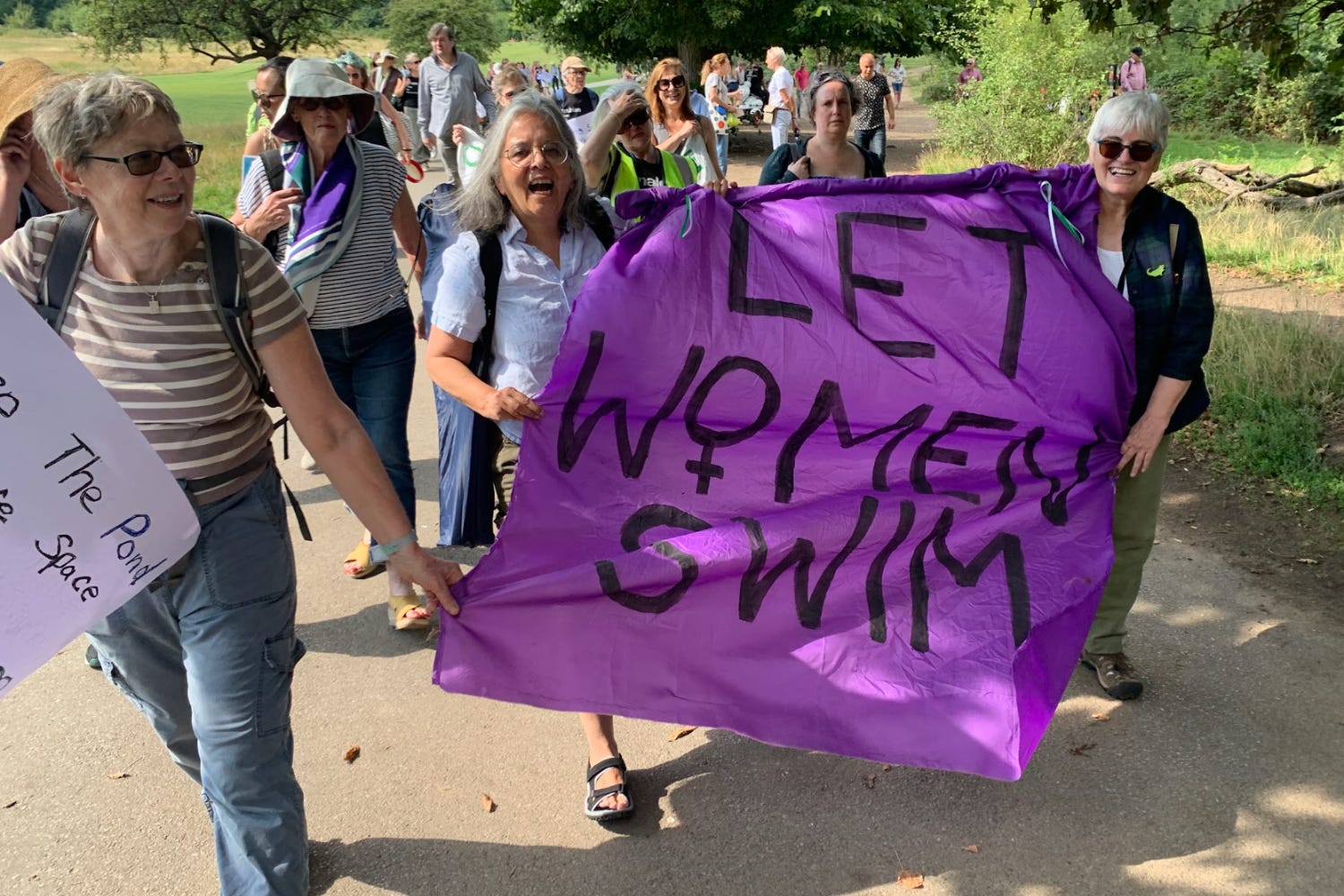
Campaigners at the Hampstead Ponds in 2022. Photo: Lily Maynard
On Tuesday 3rd and Wednesday 4th November, the High Court will hear Sex Matters’ judicial review of the City of London Corporation’s admissions rules for the Kenwood Ladies’ Pond and the Highgate Men’s Pond on Hampstead Heath. The hearing is at the Royal Courts of Justice in London.
We have now filed expert evidence from Professor Jo Phoenix. The Good Law Project and TransLucent have applied to intervene.
We are challenging the decision by the City of London Corporation that men who identify as women may use the Ladies’ Pond, including its communal changing room and showers, and that women who identify as men may use the Men’s Pond. We say that operating the facility in this way is unlawful sex discrimination under the Equality Act 2010. We are asking the court to declare the decisions unlawful and quash them.
This post sets out what has happened since our last update, and the arguments we will put to the court.
How we got here
We filed our claim on 19th August 2025, after the City decided to carry on admitting trans-identifying men to the Ladies’ Pond following the Supreme Court’s judgment in For Women Scotland v The Scottish Ministers [2025] UKSC 16.
In January 2026 the High Court refused permission for the claim to go ahead. We appealed. On 17th March 2026 Lady Justice Elisabeth Laing in the Court of Appeal granted permission, finding that each of our grounds was arguable and that “expert charities” have standing to bring claims like this one.
The City then asked for the case to be paused while it finished its own review. The court refused. On 12th May and 4th June 2026, two City committees voted to keep the ponds as “trans-inclusive spaces as currently operated”, and to spend up to £1 million on improving the changing areas.
We amended our grounds to challenge those decisions too. The City served its full defence and evidence on 10th August 2026. On 24th September we applied for permission to rely on evidence in reply.
You can read our amended statement of facts and grounds and Maya Forstater’s third witness statement.
What the rules say
The City’s access policy says:
“The Men’s Pond is open to biological men and trans men … The Ladies’ Pond is open to biological women and trans women.”
It defines a “trans woman” as “a person who was at birth of the male sex, but who has the protected characteristic of gender reassignment under the Equality Act 2010”.
The gate still says “Women Only: Men not allowed beyond this point”. A smaller sign, among others, says that “those who identify as women are welcome”.
The Ladies’ Pond has a communal changing area and communal showers, with an open-sided outdoor shower and a meadow where women sunbathe topless. Many women change in the open and shower naked, in what they are told is a women-only space.
Our first argument: excluding people because of their sex
Our case is making a careful set of legal arguments which are based on the way the Equality Act is constructed.
The Equality Act says a service provider must not discriminate against a person by refusing them a service because of a protected characteristic (s29(1) with s13). Sex is a protected characteristic, and it means biological sex.
A woman who wants to swim at the Men’s Pond will be turned away. A man in exactly the same circumstances would be let in. She is refused because she is a woman. The same is true, the other way round, for a man who wants to swim at the Ladies’ Pond.
That is direct sex discrimination. Even if some men (who identify as women) are admitted to the Ladies’ Pond, excluding other men is still sex discrimination. The law has long been clear that direct discrimination need not affect everyone who shares the characteristic to be unlawful.
In the Equality Act direct discrimination, unlike indirect discrimination, cannot be justified, apart from where there is a statutory exception. This means that the only way to lawfully run separate services for men and women is by relying on one of the exceptions, such as the exception for separate-sex and single-sex services in Schedule 3 of the Equality Act (paras 26 and 27). The Supreme Court gave “segregated swimming areas” as an example of what those exceptions are for (For Women Scotland, para 211).
But the exceptions only work if the service is separated by sex. The City accepts this. In July 2025 it told us it was “expressly not seeking to rely on the exceptions”. Its position is that the ponds are not single-sex services at all.
We say that answers the question. If the ponds are not single-sex, nothing in the act permits the City to turn people away because of their sex.
The Highgate pond and the Kenwood pond are two separate and distinct services.
Why would a woman want to swim at the Highgate pond? Why not? It is more than twice as big, with a diving board and a long circuit suited to training. Why might a man want to swim at the Kenwood pond? Why not? It is beautiful, enclosed by trees, with a meadow and warm showers.
These are not hypothetical questions. Our evidence includes witness statements from a man who would like to swim in the Kenwood pond, and two women who would like to swim in the Highgate pond, including one who asked to use the bigger pond once a week so she could swim long distances, and was refused.
As Maya Forstater says in her witness statement, if the City labelled Parliament Hill Café “Men only” and the Golders Hill Park Café “Women only”, nobody would think the question “Why would a woman want a cup of tea at Parliament Hill?” was an answer to a discrimination claim relating to these rules.
None of this means we want the ponds to be mixed. It means the City has to choose a lawful model: single-sex ponds alongside the mixed pond, or three mixed-sex ponds. What it cannot do is keep the signs that say “men” and “women” while redefining those words.
Our second argument: women bear the greater detriment
The act also says a service provider must not discriminate in the way it provides a service, including by subjecting someone to a detriment (s29(2)).
A woman at the Ladies’ Pond may find herself undressing or showering beside a man. Many trans-identifying men have not had genital surgery, and the definition of gender reassignment does not require it. We say the risk that a woman’s privacy, dignity or safety will be compromised is greater than the equivalent risk for a man at the Men’s Pond, and that this is less favourable treatment of women because of their sex.
The Court of Appeal accepted in R (Al Hijrah School) v HM Chief Inspector of Education, Children’s Services and Skills [2017] EWCA Civ 1426 that rules which look the same for both sexes can still result in direct sex discrimination.
Women’s accounts show what this means in practice. The author Amanda Craig has written in The Telegraph about encountering a large naked man in the showers. Other women have told us about leaving the meadow, covering up or no longer going at all. The City’s own consultation report records respondents who described “feeling violated, sexually harassed, triggered, or uncomfortable due to encounters with males in changing rooms or pond areas”.
The City’s own staff recognise the issue: when a man comes on site to take water samples, lifeguards ring a bell, make an announcement and close the changing-room doors.
Our third argument: indirect discrimination against women
In the alternative, we say the rules are indirect sex discrimination (s19). They put women as a group at a particular disadvantage compared with men, and the City cannot show they are a proportionate means of achieving a legitimate aim.
Professor Jo Phoenix, a sociologist and criminologist at the University of Reading, has written an expert report for the court. She concludes that the detriment to women is “generated by the rules of the space rather than by events within it”. It takes four forms: self-exclusion, modified use, sustained hypervigilance and acute distress on encounter. It operates whether or not a man is present on any given day. Her conclusion is that “the detriment to women is greater in intensity, wider in incidence and different in kind” than for men. Some groups feel it more intensely: Muslim, Orthodox Jewish and other observant women, survivors of male sexual violence, older women, lesbians and girls.
Tribunals have reached similar conclusions. In Hutchison and others v County Durham and Darlington NHS Foundation Trust (the Darlington nurses’ case), an employment tribunal held that requiring women to share changing rooms with a man put women at a particular disadvantage.
What the City says, and our answers
The City says the ponds are welcoming, “trans-inclusive” spaces with a long history of diversity.
We agree the ponds should welcome everyone who is entitled to use them: older and younger swimmers, disabled swimmers, people of every religion and sexual orientation, and people who identify as trans or non-binary using the pond for their own sex. Separate services for each sex are not against inclusion. They are often how different groups are included.
No one would be forced into a space they do not want to use. Before the City’s policy, there was a choice of single-sex ponds for men and for women, as well as the Mixed Pond and the Lido. That choice would still exist.
The consultation. The City relies on a survey in which around 86 percent of 38,742 respondents backed “trans-inclusive” ponds. But it was self-selecting, and it was promoted online as a call to action by groups campaigning for that outcome. Earlier surveys of pond users drew between 600 and 2,000 responses. At a committee meeting in January 2026, the City’s deputy director of natural environment said: “We knew there was the potential for it to get hijacked.”
Professor Phoenix says the survey “establishes the balance of expressed preference among those who chose to respond” and “cannot establish that the arrangements cause no disadvantage”. Discrimination law exists to protect people from exactly the kind of rule a majority might vote for.
The building works. The City plans more cubicles. But cubicles do not change who is allowed in. The Ladies’ Pond is a communal, outdoor space: the meadow, the deck, the outdoor showers. Unless every woman is required to change in a cubicle, nothing stops a man undressing in the open.
Enforcement. The City suggests a rule based on sex would be hard to enforce. Sex-based rules are enforced every day, in workplaces, schools and leisure centres, by clear signs and the expectation that people follow them. Hampstead Heath’s own byelaws already reserve some areas for women and children. By contrast, a rule based on gender reassignment is unworkable: no steward can see whether someone has that characteristic.
What happens next
The hearing will take place on 3rd and 4th November.
The City of London has a lawful option open to it: run the Ladies’ Pond for women, the Men’s Pond for men and the Mixed Pond for both sexes. It has chosen not to. We will ask the court to hold it to the law.
Related content
Hampstead ponds: judicial review going ahead
The City appears to be ignorant of or wilfully disregarding the Supreme Court's clarification of the meaning of the term "sex" as meaning "biological sex". Where "biological" is a redundant adjective--given what other kind of sex is there?
The City allegedly says "We agree the ponds should welcome everyone who is entitled to use them: older and younger swimmers, disabled swimmers, people of every religion and sexual orientation, and people who identify as trans or non-binary using the pond for their own sex."
But clearly, in its opening both the Ladies Pond and the Men's Pond to "trans or non-binary" people, the City opens each single-sex pond to members of the OPPOSITE sex--but refuses to acknowledge this.
So it's back to the tiresome, time-wasting TWAW word games again.