

Following the For Women Scotland judgment there has been a lot of drama about toilets. Transgender lobby groups and advertising agencies have argued that it is a breach of human rights not to allow men who identify as women to use women’s toilets, and the spectre has been raised of masses of businesses unable to meet their legal requirements. But it turned out that those “businesses” were mainly activists, many without employees or premises at all.
During the case of Good Law Project v Equality and Human Rights Commission, Sex Matters CEO Maya Forstater made a reference in her evidence to British Standard BS 6465 on toilets, which says in relation to public toilets:
“Many men and women seek privacy, and many women and children feel safer when using single-sex facilities.”
Mr Justice Swift picked this up and asked for a written briefing from the parties on the British Standard and whether it comprises any form of legally enforceable obligation.
The British Standards Institution (BSI) is an independent body formed in 1901 under a royal charter. It provides reliably uncontroversial and detailed standards for everything from the width of pipes to the performance of horse-riding helmets.
The British Standard on “sanitary installations” is the reason why toilets in public places tend to have a familiar, standardised layout.
The British Standards provide recommendations to help duty bearers meet a range of legal obligations which relate both to building work and to the management and usage of services. There are somewhat different regulations across the UK nations, for workplaces in general and for different sectors such as education and healthcare. But the basic requirements are consistent.
You don’t need to be a lawyer or have a degree in sociology to decide how many of which type of toilets you need in a building, or who can use which ones.
The expectation that male and female facilities should be separate is woven through the standards, and they have a long history. The current version was published in 2006, but previous versions go back to 1952.
BS 6465: Sanitary installations
BS 6465 tells you how many toilets you need in any building to be confident of meeting regulations. It gives detailed recommendations on the design of facilities, including lighting, ventilation, how the locks work, the size of the gaps under the doors and what the signage says.
It provides for male and female toilets (which can have gaps above and below the cubicles and may contain urinals for men) and unisex toilets, which are fully enclosed rooms that can be used by either sex and are intended for one person at a time.
It gives recommendations such as:
“All toilets and toilet facilities… should be clearly marked with signs at the entrance of the toilets.”
“WC compartments and urinals should not be visible from outside the toilets, either directly or by reflective surfaces such as mirrors.”
“Provisions for women and for men should be assessed and calculated separately.”
These make clear that the reason for providing men’s and women’s toilets are to meet the different needs of men and women, including privacy from members of the opposite sex.
It advises providers on how to work out how many toilets are needed; for example:
“In the absence of more reliable information, it should be assumed that the audience in assembly buildings will be 50% male and 50% female, and in theatres and concert halls, 40% male and 60% female.
“In sports stadiums, provision should be calculated on the normal number of male/female spectators.”
The standard also refers to BS 8501, the standard for graphical symbols and signs, which gives information and recommendations on public-information symbols (signs) and their use.
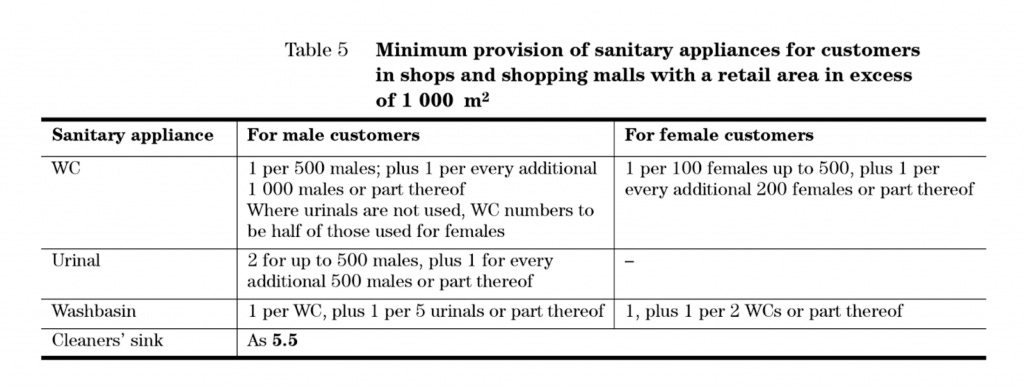
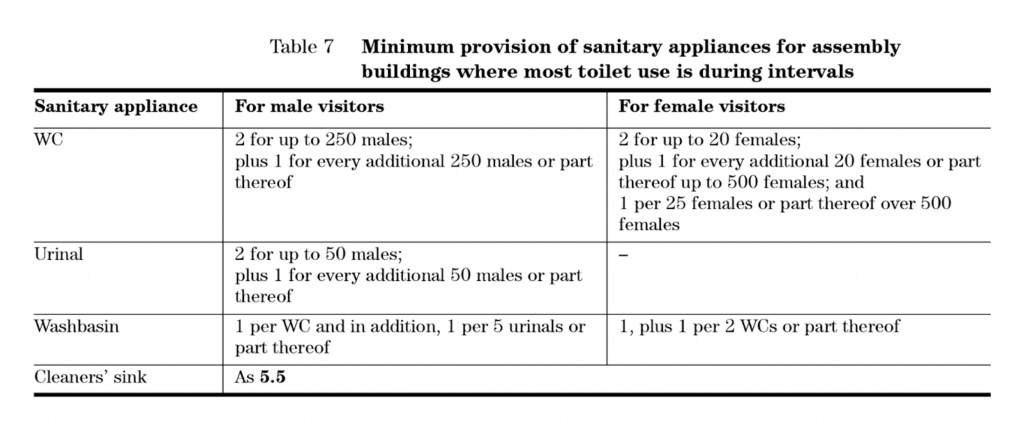
The standard sets out the number of toilets (and urinals for men) needed in different types of venue:
Buildings that meet BS 6465 will have a unisex toilet
The standard provides that in buildings other than private dwellings, toilet provision for disabled people should be as follows:
a) Where there is only one toilet in a building, it should be an enlarged wheelchair-accessible unisex type.
b) At least one wheelchair-accessible unisex toilet should be provided at each location where sanitary facilities are provided for the use of staff, customers, and visitors to a building.
In larger facilities it also recommends disabled facilities in the women’s and men’s toilets. This reflects requirements in the building codes. Older or smaller buildings may not have this range of facilities, but most larger venues will.
The standard doesn’t recommend all unisex toilets. Part four of BS 6465 is the code of conduct for public toilets. It says:
“Many men and women seek privacy, and many women and children feel safer when using single-sex facilities.”
and recommends that:
“Separate facilities for men and for women should be provided in preference to unisex facilities, wherever possible.”
Who regulates toilets?
Toilets come under regulation by local authorities (licensed venues, most offices, and retail and light industrial workplaces) or the Health and Safety Executive (government buildings, building sites, oil rigs, farms and factories), as well as building regulations. They are also affected by sector regulations, for example in educational and healthcare facilities.
Toilet facilities are designed to ensure dignity and privacy. For example, the Care Quality Commission in England says:
“People using services should not have to share sleeping accommodation with others of the opposite sex, and should have access to segregated bathroom and toilet facilities without passing through opposite-sex areas to reach their own facilities. Where appropriate, such as in mental health units, women should have access to women-only day spaces.”
Local authorities are responsible for licensing venues that sell alcohol or provide regulated entertainment, such as theatres, cinemas, and music and sports venues. Under the Licensing Act 2003 they must carry out this function with a view to preventing crime, disorder and public nuisance, promoting public safety and protecting children from harm. Applicants for licences typically have to provide plans that contain details of their toilets.
Local authorities also have powers under the Local Government (Miscellaneous Provisions) Act 1976 to serve notices on relevant business, such as those serving food or beverages, requiring them to provide “specified, sanitary appliances of such kinds and numbers as are so specified”. They typically adopt policies based on the British Standard for working out what number of facilities are needed.
All of this is straightforward. It is the reason why the claim promoted by trans lobby groups that businesses are panicking about the cost and difficulty of complying with the For Women Scotland judgment is simply not credible.
The only organisations that are struggling to comply with the Equality Act when it comes to toilets are those that don’t meet BS 6465 already (such as those that have tried to make everything gender-neutral, without considering the needs of women) and those that have made the unfulfillable promise to trans lobby groups that they will never expect staff or customers who don’t wish to use the facilities provided for their sex to use unisex facilities.
Everyone else can keep calm and carry on!