

Update from Helen
At the end of May I received a surprising email from a PR agent. It said:
“We represent Dr Helen Webberley. Dr Helen is the founder of GenderGP. We were wondering if Helen Joyce would like to debate with Helen Webberley on a platform? Initially, If your Helen was interested, I would approach a couple of well known television and radio channels, to try and organise this.”
In case you don’t know her, Webberley is a former GP who founded an online prescribing service for puberty blockers and cross-sex hormones with her husband, a retired consultant. After regulatory complaints from more cautious gender clinicians the pair faced fitness-to-practise hearings. He was struck off the medical register for “wide ranging failings” in treating young transgender patients and in prescribing testosterone for men. She kept her licence to practise after appealing against her suspension, but has since let it lapse.
Now the firm they founded, GenderGP, is registered in Singapore (although the Singaporean government has barred it from prescribing to locals because of concerns about its standards). It offers online consultations and prescriptions for so-called “gender-affirming” care – that is, hormone blockers and cross-sex hormones – issued by doctors who still have prescribing rights and then supplied privately by friendly pharmacists.
Webberley isn’t just someone whose beliefs and actions I oppose as vigorously as I am able; she has been personally insulting to me and to others who campaign against the harms of gender medicine. Some years ago she refused to be in a film simply because Stephanie Davies-Arai of Transgender Trend was also going to be interviewed. And here she is on TikTok calling me “batshit crazy”.
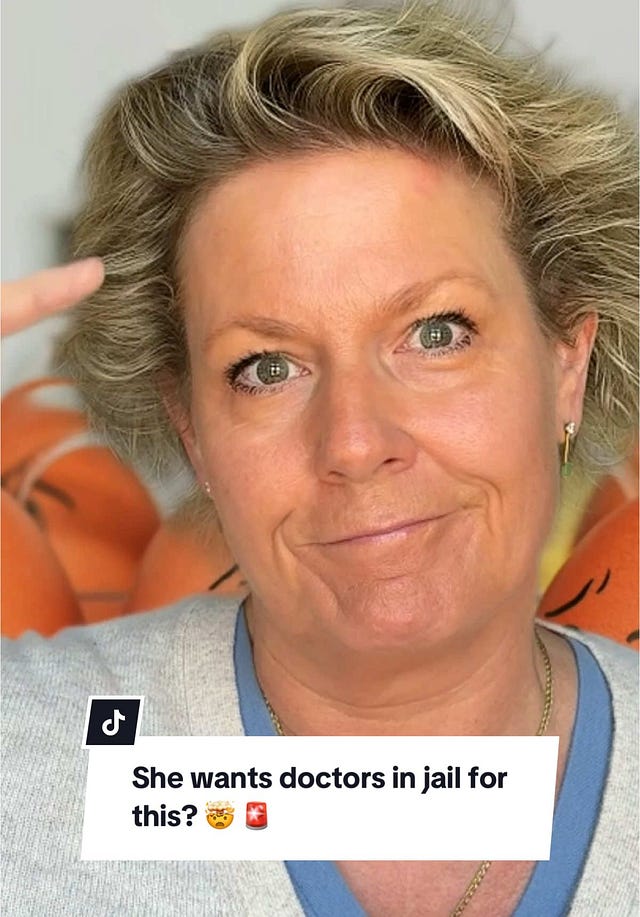
 Tiktok failed to load.
Enable 3rd party cookies or use another browser
I thought it was a setup. I thought that she and her team expected that I would refuse and that she could then crow about that publicly, saying that I was a hypocrite who claimed to believe in the importance of free speech and open debate but turned tail when given the opportunity to go head to head with someone whose position opposes mine.
At the same time, I was worried about doing anything that gave Webberley the oxygen of publicity. No matter how ridiculous and contradictory she is, and no matter how well an interviewer or debater may do in pressing her on the harms of gender-affirming care, I feared that desperate children who have become fixated on puberty blockers or cross-sex hormones as the solution to all their problems would hear nothing but a single message: “This woman will give me what I want.”
In the end, I decided to agree in principle, and see if anything came of it. Webberley is already widely platformed, for example featuring in a long and in my opinion far too uncritical interview in The Times last year. I wish that by ignoring her I could make her go away, but I can’t. At this point the only way out is through.
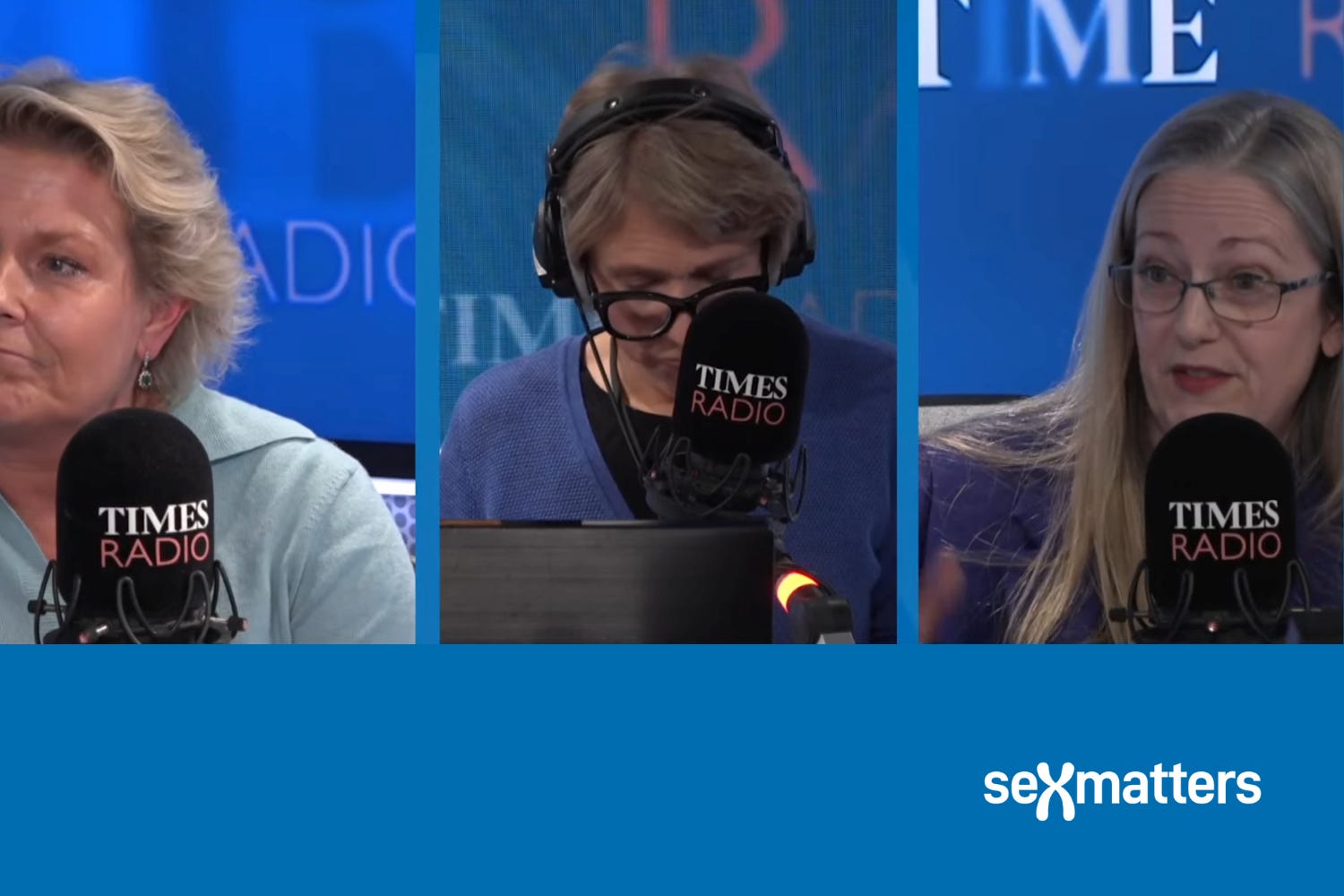
Much to my surprise, the suggestion of an interview proved to be genuine. After some back and forth about format, venue and date, Times Radio agreed to host an hour-long conversation, moderated by journalist Jo Coburn. It was broadcast live at 9pm on Thursday evening, and is available to watch back on the Times Radio YouTube channel:
I knew it would be difficult, because Webberley seems never to open her mouth without making multiple outlandishly false statements. Her speaking style reminds me of the expression “firehose of falsehood” coined to describe disinformation propagated by the Russian regime, which involves spraying out unrelated falsehoods, half-truths, misrepresentations and irrelevancies at high speed. The point is not to convince the audience but to baffle and confuse.
This technique is extremely difficult to counter because a single statement can contain a half-dozen unrelated pieces of complex nonsense, each of which would take several minutes to rebut – by which point the audience will have forgotten what you were talking about. The undirected spray also gets in the way of you making your own points, and gives listeners the impression that the whole situation is too complicated to work out what is true and what is false.
With that in mind, I’ll just pick out three things from the infuriating mess to comment on here.
The first was that Webberley wildly misrepresented the law, saying that the protected characteristic of gender reassignment gives people the legal right to live in their “reassigned” gender, meaning they can use single-sex spaces for the opposite sex (not that she put it that way; she thinks trans-identifying people are the sex they identify as – see what I mean about infuriating?). Incredibly, she suggested that the Supreme Court got the law wrong. That is a contradiction in terms: it is the highest legal authority in the land, and unless and until the government of the day rewrites the law, what it says stands. She also said that calling male people who identify as female “male” is hate speech that risks prosecution (again, I’m translating her ideological mush into reality-based language). This too is entirely false.
The second is what this reveals about what happens in the consulting room of the gender-affirming clinician. We have to presume that Webberley – and other “gender-affirming” clinicians – has told patients that they have the right to use spaces and services for their “affirmed gender”, and that anyone who doesn’t use their “preferred pronouns” risks prosecution. Knowing this makes it easier to understand why it’s proving so difficult to get the For Women Scotland judgment to stick. That patients are likely to have been given these false assurances also raises questions about whether their consent to hormones and surgeries, which they presumably regard as part of their journey to “changing gender”, is truly informed.
The third is that she revealed possibly more than she intended about how the hard core of gender-affirming clinicians are responding to the ban on puberty blockers (gonadotropin-releasing hormone agonists; drugs that interrupt the hormonal signals that trigger puberty). She said other drug protocols were replacing puberty blockers for use in young teenagers. Although she didn’t name them, an informed guess is that these clinicians are prescribing testosterone to girls around the onset of puberty, and a combination of spironolactone (a testosterone suppressor) and oestrogen to boys.
In other words, it seems that some clinicians are skipping the puberty-blocking pause with patients and proceeding straight to cross-sex hormones, which have irreversible effects, with patients who are likely to be no more than 12 or 13. This isn’t just shocking; it may be of interest to medical regulators.
Helen Joyce
The government is “trying to rewrite For Women Scotland”
That was the judge’s comment on the convoluted arguments put forward in court by the legal counsel acting for the Minister for Women and Equalities in the case of Good Law Project and others v Equality and Human Rights Commission. The Supreme Court judgment made it clear that this kind of reasoning is wrong, and undermines the basic duty of employers and service providers to provide single-sex facilities for women. So why is the government making these arguments?
Happy World Toilet Day!
We celebrated with a detailed analysis of the British Standards for sanitary installations, as requested by Mr Justice Swift when Sex Matters CEO Maya Forstater was giving evidence in Good Law Project v Equality and Human Rights Commission.
Withdraw this unlawful civil-service policy
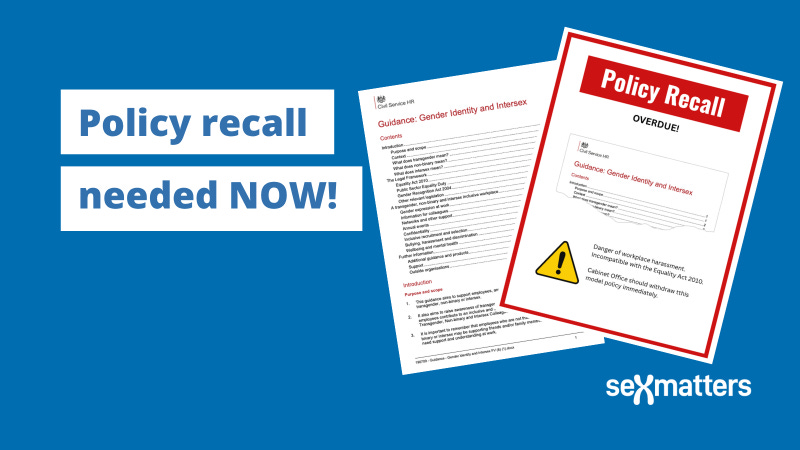
Government departments are still using a model policy that allows employees to access opposite-sex workplace toilets, even after a court case about this resulted in a six-figure payout and several departments promised to introduce a new policy by the end of 2024. We’ve asked the head of the civil service to either state that the actions authorised by the current policy are lawful (our letter explains why they are not) or withdraw the policy immediately.
Toilets matter

Sex Matters intervened in Good Law Project v Equality and Human Rights Commission and brought in three witnesses to give evidence about why toilets matter. Michelle Shipworth shared her painful personal experience of a traumatic assault in a women’s toilet. Physiotherapist Elaine Miller focused on women’s biology with evidence based on her expertise in pelvic floor dysfunction. And Maya Forstater explained why clear, lawful guidance is urgently needed after years of confusion, misinterpretation and pressure have undermined women’s rights to privacy and dignity.
In the news
The leak of the EHRC’s draft code of practice to Geraldine Scott for The Times dominated news headlines this week. In response, Samuel Montgomery, Gabriella Swerling and Ruby Cline for The Telegraph quoted Maya Forstater as saying that it seems to be common-sense guidance which brings the code back into line with the law, and will help businesses stand up to activist demands. Fiona McAnena and Maya were interviewed by Times Radio on the story, and Maya and Helen Joyce were also interviewed on Talk TV.
Sex Matters’ letter to civil service head Sir Chris Wormald, warning that he must either defend or withdraw the Cabinet Office’s problematic 2019 gender-identity model policy, was covered by Martin Beckford for the Daily Mail and Geraldine Scott for The Times. Maya said that the policy gets the law wrong and has harmful impacts on the working life of half a million civil servants, and that Sex Matters will consider next steps in terms of legal action if it is not withdrawn. Geraldine also quoted Maya in her story revealing that the Cabinet Office referred to the 199 Days Later march as an “anti-transgender rights” protest.
Samuel Montgomery for The Telegraph revealed new plans by Guy’s and St Thomas’ NHS Foundation Trust to fly the transgender and so-called “Progress” Pride flags from the roof of its building on the banks of the Thames, opposite the Houses of Parliament. Fiona said that these flags represent a campaign that has relentlessly advocated for harmful surgeries, puberty blockers and cross-sex hormones, not to mention injury-causing breast-binders, and this kind of activity has no place in the NHS.
News that NHS Fife chief Carol Potter is resigning after presiding over the board during Sandie Peggie’s disciplinary proceedings and employment tribunal was covered by journalists including Andrew Learmonth for The Herald, Claire Warrender for The Courier, Dan Barker for the Daily Mail, and Marc Horne for The Times. All quoted Maya as saying that responsibility for ensuring that all policies are lawful and do not result in harassment or discrimination rests ultimately with the chief executive, and in NHS Fife the chief executive failed in this essential task.
Helen’s high-profile debate with Helen Webberley, hosted by Jo Coburn on Times Radio, was covered by Sanchez Manning for The Times, who reported that Webberley said she would give puberty-blocking drugs to children aged nine and younger.
Want to get our weekly email update? Sign up now!