

Update from Maya
The news on 29th April that the High Court had overturned the £585,000 fine imposed by the Office for Students (OfS) on the University of Sussex for breaching free-speech regulations was hugely disappointing.
I have written to the chair and chief executive of the OfS calling on it to appeal the judgment, which Sex Matters believes is wrong in law. Our argument has also been published in an article in Times Higher Education.
In short: there is a huge Equality Act-shaped hole in the middle of the judgment.
The OfS started its investigation in 2021, after Professor Kathleen Stock was hounded out of the university (you can read the whole history here). The OfS said: “It’s important to stress that this case – and the OfS’s investigation – is not about the substance of ongoing debates around sex and gender.”
We say it couldn’t be more wrong.
What happened at the University of Sussex cannot be understood unless you recognise that when activists put pressure on the university to adopt a policy banning “transphobic propaganda” in 2018, what they wanted banned were statements that straightforwardly reflect the definition of sex in the Equality Act. What Stock had been targeted for in the first place was pointing out the problem with what those activists meant by “transphobia”.
A large part of the judgment hinges on arguments about the meaning of the terms “reasonably practicable” and “freedom of speech within the law” when assessing whether or not the university had breached its obligation to “take such steps as are reasonably practicable to ensure that freedom of speech within the law is secured”.
It was here that everyone in court appeared to have a collective attack of amnesia. The judgment reads as if my employment appeal tribunal case, and the cases of Jo Phoenix v Open University, Rachel Meade v Social Work England, Roz Adams v Edinburgh Rape Crisis, Higgs v Farmor’s School and all the rest had never happened. It completely overlooks the detailed legal framework for balancing freedom of belief and speech with protecting people against unlawful harassment.
The answer to what is “reasonably practicable” for a university to do is the same as for any other institution: set policies in line with the Equality Act, train staff on those policies and enforce fair and robust disciplinary processes.
So when campus activists started agitating for the University of Sussex to adopt a sweeping new policy in time for Trans Day of Remembrance, it should have just said: “No thanks, we’ve already got a policy that aligns with the Equality Act and covers all nine protected characteristics.”
Perversely, the university cited the fact that it already had a high-level policy protecting free speech and academic freedom when defending itself in court, even though in practice that high-level policy did not stop the university from adopting the activists’ charters.
A further twist in the tale is that the policy Sussex adopted in 2018 came almost word for word from one written by Equality Challenge Uni (now Advance HE) that was in turn based on one adopted by the Association of Colleges in 2005, which was drafted by Socialist Workers Party activist David Renton. Tribunal-watchers will remember that Renton is now a barrister and was Allison Bailey’s roommate at Garden Court Chambers. He refused to express solidarity when she was discriminated against and harassed for expressing views that are in line with the Equality Act. Instead, after overhearing Allison talking on the phone about why trans-identifying men should not be in women’s prisons, he told a colleague that her view seemed “a million miles away from chambers values”.
In 2023 the University of Essex published a paper by Renton and two academics, titled Universities’ Legal Obligations in the Context of Trans Inclusion, Trans Equality, and ‘Gender Critical Activities on Campus. This claimed: “The decision in Forstater has been widely misunderstood and it is worth emphasising that the Appeal Tribunal in that case accepted that Ms Forstater had a protected opinion, does not mean that the manifestations of that opinion were protected.”
It is shocking how a tiny coterie of motivated and persistent people has managed to corrupt the governance of large, expensive and important institutions by promoting a misreading of the Equality Act. Anyone who wants to save the Equality Act and these institutions needs to drag them back to reality.
Maya Forstater
City firms flout sex-based rules
Our new report exposes widespread non-compliance
In this week’s episode, Maya and Helen discuss our latest report, Sex-based rights in the City, which uncovered the widespread failure of the financial sector to comply with the Supreme Court ruling.
Not one of 15 financial institutions contacted replied clearly stating that it provided single-sex toilets, as required by workplace regulations, and restricted access to people of that (biological) sex.
Maya and Helen discuss how we got here, the experiences of those working in the sector and what can be done to bring employers into compliance.
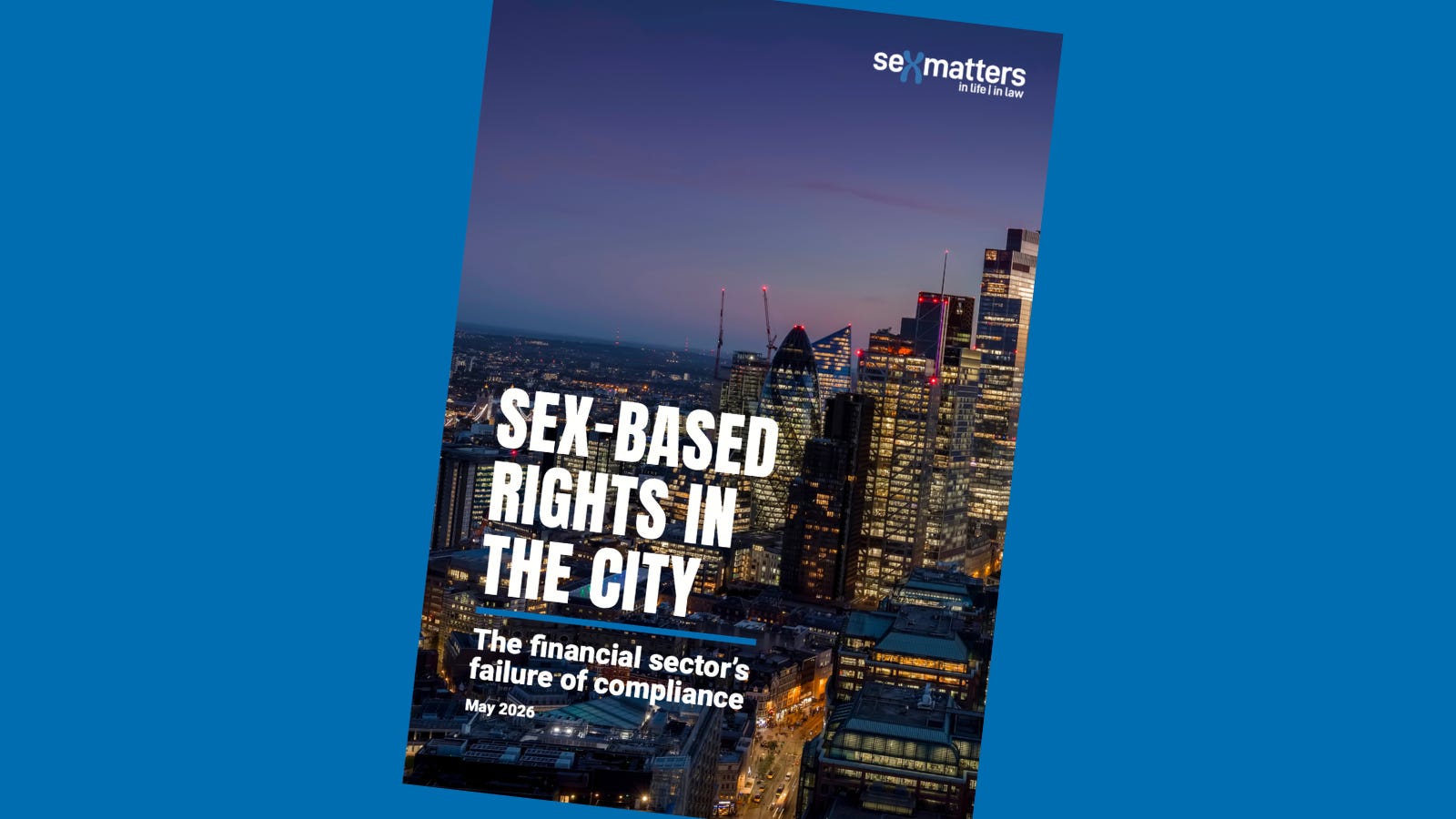
Our new report finds that despite usually taking legal compliance seriously, firms in the financial sector failed to update their policies on access to single-sex spaces in line with the 2025 Supreme Court judgment.
In the news
Eleanor Harmsworth for The Telegraph covered Sex Matters’ report on sex-based rights in the financial sector as an exclusive, revealing that none of the 15 companies contacted could confirm that they are compliant with the Supreme Court ruling. The report quotes female staff concerned about this as feeling angry, unvalued and cynical, and points out that on any other topic, a Supreme Court judgment would see City firms rushing to ensure all policies were brought in line with the law.
Maya wrote for Times Higher Education on the High Court judgment in the University of Sussex’s case against the Office for Students. Sussex was successful in overturning the record fine imposed on it for failing to uphold free speech on campus and academic freedom, after an investigation prompted by the hounding of Professor Kathleen Stock. Maya argued that the verdict wrongly overlooked the Equality Act’s role in determining what universities can be expected to do to protect free speech.
Writing for The Telegraph, Cameron Henderson broke the news that education provider Pearson is teaching GCSE pupils that it is “discrimination” and “inequality” to provide toilets only for men and women. Maya said that single-sex facilities ensure safety, dignity and privacy for everyone, as well as preventing discrimination against women, who are harmed more than men are by having to share toilets and changing rooms with the opposite sex.
Helen wrote for The Critic on her experience of both making crime reports and being the subject of them. She contrasts the criminal justice system’s deferential treatment of trans-identifying former police officer Lynsay Watson, who makes serial allegations about gender-critical people and seeks judicial review when police decline to prosecute, with the way allegations of criminal harassment against him are slow-walked or ignored.
If you’d like this memo in your inbox every Friday at teatime, join our mailing list now.
Sex Matters survives on your support.
Without it, we simply wouldn’t exist.
Sex Matters can deliver essential research and analysis, help shape the debate, and empower people with clear, published guidance on their rights – but only with your support. Please contribute what you can to keep us going.