


Sex Matters recently challenged the Director of Public Prosecutions (DPP) in the High Court over Crown Prosecution Service (CPS) legal guidance on deception as to sex. Deceiving a partner about biological sex can mean there is no legally valid consent. But this guidance (which was previously called “deception as to gender”) conflates the concepts of sex and gender identity.
The case was heard by the President of the King’s Bench Division, Dame Victoria Sharp DBE, and the Honourable Mrs Justice Heather Williams. On 25th September 2026 the High Court handed down its judgment dismissing our claim, but making stinging criticism of the CPS guidance.
The CPS guidance is one of many pieces of government guidance that has been influenced by years of transactivist lobbying. Sex (being male or female) is an objective fact that matters when it comes to sexual consent. We think that “gender identity”, which is a subjective feeling or the performance of an identity, does not.
We brought this case to ensure that prosecution guidelines do not undermine justice and that public authorities understand that the reality of sex and the idea of gender are not interchangeable.
Whatever happens next, our action has already gone a significant way towards ironing out confusion and making clear that the DPP must stop taking dictation from transactivists.
Key takeaways
Important revisions: After we initiated legal action, the DPP agreed to amend and update its guidance.
CPS guidance criticised: The judges called sections of the guidance that the DPP defended “surprising”, and overly sympathetic towards rape suspects, noting that the text presented suspects as if they were vulnerable persons rather than suspects facing criminal allegations.
Consent is legally complex: The High Court stopped short of declaring the guidance unlawful, but the judges acknowledged that the criminal law concerning consent obtained by deception remains complex.
Judicial review appropriate: The High Court rejected the DPP’s argument that the drafting of the Rape and Sexual Offences prosecution guidance was not the kind of thing that could be challenged by judicial review.
Standing confirmed: The court recognised Sex Matters’ legal standing to bring this challenge, noted our expertise on the legal boundaries of sex and gender and thanked our legal team, Sarah Vine KC and Chris Knight KC (as well as the other side’s legal team) for the “very high quality of the submissions”.
Our challenge focused on two legal issues. The first was that the guidance appears to encourage prosecutors to consider a trans identity as a potential “get out of jail free” card in a case of consent obtained by deception about the suspect’s sex. The second was that it claims that deceiving a sexual partner about “gender identity” could, in itself, negate consent, even when the person is honest about their sex.
The outcomes were:
The court strongly criticised the guidance for the way that it presents trans identity as a potential mitigation in a case of sex by deception. But it did not think this bad drafting was enough to make the guidance unlawful.
The court disagreed with us on the legal question of whether deception about gender identity could vitiate consent (it said this couldn’t be ruled out).
Guidance to be improved
Although the court dismissed our challenge, by bringing the case Sex Matters forced the DPP to make changes to the CPS guidance. As the court noted, our pre-action correspondence led to the DPP conceding several points and agreeing to drop some statements from the guidance rather than defend them. The DPP is due to publish a new version of the guidance following our action.
The currently published guidance says “prosecutors should address trans victims, witnesses, suspects and defendants according to their affirmed gender and name, using that gender and related pronouns in all documentation and in the courtroom.”
We said that this erodes legal protections for victims of sexual assault and may result in unfairness.
The DPP accepted this and pledged to amend the guidance to say that preferred pronouns should be used “save where to do so would lead to unfairness and, if in doubt, the matter should be raised with the Court in the absence of the jury”.
The guidance included under its list of factors to be considered:
Whether the suspect’s gender identity was different to their sex at the time of the alleged offence.
Whether the suspect had concerns over any potential adverse impacts of revealing their sex.
Evidence that the complainant was exploring their own sexuality at the time of the alleged offending, if it is consistent with them being aware of the suspect’s sex, gender identity or both.
The DPP agreed to remove these irrelevant considerations when we challenged them. It also agreed to edit a section that suggested that having a gender-recognition certificate might be relevant to whether a crime was committed.
It said that following the For Women Scotland judgment it would change all references to sex to “biological sex” and add new text making clear that the Gender Recognition Act should not be read as imposing recognition of a person’s acquired gender in private, non-legal contexts.
You can see the edits already agreed in this exhibit from the case.
Judgment criticises CPS sympathy for rape suspects
In relation to whether a declared trans identity could help someone avoid prosecution for deception as to sex, the judgment is sharply critical of the guidance. It agrees with our criticism of a particular passage as unusually sympathetic for a document of its kind, which concerns suspects in a rape case.
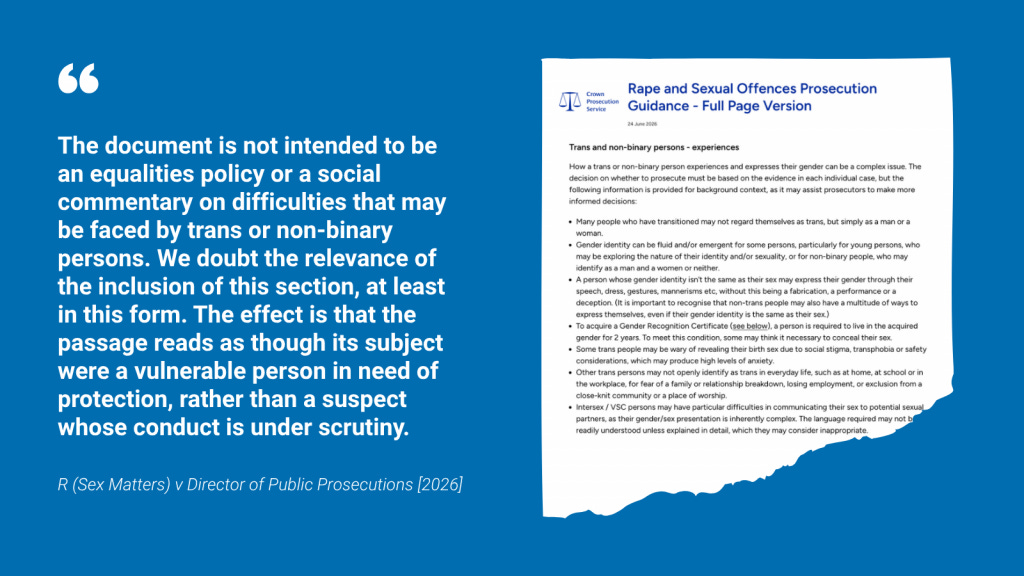
The guidance appears to encourage prosecutors to consider that a trans person’s belief in the authenticity of their identity is a relevant point against charging them in a case of sex by deception.
The court said this section was “surprising” given that the guidance is intended for prosecutors considering whether a suspect should be charged with a crime, and suggested that “the DPP may wish to reconsider” it:
“The document is not intended to be an equalities policy or a social commentary on difficulties that may be faced by trans or non-binary persons. We doubt the relevance of the inclusion of this section, at least in this form. The effect is that the passage reads as though its subject were a vulnerable person in need of protection, rather than a suspect whose conduct is under scrutiny.”
The judgment, while stopping short of declaring the guidance unlawful, sends a clear message that a trans identity is not a loophole that can be used to excuse abuse of consent. We have written to the DPP to ask how it intends to respond to the court’s criticism.
Deception as to gender identity
Although the court was critical of parts of the guidance, it said that it couldn’t rule out that deception about gender identity could itself vitiate consent.
The legal test depends on whether a deception is closely connected to the nature or purpose of the sexual activity, or whether it is part of the “broader circumstances” around the relationship.
The case of Justine McNally, in which a woman posed as a man to get another woman into bed, established that honesty about a person’s sex matters to consent.
In the “SpyCops” case of Monica, an undercover police officer who lied to a woman he was surveilling, posing as a fellow environmental activist throughout a six-month relationship, was found not guilty of sex by deception. In the case of Lawrence, in which a man lied about having undergone vasectomy, the courts said no crime was committed. Undisclosed HIV status has also been found not to vitiate consent.
No appellate court has so far considered deception in relation to gender identity.
During the case the DPP raised the example of R v H, a first-instance case in which the defendant, a woman who had claimed to be “living as a man”, but was actually a lesbian pleaded guilty. The DPP said this was a case where deception as to gender identity had negated consent. We said it was a wrongful conviction and illustrated a concerning risk of over-prosecution of trans-identifying and gender questioning people.
R v H
JH is a woman who pleaded guilty to two counts of sexual assault of another woman (for oral sex) and one count of assault by penetration. She was sentenced in September 2021 to 24 months’ imprisonment suspended for two years.
JH and GF had a brief relationship, which began online. GF identifies as heterosexual. JH sent GF photographs in which she presented as male in appearance and suggested she was a post-operative “female-to-male” transsexual.
On two occasions JH performed cunnilingus on GF and on one occasion they also had penetrative sex with JH entering GF from behind. GF believed she was being penetrated by a constructed penis. It subsequently emerged that JH had not had surgery, was still living as a woman and was probably using her fingers. GF said she would never have had a sexual relationship at all had she known the true situation and that she felt betrayed and violated.
JH pleaded guilty (we presume advised by a legal representative who had read the CPS guidance). We argued that while JH was rightly convicted of the offence of assault by penetration because she had penetrated GF with something other than the promised pseudo-penis, JH had been wrongly convicted in relation to giving oral sex. In this case GF knew both the physical nature of the sexual act and the sex of the person performing it. We said that there was no failure to gain consent here.
However the court said that our distinction between the two acts was “highly artificial and unduly technical” and that JH’s “gender identity” mattered to GF’s consent.
R v H is not an authority from a higher court. But High Court in our case said: “Nonetheless, it provides a useful example of how a deception as to gender identity could negate the complainant’s consent.”
We think this is wrong in law. Gender identity is not close enough in purpose or nature to the sexual act to vitiate consent. It is subjective and can be fluid, and may be understood differently by different people, including judges.
The court confirmed that Sex Matters is a charity that “has a genuine interest in and particular experience in relation to the boundaries of sex and gender”. It said that the law on consent is an area “that would benefit considerably from consideration by the Supreme Court in an appropriate case”.
We are considering our next steps with our legal team.
“The guidance appears to encourage prosecutors to consider that a trans person’s belief in the authenticity of their identity is a relevant point against charging them in a case of sex by deception.”
In effect they would like to provide a no-consequences “not criminally responsible by virtue of the authenticity of the attacker’s self delusion” yet at the same time any discussion of repathologizing gender dysphoria is bigotry.
If a similar case were made for a killer who “really” believed they were slaying a demon, we would in Canada have that person committed to indeterminate confinement in a secure mental health facility, until their mental health has been restored; why would we not do the same for a delusional rapist?