

Update from Maya
It has been a hot and busy week. On Sunday I spoke alongside some brilliant women on the opening panel of the Women’s Rights Network conference. The question we were asked was whether the social contract between women and the state is broken. This is what I said.
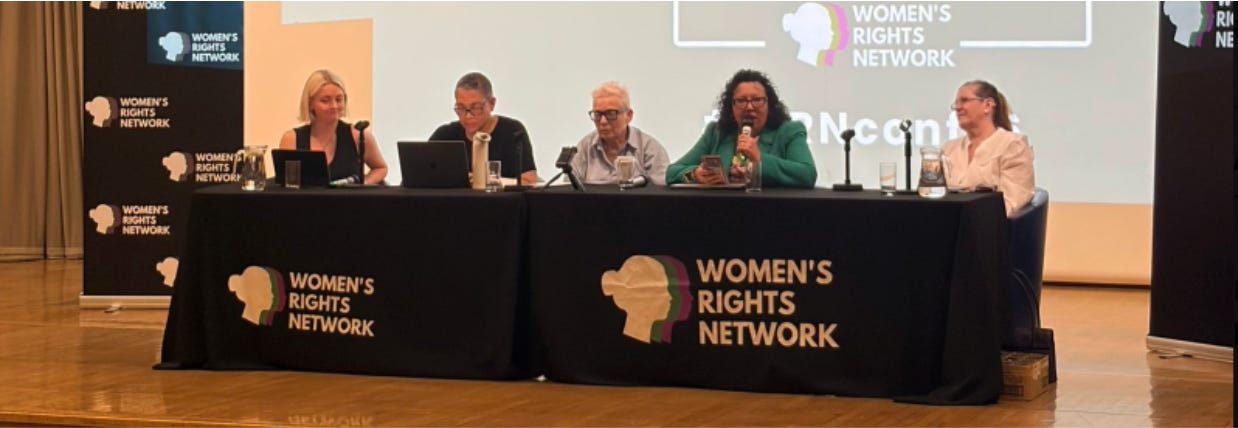
Left to right: Emma Hartley moderating, Akua Reindorf KC, Professor Jo Phoenix, Maya Forstater and Susan Smith
My answer to the question we have been asked is yes: not because women have lost legal protection, but because for years the state, its regulators and the professionals and charities it recognises have misinterpreted and failed to uphold the law.
Worse than that, the law that was meant to protect us was used against us. The social contract rests on a simple principle: citizens accept the authority of the state because the state applies the law fairly, consistently and equally. We decide our laws and policies through democratic debate, protected by freedom of speech, and we have institutions capable of being held to account to deliver those laws and policies.
That is what being “worthy of respect in a democratic society” means.
But if you redefine the words that laws rely on, if you make truth too “offensive” to speak, you undermine both democracy and the rule of law. You turn systems that are meant to protect into systems that do harm.
And that is what happened. Men were placed in women’s prisons; men were allowed into women’s changing rooms, counselling services and refuges; men competed in women’s sport. Meanwhile women who objected were labelled bigots and made to fear for their jobs.
My legal case won back protection for freedom of speech. For Women Scotland dragged the Scottish Government all the way to the Supreme Court to hold it accountable for its failure to uphold the Equality Act.
The Supreme Court carefully examined the law and concluded something extraordinary and powerful. It said that the provisions on sex discrimination as a whole “cannot properly be interpreted as also extending to certificated sex without rendering them incoherent and unworkable”.
Imagine if the Supreme Court had delivered such a stinging ruling that wasn’t about harm to women, but about something that actually mattered – like football. There would be inquiries, resignations, apologies.
Instead, after years of women fighting this case all the way to the Supreme Court, no one has said sorry, no one has been held accountable, no one has lost their job.
Instead we have been told, for more than a year, that everyone is “waiting for guidance”.
And when the guidance finally arrived, instead of giving duty bearers a simple message – that if a service is for women, that means women, and if people try to break the rules you can tell them to leave – it introduced new confusion, suggesting that sex should be treated as “special category” data.
We believe that is legally wrong, and it risks taking us back towards gender self-identification by another route. That is why organisations like Sex Matters are still in court and will keep going back to court.
We have challenged police policies on searching.
We have challenged the Crown Prosecution Service over guidance on the crime of sex by deception.
We have a hearing in November on the Hampstead ponds, a case about single-sex services..
And there will be more litigation to come.
It is a scandal that more than a year after the Supreme Court clarified the law, campaign groups like Sex Matters and For Women Scotland are still having to take public authorities to court to force them to follow the law.
So yes, the social contract between women and the state has been broken. Naomi Cunningham, who unfortunately couldn’t make it today, said at the end of her cross-examination of Emma Dunn, the chair of the civil service a:gender network, this week: “Your position is like that of an invading army that has subdued the local population.”
I don’t think she is quite right here. This is not an invading army. This is corruption of the state. It is embedded.
What we feel and see this summer is a corrupt system reasserting itself. It runs in well-worn grooves, responding to still-strong incentives and refusing to budge. It was developed during 15 years in which the law was misrepresented at the highest levels and it is still locked into place in our institutions.
Some people think that what we are fighting for is trivial – “just toilets” or “just pronouns” – or that it is “just a few people”. But more than these apparently minor matters are at stake. What is at stake is the integrity of the police and the courts, the system of safeguarding built on hard-learned lessons, civil-service impartiality, the governance of organisations. It’s 43% of GDP, people who are paid with our taxes – government ministers, public bodies, regulators, officials – who respond rationally to corrupted incentives and now see it as in their interest to ignore the law or wait for someone else to take responsibility.
This is how democracy fails. It is terrifying to witness.
We cannot ask one political leader, one judge or one official to see it all. We cannot hope for a grand commission of inquiry of the great and the good to unpick it all. And that is frustrating. But we all can use our voices and whatever power we have to demand that institutions and the people within them do their jobs.
People shout at me: “Why don’t you repeal the GRA?” The answer is that I can’t – and even if I could, that is not what is holding this corrupt system in place. At this point it is self-supporting and self-reinforcing.
But we can still find and build levers that work. Sometimes that means going to court. Sometimes it means standing your ground and taking up space. Sometimes it means complaining. Most of all it means refusing to give up and give in, and finding like-minded others.
Akua Reindorf says that “the judges will save us”, and that is certainly part of the story. The other powerful thing is ordinary people refusing to lose hope and refusing to accept that the social contract is irreparable.
Every one of you here is standing up in your towns and cities, in your workplaces and the organisations you are connected to. And every one of you here is connected through local groups and networks, and that is incredibly powerful. This is why I say the social contract has been broken but it doesn’t have to stay that way.
Victory for women’s sports in America
Kim Jones of ICONS on the legal fight for fairness
In this week’s episode, Fiona McAnena is joined by Kim Jones, co-founder of the Independent Council on Women’s Sports, to discuss the landmark US Supreme Court ruling which reaffirmed that Title IX protections are based on biological sex.
In January, the Supreme Court heard two cases that required it to adjudicate on what “sex” means in US anti-discrimination law. Idaho and West Virginia were defending state laws that restrict female athletics to those born female. Acting in the public interest and in pursuit of its charitable aims, Sex Matters provided an “amicus curiae” brief supporting the two states.
Fiona and Kim break down what the decision means, why it matters and what comes next in the legal battle to protect safe, fair sport for women and girls.
Sex by deception: we challenge the CPS

This week, Sex Matters was in the High Court challenging a Crown Prosecution Service policy which suggests that whether someone identifies as trans may be relevant to whether they have committed the crime of “sex by deception”.
Find out more
We’re taking the CPS to court over sex by deception
Media coverage
Lawyer Monthly (Richard Sanders) previewed the case, outlining our position that only biological sex is legally relevant to the question of intentional deceit capable of vitiating consent.
Grading new schools guidance
The government published the final version of its statutory safeguarding guidance, Keeping children safe in education, which comes into force in September and says that no child may be permitted to use single-sex facilities designated for the other sex.
Find out more
Keeping children safe in education: better than before
Media coverage
This was covered by The Times (Geraldine Scott), The Telegraph (Daniel Martin) and the Daily Mail (Eleanor Harding), with Maya quoted as saying it was a step forward after 15 years of unbridled transactivism in schools, but that its suggestion that schools may be able to accommodate “social transition” was deeply concerning.
In other news
Health Secretary James Murray told Parliament that he is “uneasy” about the puberty-blocker trial but said it should proceed “carefully” under intense scrutiny. The Daily Mail (Shaun Wooller) quoted Helen as saying Murray should differentiate himself from his predecessor, Wes Streeting, by listening to his conscience – and to an increasing number of concerned medics and a large majority of the British public – and call a halt to the trial.
Girlguiding UK has appointed a trans-identifying male burlesque dancer and former Guide Leader to its steering committee on trans inclusion, as revealed by the Mail on Sunday (Janet Murray and Nicholas Pyke). Helen was quoted as saying that those responsible for girls’ safety must be clear-eyed about male sexuality, including male paraphilias such as erotic cross-dressing.
Monica Kurnatowska, who volunteers as a solicitor for Sex Matters, wrote for the Law Society Gazette on single-sex spaces and the limits of inclusion, rebutting an article by solicitor and Stonewall trustee Steven Friel, who had compared sex-based rights to the historical exclusion of women from the legal profession and gay men from the armed forces.
Former Ulster Unionist Party leader Doug Beattie expressed concerns that proposed conversion-therapy legislation for Northern Ireland goes significantly beyond initial proposals, which he supported in principle. Comparing the legislation, the News Letter (David Thompson) referred to Sex Matters’ warning that the weak evidence underpinning the UK Conversion Practices Bill is no basis for new criminal law.
If you’d like this memo in your inbox every Friday at 5pm, join our mailing list now.
Sex Matters survives on your support.
Without it, we simply wouldn’t exist.
Sex Matters can deliver essential research and analysis, help shape the debate, and empower people with clear, published guidance on their rights – but only with your support. Please contribute what you can to keep us going.
What rights are men deprived of?
The social contract will be mended when there is also a Men’s Rights Network.