

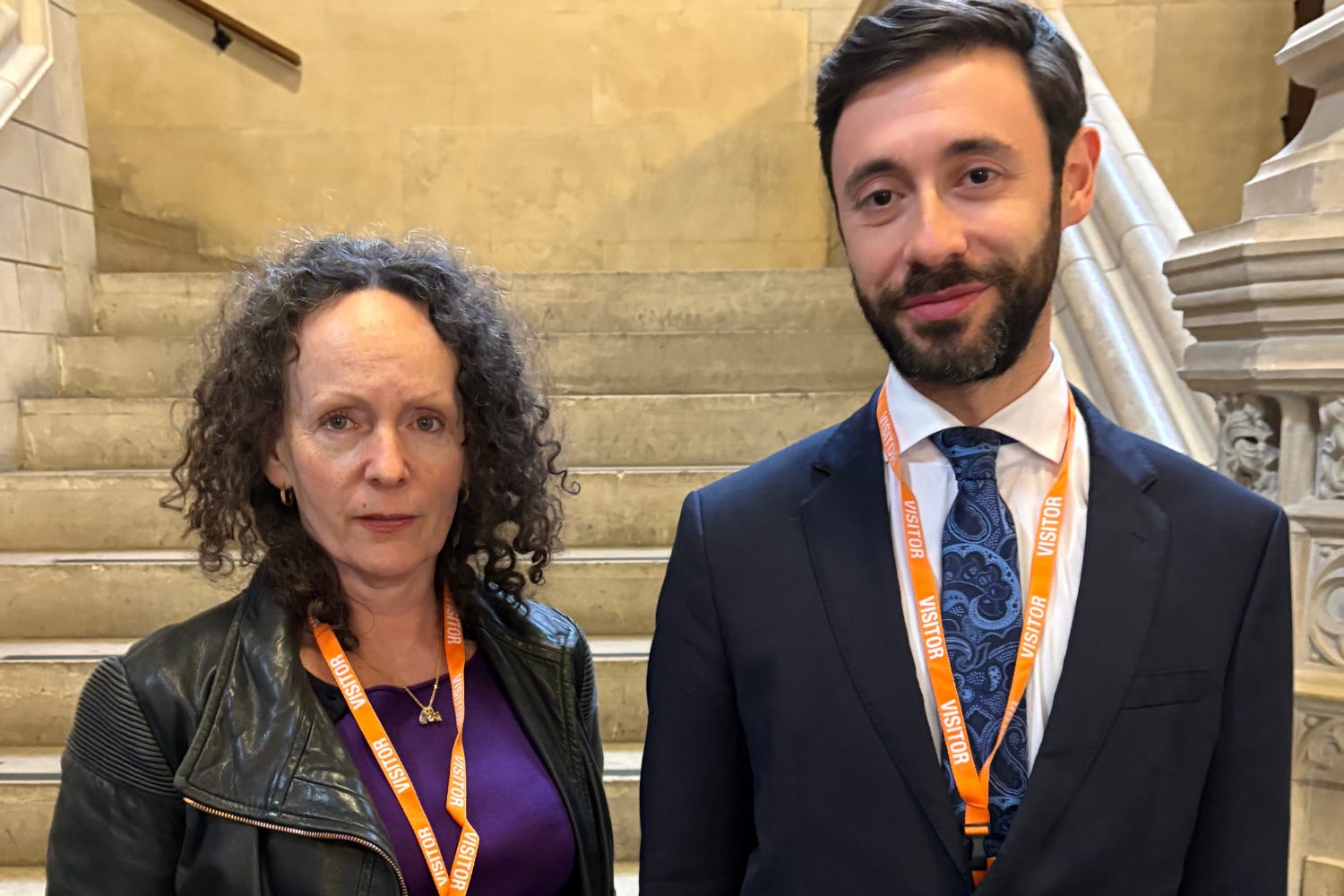
Our director of campaigns Fiona McAnena with James Esses before the debate
More than 146,000 people signed a parliamentary petition set up by James Esses calling on the government to cancel the puberty-blocker trial and safeguard vulnerable children. This led to a Westminster Hall debate on Monday 23rd March.
These debates are the chance to discuss an issue. A government minister is present to hear and respond to the debate and there is a vote at the end, but there is no decision to be made.
Read a full transcript of the debate or watch it on parliamentlive.tv.
Opening comments
The debate was opened by the chair of the parliamentary petitions committee, Jamie Stone MP. He said:
“The petition raises two main areas of concern: the possible long-term medical side effects of puberty blockers, and whether meaningful consent can ever be obtained from a child or adolescent.”
Despite this, he sought to balance the horror of healthcare disasters like that experienced by Keira Bell by citing another transitioner whose experience with puberty blockers, he said, was “profoundly positive” and who had “experienced no negative health outcomes”. He said that:
“For her, being forced to undergo male puberty would have been the greater trauma. She is one of many who report that their lives have been significantly improved by timely support.”
Four MPs intervened during the opening speech, two Labour and two Conservative, all with pithy points for the petition. Tonia Antoniazzi pointed out that the survey being used in the “Pathways” trial asks questions like: “Have your parent(s) treated you fairly?”. She wondered how her son aged 11 would have answered that. Since any child at that age would probably say No, she felt the questions were not fit for purpose.
Graham Stringer challenged Stone’s framing of the issues as complex, saying:
“It is actually quite simple: we should not be experimenting on children, particularly as we cannot do double-blind experiments. Those are two fundamental reasons why these so-called experiments should not go ahead.”
Stuart Anderson said that his own children constantly changed their minds about things, and that he could see no justification for experimenting on children:
“What might be a short-term solution could become a permanent solution that people often grow to regret.”
Sir Julian Lewis asked about the data from all those children previously treated at the Tavistock’s Gender Identity Development Service (GIDS), saying surely no more children should be treated with these drugs until that data had been explored.
Twelve MPs spoke for the petition
Speeches from backbenchers were limited to two minutes each. This meant there really could be no debate, because speakers short of time refused to give way to interventions. Twelve spoke for the petition, against the trial going ahead, and six spoke against the petition and for the trial.
For the petition, David Smith said that in the “Pathways” trial:
“Parents are being asked to consent to a potentially life-altering intervention to their children in the absence of a life-threatening condition, based on an unreliable diagnosis with an unknown trajectory.”
Rebecca Paul pointed out the flaws in the ethical committee process that had signed off the trial. Rosie Duffield spoke about the punishment meted out to whistleblowers who had expressed concern about the use of puberty blockers at GIDS over many years.
Jonathan Hinder said:
“Children of primary-school age cannot possibly give consent to these life-changing decisions. When they become adults, many of them will look back on what was done to them and ask, ‘How did this happen to me? How did the Government do this to me?’”
Carla Lockhart, who said she had met Keira Bell, pointed out that minors are not allowed to drive, get married, buy alcohol or own a gun, and that for most puberty would naturally resolve gender dysphoria. Iqbal Mohamed quoted the statistics on this, saying:
“They mean that the government are choosing to prioritise the interests of between five and 90 of the 226 children involved in the clinical trial at the expense of deliberately harming between 135 and 203 children, who will eventually come to terms with their birth sex.”
Joy Morrisey said the diagnosis is subjective, based on how the child feels, asking:
“Can the long-term risk of medical intervention be justified by such a vague diagnosis?”
Sarah Pochin said:
“Last week, I hosted a roundtable about the indoctrination of our children in schools on this very subject, and I heard horrific stories from isolated parents whose children were lost to them because of brainwashing and the fantasy world they had been taught about at school.”
Jim Allister pointed out how the feelings of adolescents fluctuate, making them among the most vulnerable and in need of protection.
Rebecca Smith drew on her experience as a “corporate parent” to flag the over-representation of looked-after children (those in the care of a local authority, living with foster parents or in residential homes) in the GIDS patient group, and pointed out that most of the girls were lesbians.
Gregory Stafford said:
“When the evidence is weak, the risks are real and the patients are children, pressing ahead is not leadership, but recklessness.”
Six spoke against the petition and for the trial
The main defence of the trial was that Dr Cass had recommended one, with three MPs suggesting that pausing the trial was a political move, not justified by the evidence. They pointed out that this trial had gained ethical approval and that no new clinical information has emerged since the Cass Review.
Carla Denyer and Dr Scott Arthur talked about meeting trans-identifying constituents or their parents, who expressed their regret that puberty blockers had not been available. Others talked cheerfully about “trans people”, with no acknowledgement of concerns about what “trans” means, how it might be determined in a child, or the historical evidence of desistance among most children claiming to be trans.
Alex Sobel quoted a constituent who had told him: “To be a true ally you must support all trans people and their needs, not just adults.” He said that politicians should not meddle in medical decisions, then cited the World Professional Association for Transgender Health (WPATH) as “international best practice” and asked the minister for health “to meet advocacy groups such as TransActual”.
Two of these MPS said it was important to “do no harm” – and that making children wait for puberty blockers was harmful. To gasps of astonishment from the public gallery, Rachel Taylor, arguing that the trial must go ahead, said:
“We cannot afford to sacrifice the future of vulnerable young people on the altar of ideology.”
Heated exchanges about hounding and death threats
Tonia Antoniazzi intervened while Emily Darlington was speaking to defend Professor Jacob George of the Medicines and Healthcare products Regulatory Agency (MHRA), whose input led to the trial being paused, saying he was a decent man who was being hounded. Darlington retorted: “A leader of a political party shouted ‘Traitor’ at me when I said we should watch our language around this issue.” She went on to say:
“The honourable member for Canterbury (Rosie Duffield) has said she has received death threats; I get death threats too. This is not unique to the honourable member.”
Other MPs’ reactions to this indicated that they found it improbable that those opposing puberty blockers are issuing death threats.
Health spokespeople responded
The final three speakers were Helen Morgan, the Liberal Democrat spokesperson for health, followed by the shadow minister for health, Dr Caroline Johnson, who is a paediatrician, and finally Karin Smyth, minister of state for health (secondary care), to respond to all the points made. They all had more time to speak.
The LibDem position was somewhere in the middle. Helen Morgan welcomed the pause to address the MHRA’s concerns but said the evidence was needed. She said that “treatment should first be based on talking therapies” and that waiting times are a concern:
“All trans and non-binary people should be able to access the high-quality healthcare they deserve.”
Dr Caroline Johnson for the Conservatives was less equivocal. She said:
“To suggest persistent incongruence with gender stereotypes is wrong could undo years or decades of rolling back gender norms. If it is not causing the person any distress, why would we want to treat it, especially when we know that most children, even those with gender dysphoria who do have distress, will get better without any puberty blockers?”
She asked why there was a rush to do the trial rather than waiting for the data-linkage study, then had another pertinent question:
“What is the point of the treatment? It has been suggested that it helps transgender adults pass more easily as the opposite sex and potentially avoids surgical operations in adulthood, but how on earth can it be ethically, morally or medically right to treat a large group of children with risky medication to give cosmetic benefits to a much smaller number of adults?”
She pointed out that this was not like prescribing potentially harmful drugs such as when chemotherapy being given to save a child’s life. Puberty blockers are to pause “a perfectly normal physiological process in a physically healthy child”, and she recapped on the known health risks such as bone density, cognitive development, fertility and sexual function, which others had mentioned earlier. She asked whether prescriptions of puberty-blocker alternatives had gone up since the ban (Karin Smyth said she would give an answer to this). She concluded:
“I hope we can all agree that we do not need a clinical trial to know that helping a child to be at peace with themselves and their body is infinitely preferable to a lifetime of harmful medical intervention.”
Finally Karin Smyth, the minister for secondary care, talked through the background to the proposed trial and the Cass Review’s recommendations. She said that important final steps were being taken to enable the data-linkage study to begin and that the study analysis was expected to take around a year to complete.
She pointed out the harms being done by private prescribers of puberty-blocking medication. She responded to the concerns about waiting times by saying that three new gender clinics have been opened since April 2024, when the Cass Review was published, and a fourth is about to open, all operating a model different from that of the now-closed GIDS clinic.
She defended the planned clinical trial as “a key step that we are taking to build an evidence base to prove whether puberty blockers are safe and effective in treating gender incongruence and gender dysphoria”, but said nothing about the reasons for the pause or the next steps.
The ayes have it
At the end of the debate the chair asked for all those in favour (of the petition) to say “aye” and those against “no”. He then declared that “the ayes have it”, meaning that the majority of MPs in the room supported the petition to cancel the trial.
What now?
That is the end of the process for the petition. But opposition to the puberty-blocker trial will continue. The legal challenge brought by James Esses and Keira Bell has been “stayed” – that is, paused – until the discussions between the MHRA and the trial’s sponsor, King’s College London, have concluded. It seems inevitable that the legal challenge will then resume, or a new legal case will be brought to oppose the new trial arrangements.
Read Sex Matters’ timeline of puberty blockers and cross-sex hormones for children.
Thanks for this report of the debate. Great to see a lot of MPs on our side. I think the JR will need to proceed.
Have cross posted
https://dustymasterson.substack.com/p/deutschland-bleiche-mutter
Dusty