

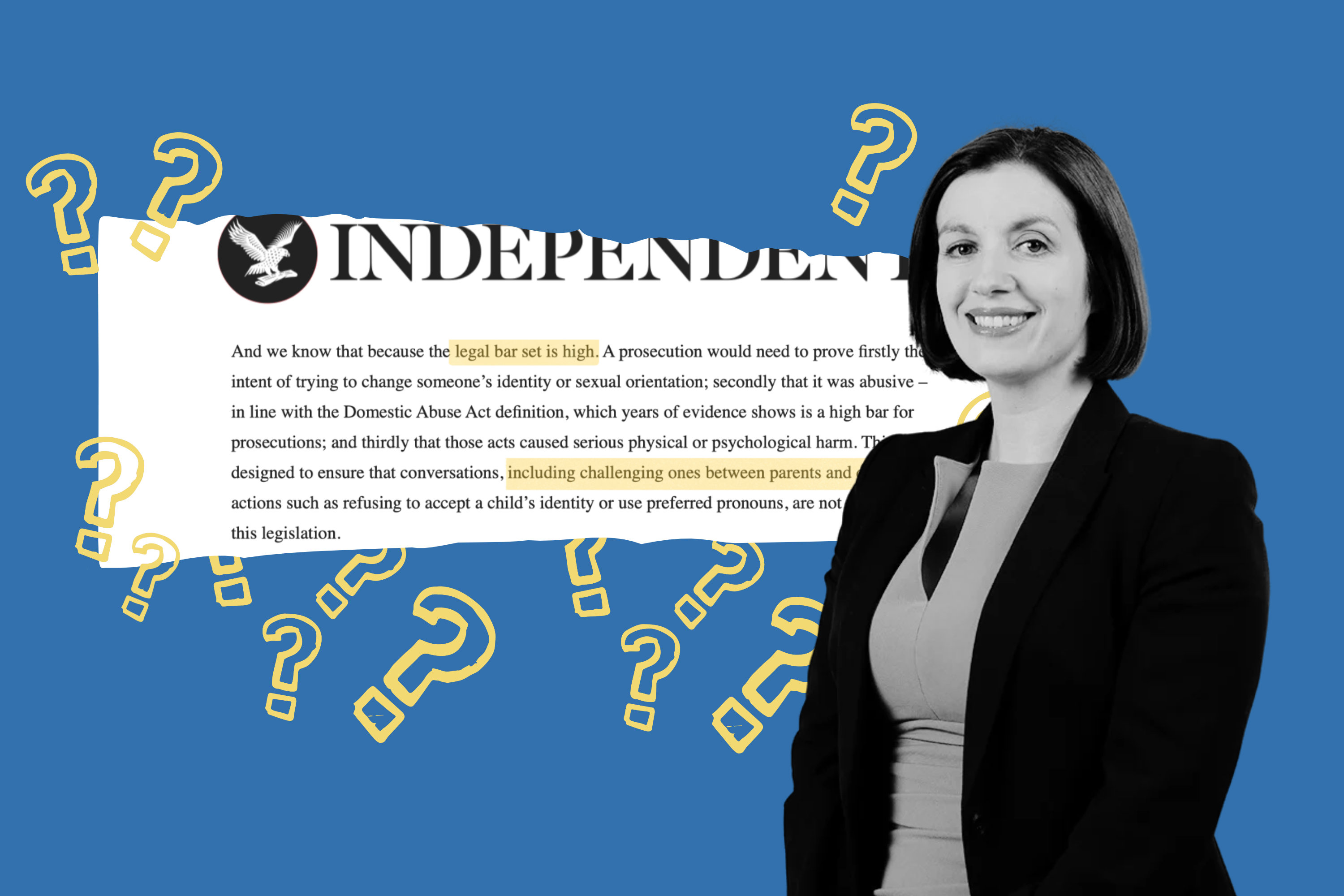
Bridget Phillipson, minister for women and equalities, says the draft Conversion Practices Bill will not catch parents who have difficult conversations with their children. But there is nothing on the face of the bill that protects those parents.
In an article in The Independent on Sunday 18th October, the minister wrote that the draft bill “will not impinge on” people’s freedom of expression, religious practice or decisions about how to parent, and that this is so because “the legal bar set is high”.
She claimed that the bill is designed to ensure that conversations between parents and children, such as “refusing to accept a child’s identity or use preferred pronouns”, would not be caught by the legislation.
But a criminal court will apply the words of the act, not a newspaper article written by a minister. And the words of the bill do not say what Phillipson says they do.
We wrote to Bridget Phillipson.
The bill has no exemption for parents, other family members, friends, teachers or social workers. Nor does it make provision for schools that follow the latest Keeping children safe in education guidance.
The definition of “abusive” is left open, and the bill says courts should consider, among other things, whether the conduct involves “economic pressure” or “psychological or emotional pressure”. Parents frequently apply such pressure to children, and doing so may be necessary to keep children safe.
Conflicts between children and parents are an ordinary part of family life, as parents seek to instil their beliefs, values and rules, and try to protect their children from harm. This is not the same as a coercive or controlling relationship between adults. A husband who took his wife’s phone away to control her conversations is doing something wrong; a parent who does this to stop a child talking to strangers they have met online, or to stop them from sourcing cross-sex hormones from street dealers or on the internet is being loving and responsible. It is not the role of the state to protect a child’s “freedom” from the boundaries that their parents choose and enforce.
The harm test is much lower than the minister claims. Phillipson says that conduct must reach the level of causing “serious physical or psychological harm” in order to trigger prosecution. But the bill gives a second, lower option of “serious alarm or distress to the individual which has a substantial adverse effect on their usual day-to-day activities”.
If a child becomes convinced that a parent’s attempt to stop them presenting as the opposite sex, or being referred to as the opposite sex is harming their day-to-day activities, that could prompt a criminal investigation of the parents, and of anyone who supports them. The chilling effect is clear.
Protection orders have no stated limits. The bill would let courts issue “conversion practice protection orders” containing “such prohibitions, restrictions or requirements” as they consider appropriate. There is nothing to say courts won’t make orders telling a parent to use particular names or pronouns. Breaching an order without “reasonable excuse”could lead to up to two years in prison.
Bayswater Support Group made a similar point on X. It said the minister’s assurance is contradicted by the bill itself.
“An op-ed by a politician will be scant consolation when a parent is facing a criminal claim or a protection order that will destroy their relationship with their child.”
What mental-health professionals told us
Along with the letter, we sent the minister a short summary of Criminalising conversations, a recent report for Sex Matters’ by social-science researcher Matilda Gosling, based on in-depth interviews with 30 mental-health professionals.
Read Criminalising conversations – summary
Many of those therapists work with young people who are distressed about their sex, and all of them expressed serious concerns about the proposed law. What concerned them most was the lack of protection for parents. One clinical psychologist put it this way:
“A conversation around the kitchen table could put you in jail.”
We sent her the anonymous interview we broadcast on 16th October, featuring a mother of a daughter who identified as trans for seven years and has since desisted. She warns that families like hers could face criminal charges simply for doing what is in their children’s interests in very difficult circumstances.
“If you’re trying to kind of encourage them to explore those very important underlying questions, then arguably, you know, you could be accused of psychological pressure and coercion.”
What we have asked the minister
We have asked the minister to write to the joint committee raising the importance of ensuring that parents are not captured by the legislation and asking her to commit to amending the bill to make sure that parents are not captured.
The minister says that parents should not be caught. If that is the aim, the protection belongs in the bill, where a court can read it – not in a newspaper article.