

Update from Maya
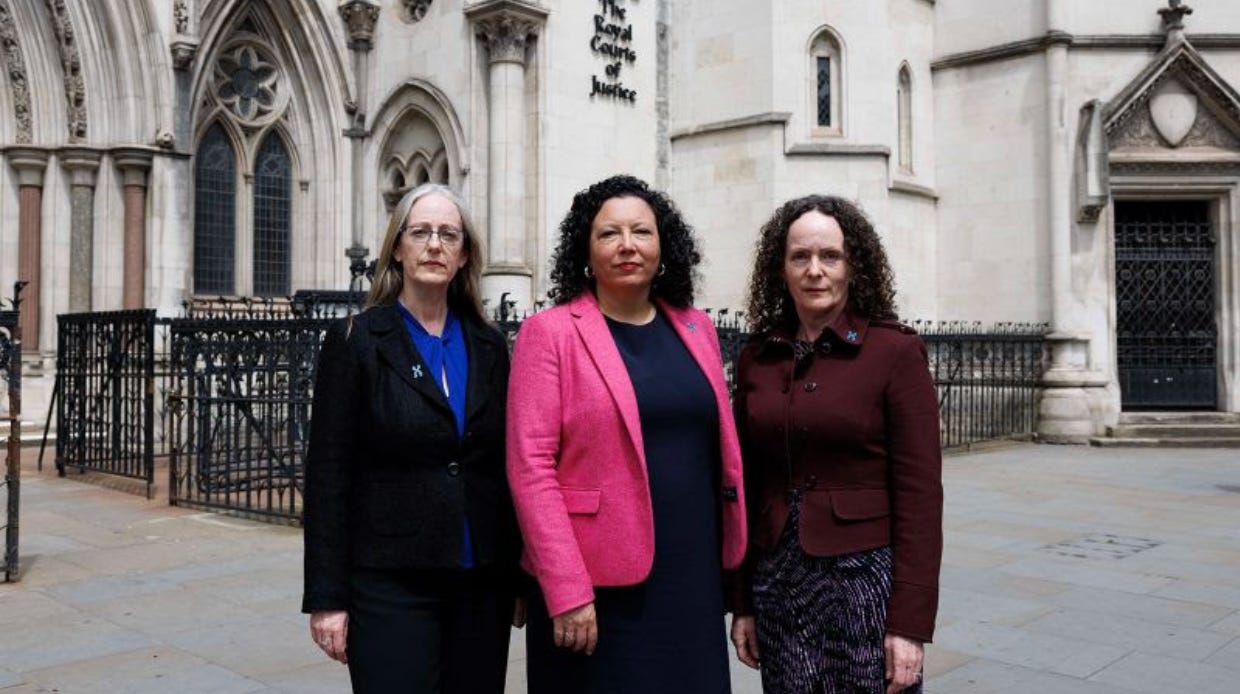
Helen, Maya and Fiona outside the High Court on 16th June before the hearing
The High Court has ruled against Sex Matters in our case against the National Police Chiefs’ Council (NPCC) and British Transport Police (BTP) over their “consensual” searching policies.
It isn’t over yet.
We think that the judgment is wrong in law and we are applying for permission to appeal.
It’s been a long road to get here and we aren’t giving up.
The answer to whether male officers should be allowed to strip-search women, or female officers asked to strip-search male detainees, should be clear, simple and obvious. Whatever their pronouns, whatever they like to wear, whatever hormones or cosmetic surgery they may have had, it should be No.
Women have rights. But those in charge have again and again put trans-identifying men’s feelings and desires above the safety, dignity and autonomy of women.
In 2004 the House of Lords (which was then the Supreme Court) ruled in the case of A v Chief Constable of West Yorkshire Police that a man who “has done everything that she possibly could do to align her physical identity with her psychological identity” should be allowed to forcibly strip-search women. Lady Hale said that it would not be “rational” for women to object.
In 2012 the LGBTQ+ lead for the Association of Chief Police Officers wrote to all chief constables sharing advice from the Equality and Human Rights Commission which drew on that case and said that what mattered for lawful searching was a person’s “legal gender”. In 2019 the next LGBTQ+ lead wrote to all chief constables encouraging them to permit officers to search detainees “without proof of their legal sex status”.
In July 2021 Standing for Women produced the first report challenging this practice. The NPCC doubled down. It got “independent legal advice” and issued guidance that trans officers be permitted to strip-search and even intimately search suspects of the opposite sex. The policy was adopted and implemented by the majority of police forces across the country.
By January 2024 the tide of public opinion had turned, so that when Women’s Rights Network (WRN) produced a report in January 2024 calling this “state sanctioned sexual assault” the government and police chiefs paid attention. The policy was withdrawn. But the policing minister said that gender-recognition certificates should allow cross-sex searching. Together with WRN and Fair Play For Women, we wrote to him and explained that this is not the law, and it is not fair or safe for women.
The NPCC doubled down again. In April 2024 it told us it was going to be consulting on new searching guidance and that it had an independent barrister advising on the law. This turned out to be trans-identifying male barrister Robin Moira White, who had advised on the policy the NPCC had just had to withdraw. I wrote to Chief Constable Gavin Stephens, pointing out that White is an activist in gender-identity politics. I sent screenshots of White comparing gender-critical women to Nazis and calling Sex Matters a “hate group” and the Minister for Women and Equalities “evil”.
The NPCC just doubled down some more. Gavin Stephens said: “The NPCC has considered at great length who is best placed to provide legal advice and given the subject matter.”
In November 2024, when British Transport Police issued its new policy based on the NPCC approach, we started down the road to legal action. After the FWS judgment the NPCC, BTP and other police forces withdrew their faulty policies, but didn’t say Sorry. Instead they developed new policies to let trans-identifying detainees request that an officer of the opposite sex would search them “consensually”.
When we raised concerns about female officers being put under pressure to strip-search trans-identifying men, the NPCC and BTP said that officers who refused to search trans-identifying detainees of the opposite sex would not face career detriment.
We know from experience that sometimes you have to continue up the court system to find judges willing to see past the years of exceptional practice and declare that ordinary truth and ordinary laws apply to everyone. It is infuriating. But we will keep going.
Why we’re continuing this legal fight

Read more about why we think this judgment is wrong in law, why we are seeking permission to appeal and why this case matters for female police officers, detainees and the rule of law.
Media coverage
Our searching case was referenced by The Telegraph (Hayley Dixon), who reported earlier in the week that Staffordshire Police force is treating trans-identifying male detainees as women, in defiance of the Supreme Court judgment.
Helen commented on the case in a wide-ranging interview with Alex Phillips on Talk TV, in which she also discussed transactivists’ threats and aggression and the failure of public institutions to tackle this intimidation.
Breaking news
As we were preparing to send this week’s memo, news broke that Bayswater Support Group, Keira Bell and James Esses have been refused permission to bring a judicial review seeking to halt the puberty-blocker trial.
The High Court’s decision is both devastating and inexplicable. These drugs have been blocked for use in gender treatment in both the NHS and private practice because of increasing evidence that they cause serious, permanent harm to vulnerable children. And yet a trial so badly designed that it cannot possibly produce any useful scientific data has irresponsibly been given the go-ahead.
Interrupting children’s development into healthy, fully functional adults is a human-rights abuse. Doing it with no more substantial goal than finding out whether it cheers them up briefly, as the planned trial does, is ethically monstrous.
The history of medicine is littered with tragic stories of researchers and doctors convinced by faulty theories doing terrible harm in the name of healthcare. Years later, public inquiries declare that “lessons must be learned”, but that is little comfort to the people whose bodies have been irreversibly harmed.
No more excuses: guidance on single-sex spaces comes into force
The EHRC code of practice finally comes into force on 5th August. In this week’s podcast, Helen Joyce and Maya Forstater discuss what it will mean for single-sex services, charities and associations. They make some predictions for the coming autumn, when organisations will no longer be able to claim they’re “waiting for guidance”, new school safeguarding policy will come into force and legal battles on conversion practices and the planned puberty-blocker trial will only become more fierce.
What the Supreme Court ruling means for charities

Can a single-sex charity become “trans-inclusive”? Our new briefing explains what charity law, freedom of association and safeguarding principles, taken together with last year’s Supreme Court judgment, mean for charities like the Women’s Institute and Girlguiding, and for single-sex associations more generally.
In other news
Helen’s debate with Northern Irish columnist Allison Morris on BBC Radio Ulster about the Féile an Phobail festival cancelling the event of Women’s Rights Network Northern Ireland resulted in considerable criticism of Morris for her inaccurate claims and misrepresentation of WRN’s positions.
The Liberal Democrats have been accused of softening their stance on sex-based rights after taking more than £200,000 in donations from Simon Ruddick, who has a trans-identifying child, as reported by The Times (Geraldine Scott). Helen said that it’s impossible to know whether the noticeable change in the party line is linked to donations from any individual, but that its timing is remarkably aligned with donations from someone who has a significant personal interest in transactivism.
Coverage of the fallout from Amnesty International UK’s report continued, with The Times (Marc Horne) reporting that the charity’s chief executive has agreed to meet Maya in the autumn, following Sex Matters being named in the now-withdrawn report.
If you’d like this memo in your inbox every Friday at 5pm, join our mailing list now.
Sex Matters survives on your support.
Without it, we simply wouldn’t exist.
Sex Matters can deliver essential research and analysis, help shape the debate, and empower people with clear, published guidance on their rights – but only with your support. Please contribute what you can to keep us going.