

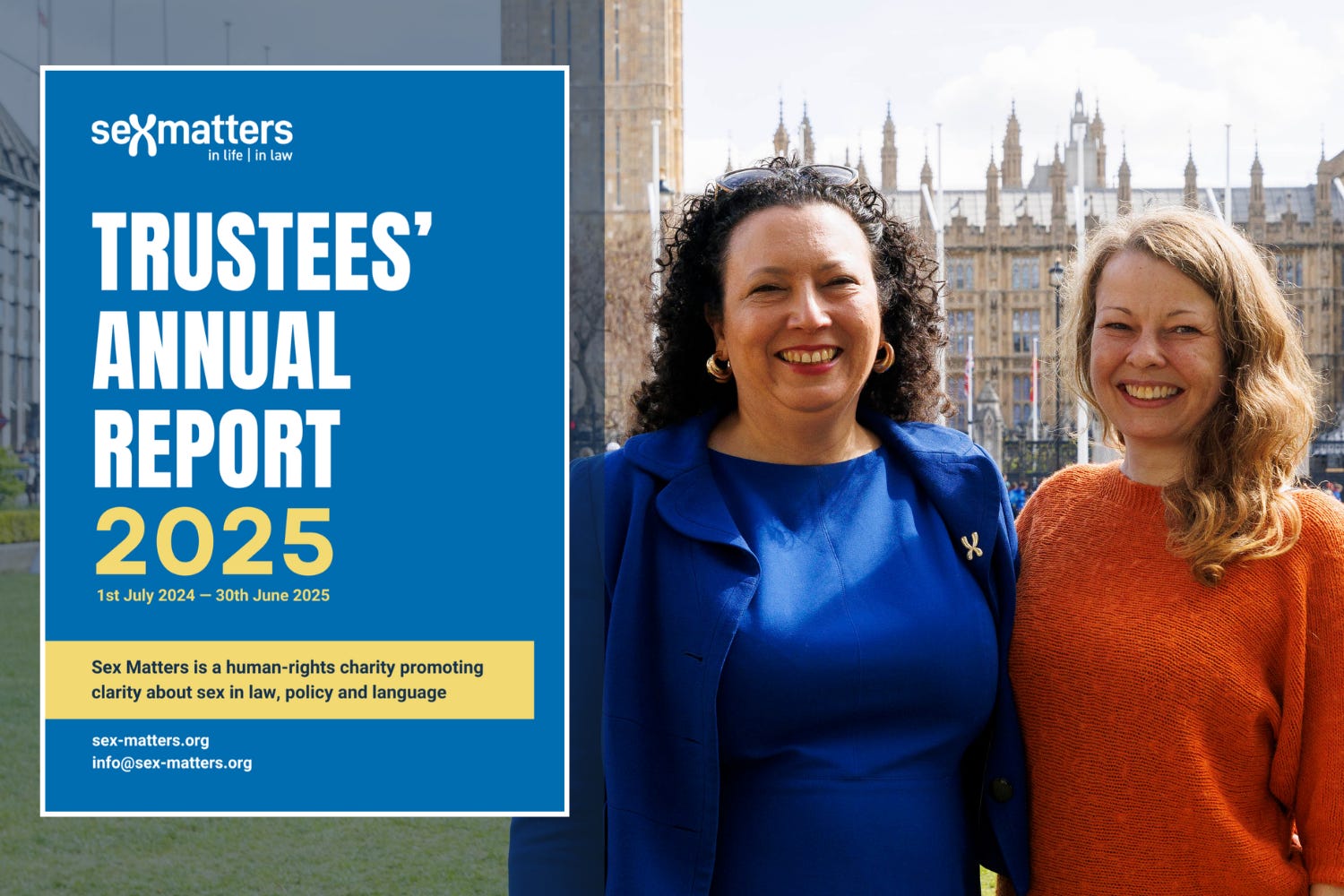
Sex Matters has published its first annual report as a charity. It covers the period 1st July 2024 to 30th June 2025.
Our first chair, Naomi Cunningham, provided a foreword along with current chair Dr Emma Hilton and CEO Maya Forstater.
Chair Dr Emma Hilton says:

“We are immensely excited to publish our first annual report. This year has been a watershed for Sex Matters. When the organisation was founded in 2020, we faced an environment where the belief that sex is real, immutable and important was deemed to be ‘not worthy of respect in a democratic society’. Sex Matters became a charity in April 2024, with a single mission: to bring back clarity about sex to law, policy and everyday life so that everyone’s human rights can be protected. Just a year later, our mission was vindicated by the highest court in the land. The Supreme Court confirmed that sex matters in life and law.”
Sex Matters’ first chair Naomi Cunningham (who passed the baton to Emma in December 2025) says:

“I’m immensely proud to have played a part in developing Sex Matters from small beginnings to the heavy-hitting professional charity that it is today. The vision, energy and commitment of its board and staff have made that possible despite the hostile environment in which they operate… I’m honoured to be succeeded as Chair by the wonderful Dr Emma Hilton. She, her colleagues on the board, and Maya and all the staff have my very best wishes for the future.”
CEO Maya Forstater says:

“Thank you to our trustees, advisory group, staff, team collaborators, lawyers and every person who has spoken up, written to their MP, shared our work or simply refused to be silent. I am particularly grateful to our donors. Without the generosity of those who committed to support us with monthly donations, Sex Matters would never have got off the ground. We are grateful for every single person who has given us support. I am proud of the faith they have placed in Sex Matters and of what we have accomplished together, as well as determined for what comes next.”
Our finances
As the report shows, the charity is in good financial health. We successfully raised over £1.2 million during the year, solely from individual and other voluntary donations, and have managed our resources cautiously as our income, operations and legal cases developed.
The charity’s income includes the closing balance of funds that were transferred from “Sex Matters for Everyone”, the not-for-profit limited company that we started with (we changed its name from “Sex Matters” so that the charity could be set up with that name).
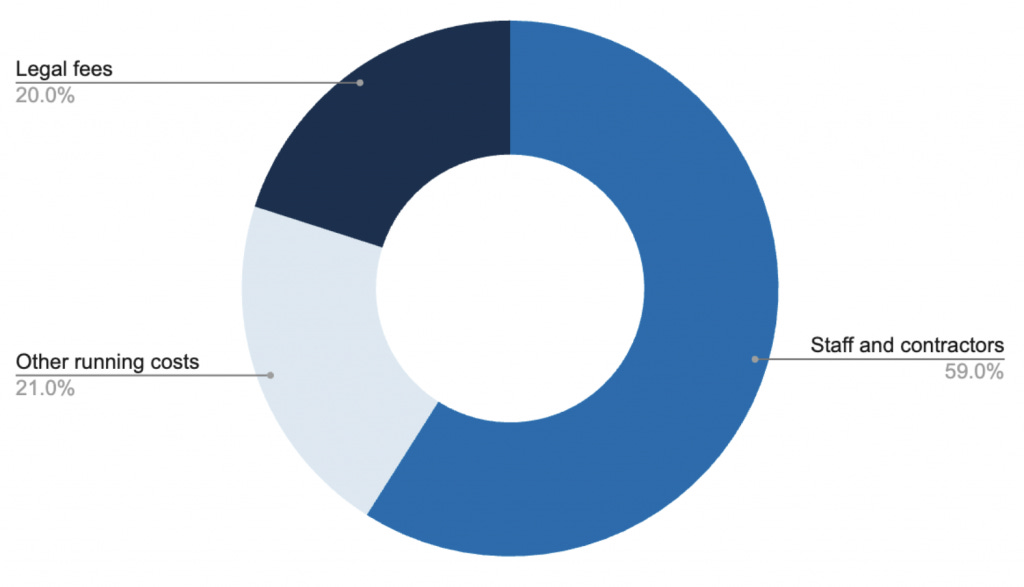
The charity spent £843,730 during the year, split between staff and contractor costs, legal fees and other running costs. None of the trustees were paid by the charity.
What did we spend money on?
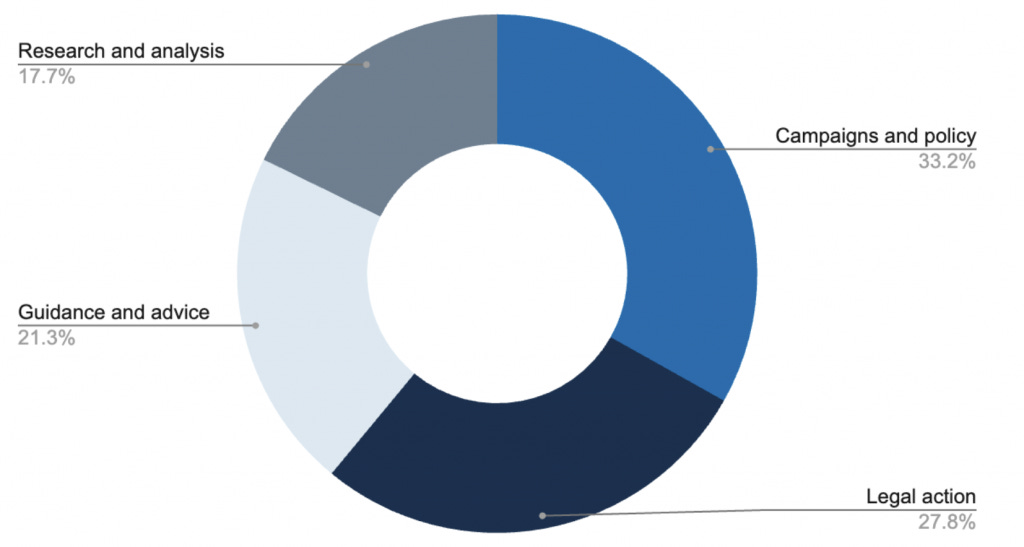
Our spending is split between our four principle activity areas: research and analysis, campaigns and policy, legal action, and advice and guidance.
Spending by charitable activity
The board of trustees is responsible for ensuring that Sex Matters maintains an appropriate level of reserves to meet future risks and provide working capital.
The trustees have set a reserves policy whereby we aim to hold six months of our forecast regular operating expenses as free reserves.
Our strategy
The report sets out Sex Matters’ strategy, the actions we have taken over the period, our impacts and our plans for the future.
Make the Equality Act clear
Making the law clear is central to our strategy to protect everyone’s rights. Misunderstanding and misrepresentation of the words “man” and “woman” in the Equality Act have allowed the law that is meant to protect women’s rights to be used to undermine them.
Our strategy includes public campaigning, engagement with the Equality and Human Rights Commission (EHRC) and legal action.
In May 2024 we lodged an application to intervene in the case of For Women Scotland v The Scottish Ministers in the Supreme Court, to argue that sex in the Equality Act means biological sex.
At the same time we continued to campaign so that people understand why clarity about the law matters. In the run-up to the general election, our “Stand up for single-sex services” campaign got the message through to politicians.
We commissioned polls showing that opinion was moving in our direction. Overall, 57 percent of the population supported the proposal to clarify that “male” and “female” in the Equality Act mean biological sex, with just 10 percent opposing.
On 11th September 2024 we held a mass lobby day. Hundreds of supporters came to Parliament to ask their MPs to stand up for single-sex services and to make the Equality Act clear.
In November 2024 we appeared in the Supreme Court, represented by Ben Cooper KC and David Welsh. The historic judgment, which came on 16th April 2025, declared that sex in the Equality Act means, and has always meant, biological sex.
Following the judgement we produced a suite of guidance materials on providing single-sex services with confidence and called for all organisations to update their policies to bring them in line with the law.
Engaging with the Equality and Human Rights Commission (EHRC) has been a core part of our strategy since the beginning. In 2024, in our response to its new strategy, we thanked the EHRC for its work and Kishwer Falkner for her courage. We called on the EHRC to continue to work on the issue of sex-based rights as a regulator. In January 2025 we gave detailed feedback on its draft new code of practice for service providers.
Win back recognition that other people have rights
Sex Matters works to raise awareness, provide evidence of conflicts of rights, and enable people to use the law in key domains where sex matters in everyday life, including single-sex services and charities, healthcare, sport and crime and justice.
Following the For Women Scotland judgment we produced guidance on single-sex services and on toilets. We provided detailed feedback on the EHRC’s updated code of practice for service providers. We have been writing to organisations that are not complying with the law.
We launched an important case against the City of London Corporation concerning the gender self-ID policy in place at the Hampstead Ponds.
We helped journalist Michelle Dewberry launch legal action against Virgin Active in order to make its changing rooms single-sex.
We worked to support a group of trustees of La Leche League who were trying to protect their charity as a single-sex service for breastfeeding mothers and facing a backlash from gender-ideology activists.They went on to set up MoMa Breastfeeding, a new voluntary organisation dedicated to supporting mothers who wish to breastfeed their children.
We conducted a review of the Rape Crisis National Service Standards and found that an organisation that does not clearly recognise the two sexes will be unable to meet 51 of its 61 indicators.
We launched a legal case against the British Transport Police (BTP) challenging its search policy, which allowed male officers with gender-recognition certificates to search female detainees. Following the For Women Scotland judgment, BTP withdrew its unlawful searching policy. We then succeeded in convincing other forces, including Sussex, Merseyside, Northumbria and Surrey Police, to withdraw similar abusive policies. We are continuing to take action against the British Transport Police and the National Police Chiefs’ Council on its new policy, which puts pressure on female officers to strip-search men if those men claim to be trans.
We monitor bias at the BBC and engage with the national broadcaster in several ways, both formal and informal. It is obliged by its charter to be accurate and impartial. But when it comes to reporting on issues of sex and gender, the BBC is neither accurate nor impartial.
We engage proactively with sports governing bodies and sports councils, bringing the scientific, legal and human rights arguments. When people tell us about their experiences of men in women’s sports, we share those too, with decision-makers and where appropriate with the media.
In August 2025 we responded to the scandal of two male athletes with disorders of sexual development (DSDs) competing in women’s boxing. We produced a hard-hitting short video about the unfairness of men in women’s sports, and briefings on disorders of sexual development and the problem of male inclusion in women’s sport.
First do no harm
There is an epidemic of children and young people seeking to socially transition and to receive hormonal and surgical treatment. Gender medicine relies on the signs and symbols of evidence-based medicine — consultations, diagnoses, drugs and surgeries — while subverting its rationale, and it disregards others’ rights.
Following the Cass Review, we published a briefing dispelling myths about suicide and transgender health care.
Emergency restrictions on puberty blockers were announced by the Conservative government in May 2024. We hosted an event in London bringing together some of the whistleblowers, campaigners, clinicians, researchers and journalists who have spoken up to arrive at this point, including Michele Moore, Stephanie Davies-Arai, Michael Biggs, Sue Evans and Heather Brunskell-Evans.
Together with other organisations, including the Gay Men’s Network and the Lesbian Project, we wrote to the Prime Minister, Sir Keir Starmer, after the general election, urging him to resist calls to to legislate to ban so-called conversion therapy and instead to commit to five tests that must be satisfied by any proposed legislation, based on the principle of “first do no harm”.
We argue that social transition in school can not be reconciled with a school’s duty of care and of safeguarding, or the Equality Act. In September 2024 we published a model policy for schools on how to set clear, fair policies in relation to sex, and how to accommodate children experiencing gender distress.
At the end of September 2024 Helen Joyce attended the Genspect conference in Lisbon. She spoke about sex, gender and human rights. We published her speech, together with the one she gave as a keynote at Genspect’s first conference in Killarney in 2023, as a booklet and online.
Be safe for work
Making it “safe for work” to speak honestly about the two sexes is crucial to winning back organisations and professions to their missions.
In July 2024, Sex Matters hosted a meeting of people involved in workplace sex equality and equity networks (SEENs). Gender-critical networks have sprung up in sectors including the civil service, banking and finance, human resources, the police, healthcare, universities and Parliament. Groups at the meeting included established SEENs and other sector networks, as well as nascent groups.
We provide resources for employers and employees, including template letters, information on the law and suggestions on where to go for help. We also provide first-line support to people through our inbox, which deals with an average of 300 queries a month.
In February 2025 Maya Forstater gave evidence in the case of Sandie Peggie v NHS Fife. Sex Matters supported press and public understanding of this important case. In October 2024 we intervened in the case of Kristie Higgs v Farmor’s School on the question of how courts and tribunals should approach religious or philosophical belief-discrimination cases concerning the “manifestation” of belief.
We also explained and documented employment-tribunal judgments as they happened, publishing a review of lessons from the Professor Jo Phoenix case at the Open University, and after the Edinburgh Rape Crisis Centre (ERCC) judgment.
We launched a series of case briefings documenting the legal cases that are winning back rights at work, in order to help to accelerate learning and stop more people suffering unlawful discrimination.
In June 2025 we launched Everyday Cancellation together with SEEN in Publishing, a research report investigating the working environment for authors, agents and publishing staff who believe that sex is binary, immutable and important.
Following the For Women Scotland case, we engaged with the Scottish Government on its workplace policies, which eventually led to it revising its toilets policy. We are also engaging with the Health and Safety Executive, calling on it to provide clear guidance on toilets and other facilities at work.
Every day we respond to enquiries in our inbox from people facing organisations that misunderstand the law – or worse, blatantly ignore it. We have a wealth of information and guidance on our website and often signposting to this is enough. Since the Supreme Court ruling, our new web pages on toilets and changing rooms for service users and for employees have been very popular because they explain the law and provide templates for challenging policies or making a complaint.
Protect privacy and data integrity
“Trans rights” are privacy rights. They are limited. The solution is to offer a proportionate, workable way to record sex accurately throughout society while respecting the private life of transgender individuals.
In October 2024 the government introduced its Data Bill, which included plans to unlock the power of digitisation to expand the economy and improve people’s lives by creating a framework to support digital identity verification, thus making it easier for people to prove who they are.
Sex Matters proposes that accurate sex data in digital identity systems could help solve the “gender wars”, addressing the needs of both those concerned with administrative coherence and the data needed for safeguarding, science and sport, and people who wish to keep their sex private on occasions where that information is not needed, such as booking a ticket or renting a car.
In November 2024 we published a report on the risks and opportunities of the bill and the problem of unreliable sex data in historic systems such as passports and driving licences. Lord Arbuthnot of Edrom, the parliamentary hero of the Post Office scandal, highlighted our report in a parliamentary debate, after talking about how people’s lives were ruined because of unreliable data generated by the Post Office’s Horizon computer system.
In December 2024, amendments we supported to solve the data issue were debated by the House of Lords. In January 2025 the amendments were passed. In March MPs removed these safeguards from the bill.
Together with Lord Arbuthnot, we met Peter Kyle MP, the minister in charge of the digital-identity programme at the time, to explain the problem. In May 2025 over 2,000 of our supporters wrote to the minister calling on him to act. The government admitted that passports do not provide reliable information on sex, but has still not come up with a solution for reliable digital data on sex.
We are continuing to engage with the government, seeking to ensure that the “sex” attribute in new forms of digital identity conveys accurate, reliable personal data — or keeps that data private where appropriate.
We also undertook interventions on open justice in several cases, challenging expectations of extraordinary privacy for individuals with trans identities by arguing that such privacy undermines the freedom of expression of others.
You can download the report, which includes our audited accounts and trustees’ review. We have published a set of frequently asked questions to go along with it.
What an astonishing list!
On the one hand it still astounds me that you are needed. That sex is still seen as something that is up for debate. And on the other I am so grateful for all that you do.
Thanks for your wonderful summary of all your great work.
Have cross posted
https://dustymasterson.substack.com/p/galaxy-quest
Onwards!!
Dusty