

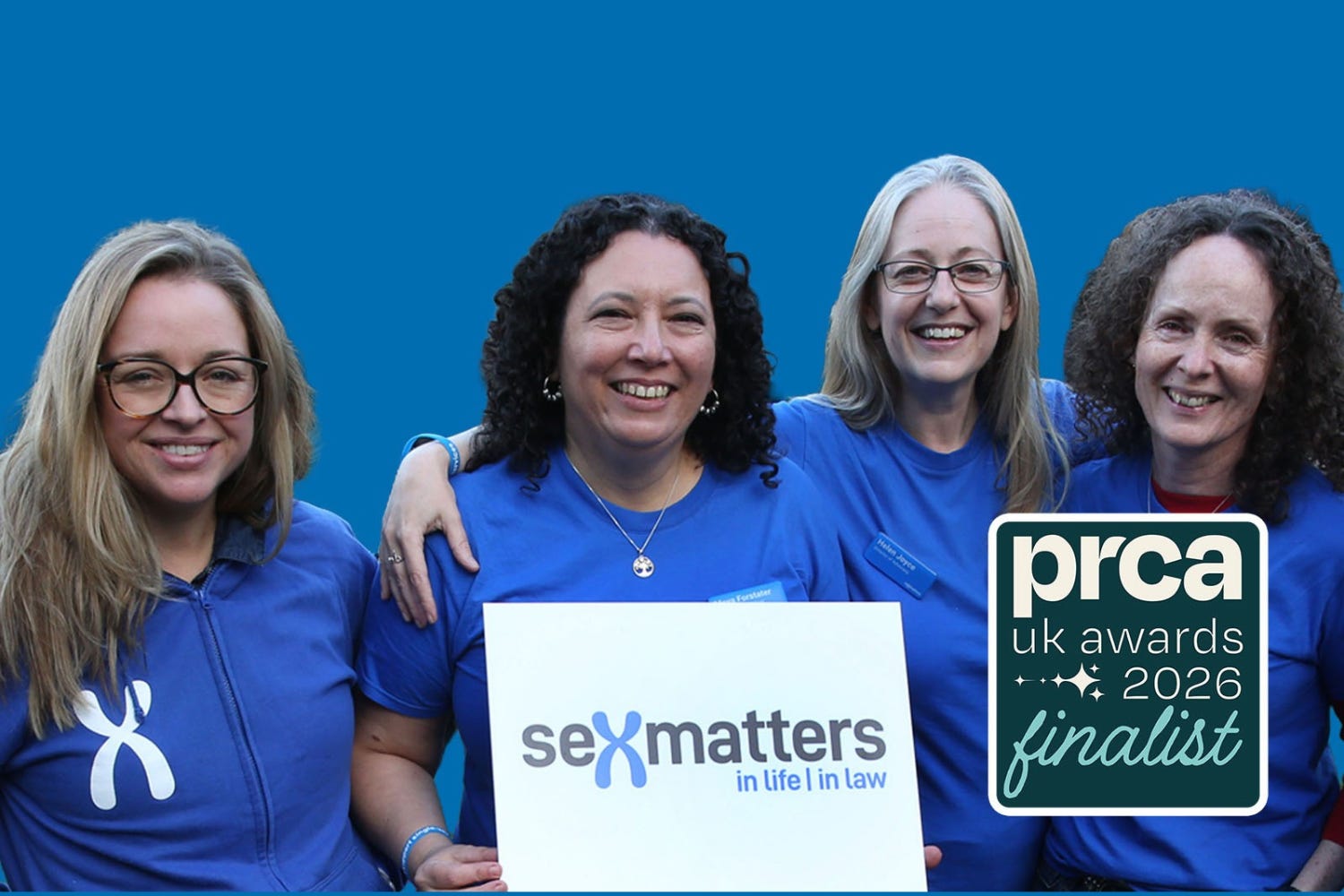
Sex Matters has been shortlisted for in-house team of the year at the Public Relations and Communications Association (PRCA) UK Awards 2026. The other finalists are Cancer Research UK, Marie Curie and NHS Property Services. We are proud to be in that company, and to have our communications work judged by the PR profession on its merits.
A small team on a contested subject
Our entry covered Sex Matters’ first financial year as a charity, from 1st July 2024 to 30th June 2025.
The core press team is two people: head of PR Sally Parkin, and director of advocacy Helen Joyce. They are supported by the head of creative and social media, Nicole Jones. Our chief executive, Maya Forstater, and director of campaigns, Fiona McAnena, act as spokespeople alongside Helen.
High quality, high volume
In that year, according to our media monitoring, we were:
featured in, or wrote, 2,322 print and online articles in the UK press: 431 national and 1,891 local, regional and specialist
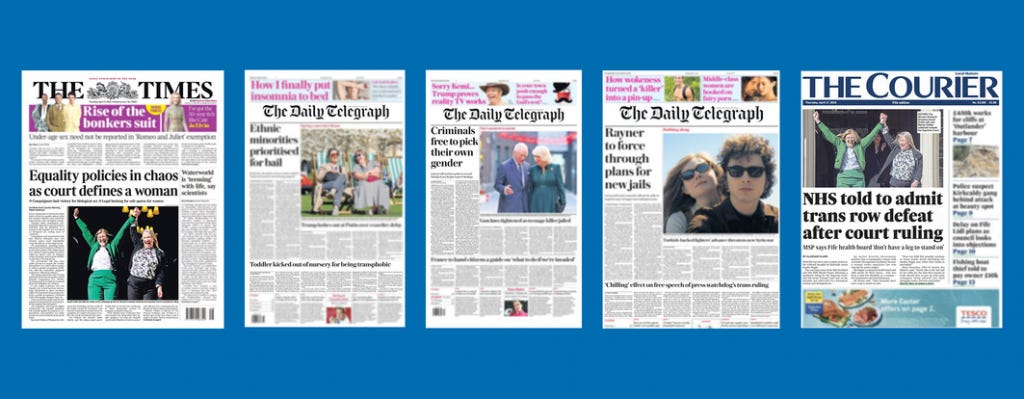
featured in one regional and four national front-page stories
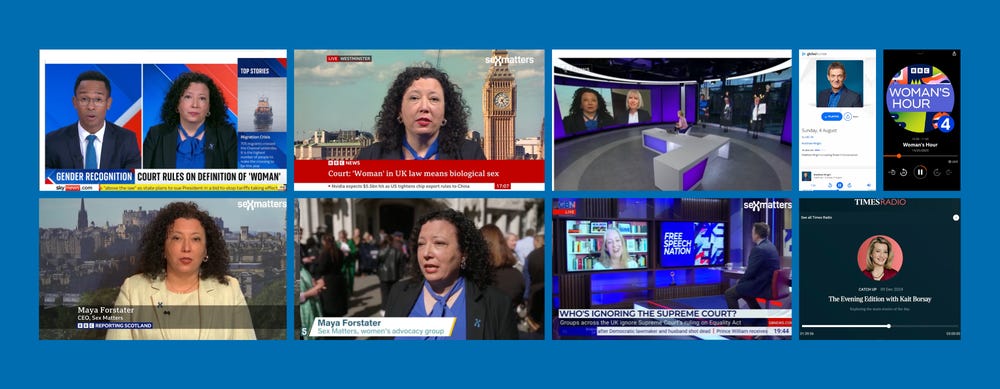
mentioned 781 times in UK broadcast coverage, including 132 interviews on BBC, ITV, Channel 4, Channel 5, Sky News, Times Radio, LBC, GB News and TalkTV, among others
covered by media in 42 countries, reaching an estimated audience of 76.3 million.
More than half of that coverage concerned our work on the Equality Act 2010. 2025 was the year in which the Supreme Court ruled that “sex” in the Equality Act means biological sex. On that day, we told PA Media that the court had given “the right answer: the protected characteristic of sex – male and female – refers to reality, not to paperwork”.
Helping journalists get it right
Much of our work is about helping journalists report accurately, often under time pressure, on subjects that are legally and scientifically complex. During the Paris Olympics in August 2024, sports journalists told us they were struggling to follow the science behind the row over eligibility in women’s boxing. We held a media briefing on sex in sport, chaired by Fiona McAnena, with biologist Dr Emma Hilton and former Olympians Sharron Davies and Mara Yamauchi. It was viewed 14,000 times in the week after it was broadcast.
We also give journalists legal briefings on major cases, and on-the-day analysis when guidance or judgments are published.
Our media handbook on sex and gender explains when and why it is right for journalists to report people’s sex.
Communication is central to our work
The PRCA has recently published a new definition of public relations. It describes PR as “the strategic management discipline that builds trust, enhances reputation and helps leaders interpret complexity and manage volatility”. Among its 10 underlying principles are “earned credibility as the primary currency” and being “grounded in insight and evidence”.
That is close to how we see our own press work. Sex Matters exists to promote clarity about sex in law, policy and language. The law protects people only if those who run services, write policies and make decisions understand what it says. Most of them learn about it not from judgments or statutory guidance, but from what they read, watch and hear.
So accurate reporting is not an add-on to our charitable work; it is one of the main ways we do it. Our approach is to be a reliable source: to explain complex cases and guidance plainly, to stick to the evidence and to be available when journalists need us. Credibility earned that way has to be earned again with every story, which is why we take care over every statement we put out.
By and large, UK national newspapers have been robust and often fearless in their coverage of sex and gender in the past several years, but some areas have been deemed too risky to cover plainly and with accurate language. This problem is easing a little at a time.
Bias within mainstream broadcasters regarding coverage of sex and gender, particularly at the BBC, has been well documented. But we think that, even within the broadcast media, there has been noticeable improvement. Increasingly, sex-based rights are reported as what they are: mainstream questions of law, policy, fairness and safety, for which accurate information matters.
We think being shortlisted alongside some of the UK’s best-known charities and an NHS body reflects that change. It’s also recognition of the work of a very small team that answers several press queries a day while pitching its own stories.
Sally Parkin said:
“I’m truly delighted that Sex Matters has been shortlisted for in-house team of the year at the PRCA awards, alongside some of the UK’s leading charities.
“This nod from PRCA is a heartening sign, especially coming after For Women Scotland received an award for public campaign of the year in Holyrood last year. It would have seemed unthinkable just a few years ago that an organisation advocating for sex-based rights would receive such recognition.”
Thank you to the journalists who have come to us for clear, accurate information. Our press office is at sex-matters.org/about-us/press.
Congratulations. You continue to do a brilliant job. I am amazed at your stamina and good humour.Thank you so much
A well-deserved honour for the team.