

When Belfast’s publicly funded arts festival, Féile an Phobail, decided to cancel a panel organised by the community group Women’s Rights Network Northern Ireland, it reckoned without the strength, resilience and fury of rebellious women.
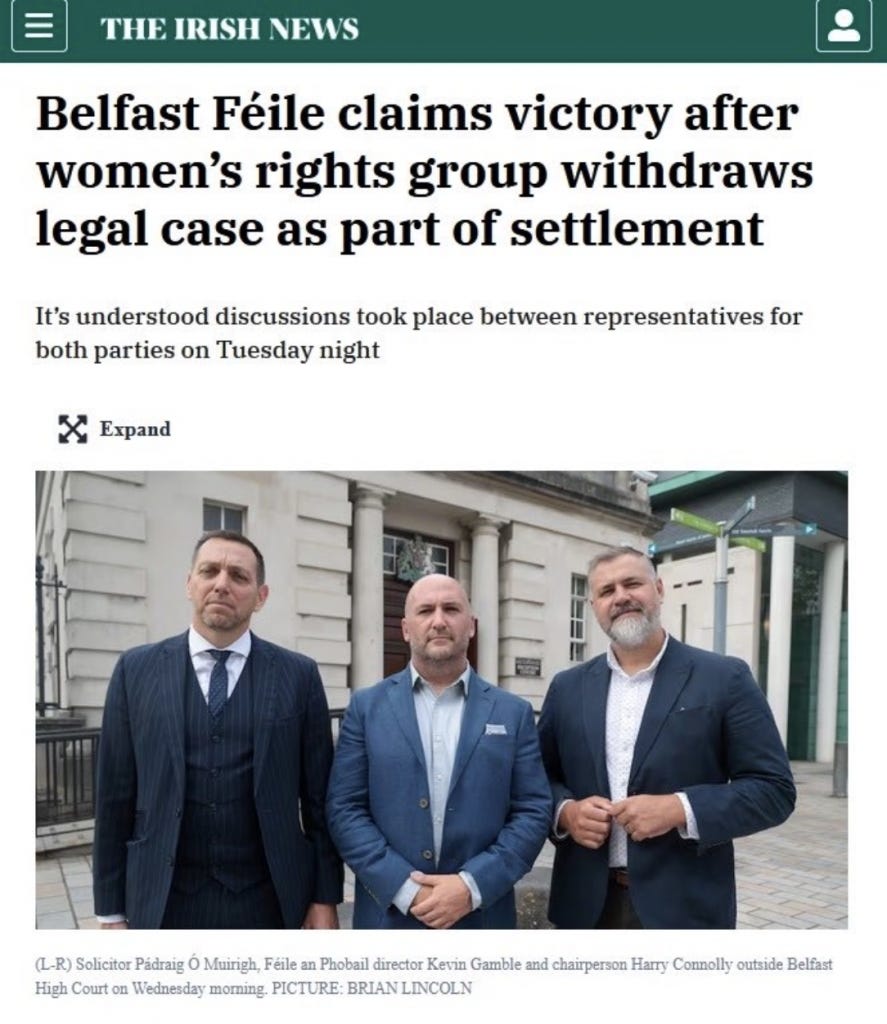
Refused both a spot at on the festival programme at St Mary’s College on the Falls Road and a meeting space in the Stormont Parliament, and falsely slurred as being “aligned with right wing, misogynist political agitators”, the group bounced back and found its own venue at the last minute.
The fringe meeting not only went ahead and sold out, but it was one of the most talked-about events of the festival, breaking through to Radio Ulster and the BBC News, and drawing commentary from the head of the Equality Commission of Northern Ireland (ECNI), Geraldine McGahey, who called for respectful public debate and respect for legal protections against belief discrimination.
The event took place on 4th August 2026, in a room packed with local women and a few men, as well as Maya Forstater and Helen Joyce from the Sex Matters team, women from Scotland who travelled to show solidarity with the women of Northern Ireland, and other visitors including Róisín Michaux from Brussels. Catherine McGinty, a journalist with The Derry News, moderated the event.
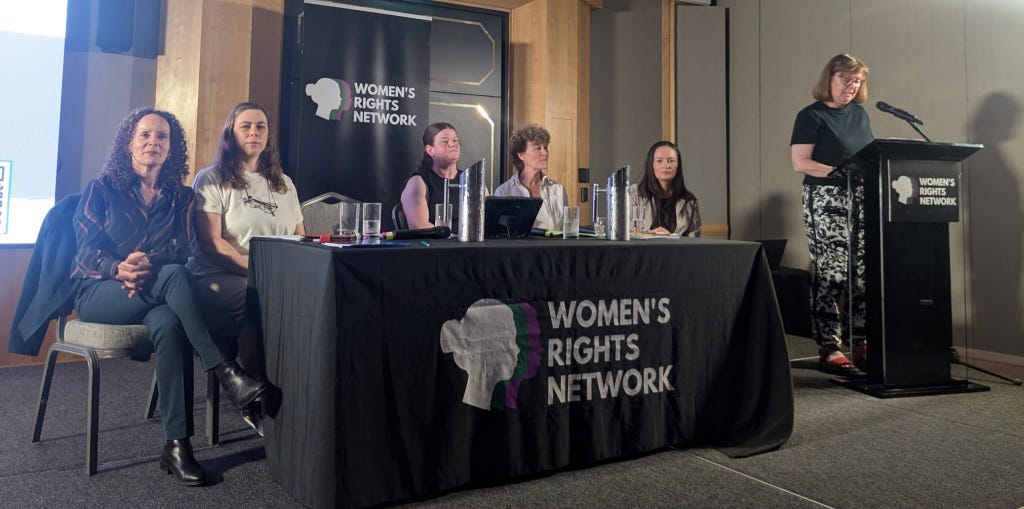
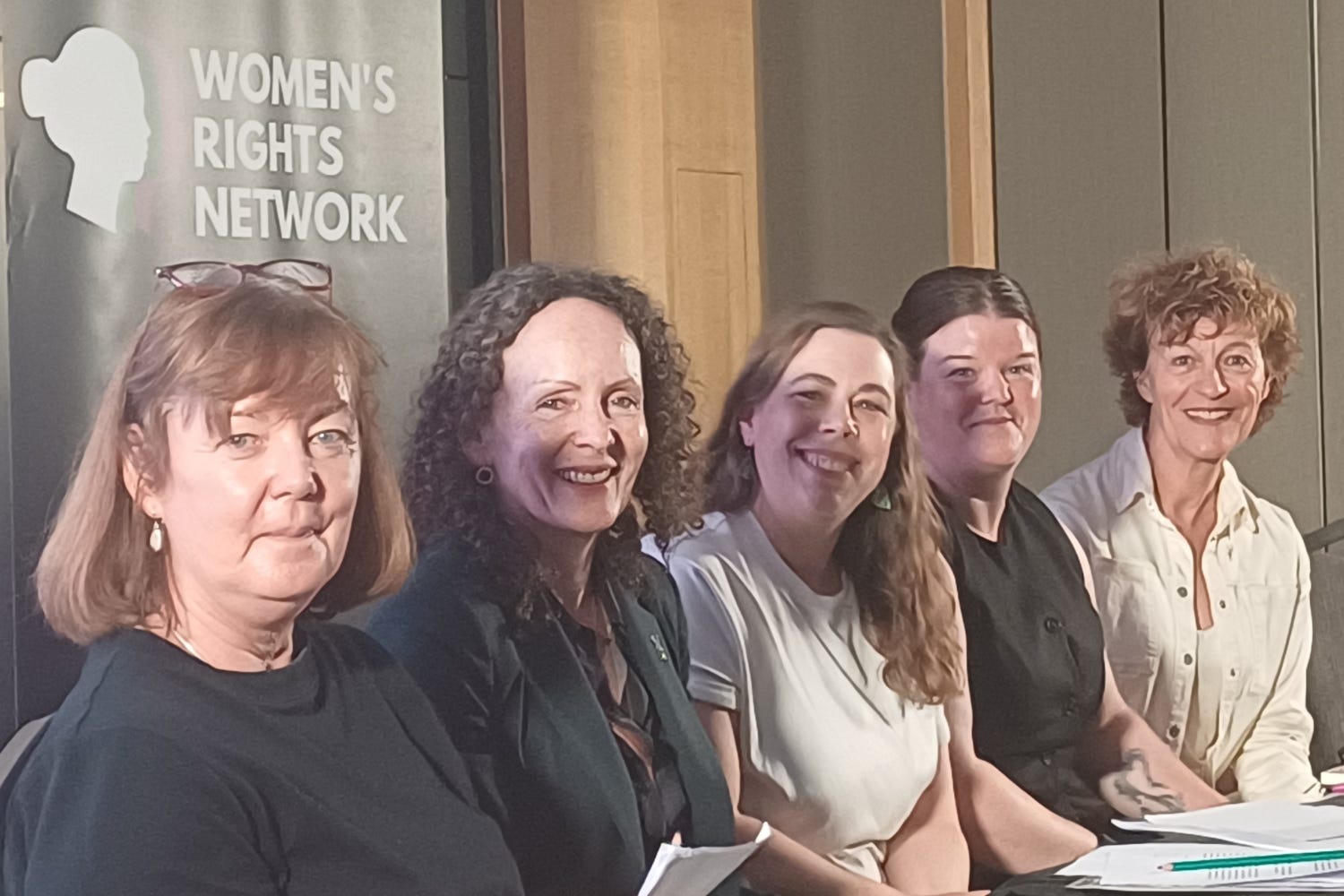
Each of the five women on the panel spoke movingly and passionately about why and how they are holding the line for sex-based rights for women and girls in Northern Ireland, the Republic of Ireland, the UK and Europe, and about the attempts to subdue them and why they refused to be quiet.
Nora Calder of WRN NI introduced the organisation. “We are your mothers, your sisters, your daughters, your friends…,” she said. “Those of us who speak publicly do so on behalf of all the many women who cannot.”
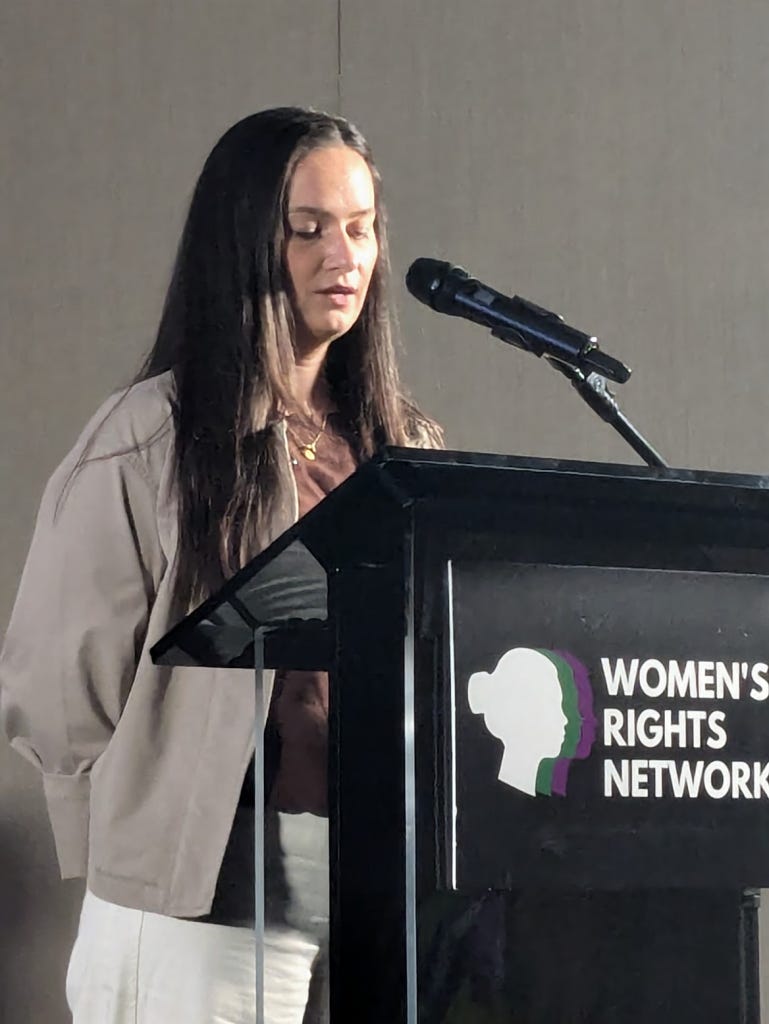
She keeps “her toaster in the cupboard”, she said (a reference to the TV show The Derry Girls – it signifies Protestantism), but added that this issue transcends Northern Ireland’s sectarian divisions. “This is not a Green or Orange issue. WRN NI is non-partisan, with women from all parties and political allegiances, all backgrounds and races and all ages.” To warm applause, she added: “Attempts have been made to silence us – we won’t be silenced.”
Nora gave a shout-out to Sara Morrison, whose case, though unsuccessful at first instance, was the first time the Fair Employment Tribunal in Northern Ireland accepted that “gender critical” beliefs are protected as political opinion for the purpose of Northern Ireland’s equality laws, which differ somewhat from those in the rest of the UK.
Daniella Loughrey from Gaels for Fair Play, a group of grassroots players, coaches, volunteers and parents seeking fairness for women and girls in Gaelic games, spoke next. “It’s hard to believe that we are still arguing that men and boys should stick to their own sex category when it comes to sport but on we go,” she said. She spoke about female players who have been injured by men allowed into the women’s game, and who have too little faith in the sports associations to make a complaint. “The sad consequence,” she said, “is not only dangerous injuries but also that females will self-exclude.”
This theme of fear of exposure was even more darkly explained by the next speaker, Sorcha Nic Lochlainn from The Countess, a grassroots group from the Republic of Ireland. It was set up in 2019 to focus attention on the conflict of rights and child-safeguarding issues caused by Ireland’s Gender Recognition Act 2015, which passed without public debate or political scrutiny. For the past decade, any man in the Republic who says he’s a woman can apply for a gender-recognition certificate, change the sex on his birth certificate, count as a woman for all legal and administrative purposes and access women’s spaces by right.
This includes prisons. In the sole standalone women’s prison in the Republic of Ireland, in Limerick, Barbie Kardashian – a violent and sexually abusive man – was locked up with women from 2022 to 2025. The dogma that people are men or women according to what they say isn’t grassroots, but enforced from the top down, Sorcha said, and results in women being totally silenced: required to lower their boundaries and demonised if they protest.
The next speaker was Marianne Driessen, who had travelled from her home in the Netherlands. She is part of Athena Forum, which advocates for sex-based right in the EU and Council of Europe. “The EU continues to find new implements to enforce gender ideology,” she said, “and one of the most profoundly affected fields is education, where it’s made its way into teaching materials for children as young as four.”
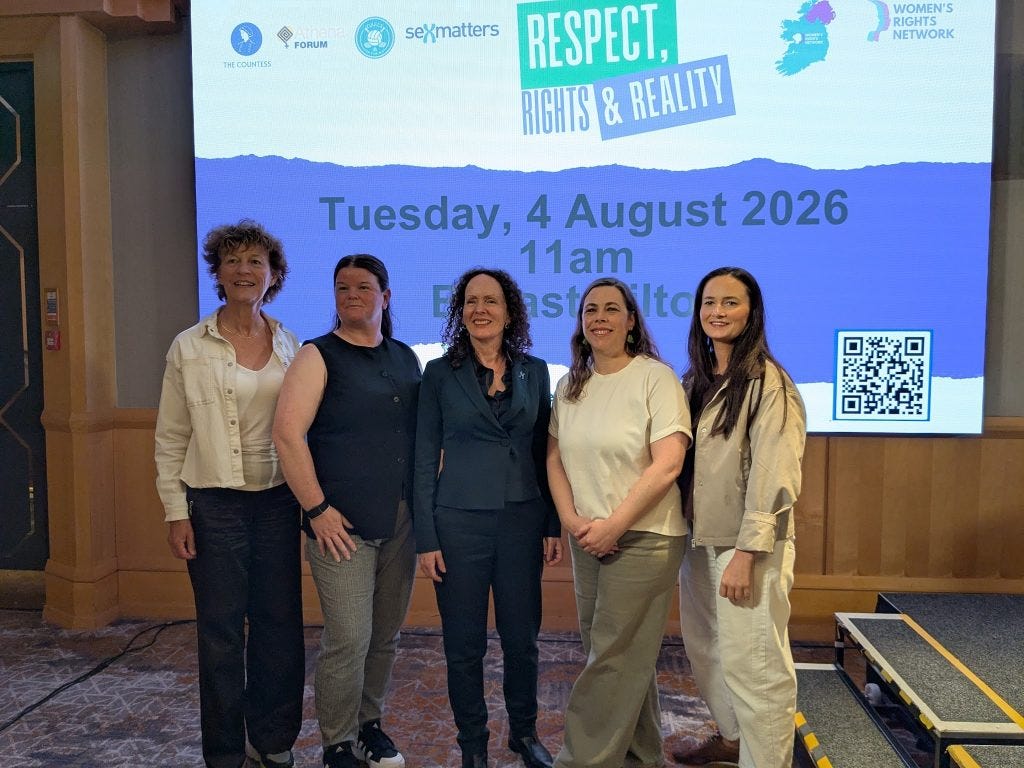
The final speaker was Sex Matters’ director of campaigns, Fiona McAnena, who was born in Derry. She spoke about her mother Josie, who had trained as a teacher at St Mary’s College (the venue for the cancelled talk), and gone on to become a headteacher while raising five children. “If she’d been born three years sooner she couldn’t have done that because of the ‘marriage bar’,” Fiona explained: until 1959 Catholic schools in Northern Ireland required female teachers to resign upon marriage. (The civil service did the same until the early 1970s.) “No one ever said of the marriage bar: ‘But how will we know who’s female?’,” Fiona pointed out. “Women couldn’t identify out of it. As far as I know, no one ever identified into it.”
This sort of sex discrimination is now thankfully outlawed, Fiona said, but the law also recognises that sometimes what’s fair or safe is to treat men and women differently or separately. She expressed her fury that single-sex spaces have become a negotiation. Saying that a space or service excludes all men “isn’t branding ‘all men’ as predators,” she said. “It’s ‘all men’ because it’s some men and we can’t tell which ones.”
Most men understand this perfectly well, and don’t object that being kept out of women’s spaces is some sort of insult, Fiona said. “They understand and accept the social contract.The problem is that if anyone can claim to be a woman then any man, even the wrong ’uns, can access women’s private spaces, single-sex services and sport by claiming to be trans. It’s not opening the door to a small number of trans people – it’s opening the door to all men. So, for the sake of 51% of the population, the boundaries must be based on sex, not identity.”
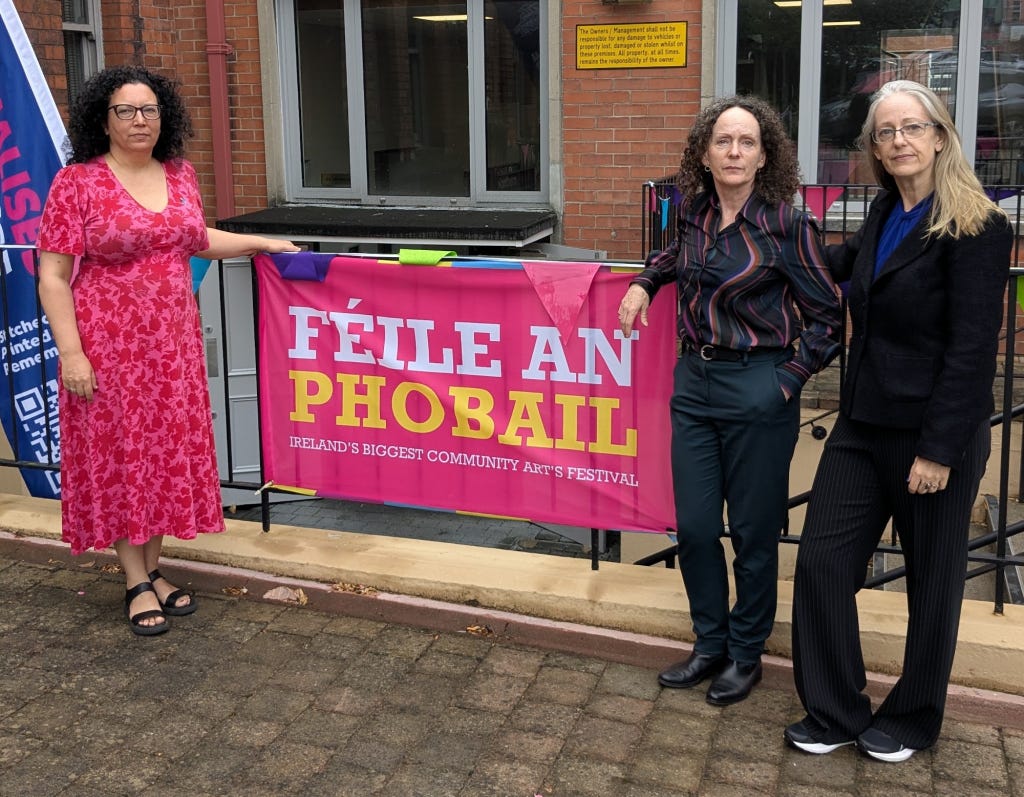
After the event the Sex Matters team went to meet our Northern Irish lawyers to discuss our prospects for challenging Féile’s belief discrimination in cancelling the panel.
We also talked about the next steps in judicial-review proceedings being brought by the ECNI, in which the regulator is asking the court to clarify how equality and related laws in Northern Ireland should be interpreted following the For Women Scotland judgment and in light of Article 2 of the Windsor Framework, which requires there to be no reduction in human rights and equality protections in Northern Ireland as a result of Brexit.
This case is dragging on slowly, and costing more public money. And when you focus on women’s rights, rather than the demands of men who wish they were women, it’s hard to understand why. As Nora Calder put it succinctly during the panel, it makes no sense to talk about people losing the right to access opposite-sex spaces, services and sports. This was never a right in the first place.
Great fight back against this crescendo of resistance to the Supreme Court ruling - one need only look (if you can bear to do so) at the Good Law Project webpage to see how everything focuses on destroying that Supreme Court ruling in practice (and therefore concentrates on the EHRC guidelines -- though the rationale offered is one of the most incomprehensively convoluted pile of nonsense ever). As you say, what are the rights of women against men who want to play at being women (and academics who are determined to assert their intellectual vanity). For some reason Jason Arday is mixed up with this outfit - you might have thought that after everything he would steer clear of such a group.
So glad the conference went ahead and was a great success after all that stupid shenanigans.
Good luck Belfast and all of the Irish sex realists.