

A worldwide survey of attitudes to “LGBT” issues published in June shows that most people oppose discrimination against gay, bisexual and trans-identifying people, but oppose trans-identifying men in women’s sport. British respondents go further, treating gay rights and “trans rights” differently.
The market research company Ipsos has conducted the same survey across 26 countries since 2021, making it easy to compare countries and to see how attitudes have changed over the past five years. It mostly uses “LGBT” as a single category, though it asks separately about LGB and transgender discrimination, and about specific transgender demands, such as options beyond M and F on passports and funding for gender-related medical procedures.
Its findings suggest that in the UK at least, more people are distinguishing between lesbian, gay and bisexual people, on the one hand, and trans on the other – and between tolerance and support for LGBT people and the demands of the trans lobby. That may help shed light on why corporate sponsorship for annual Pride events is falling. The survey also shows lukewarm public support for corporate LGBT activism, with only 44 percent of respondents agreeing that companies and brands should be “actively promoting equality for LGBT people”.
This weekend’s Manchester Pride, for example, will be much more modest than previous years’ extravaganzas after the company that ran them went into voluntary liquidation owing more than £1 million. According to the UK Pride Organisers Network, three-quarters of more than 100 Pride organisers around the UK have seen corporate partnerships decline this year.
Widespread support for protection from discrimination
80 percent of British respondents, and 75 percent across all 26 countries, agreed that “lesbian, gay and bisexual people should be protected from discrimination in employment, housing, and access to businesses such as restaurants and stores”. Likewise, most agreed that transgender people should have the same protections from discrimination – 74 percent of British respondents, 73 percent across all 26 countries.
It’s no surprise that Turkey, a conservative Muslim country, shows the lowest acceptance of gay and transgender rights at 51 percent, while Thailand is consistently at the top.
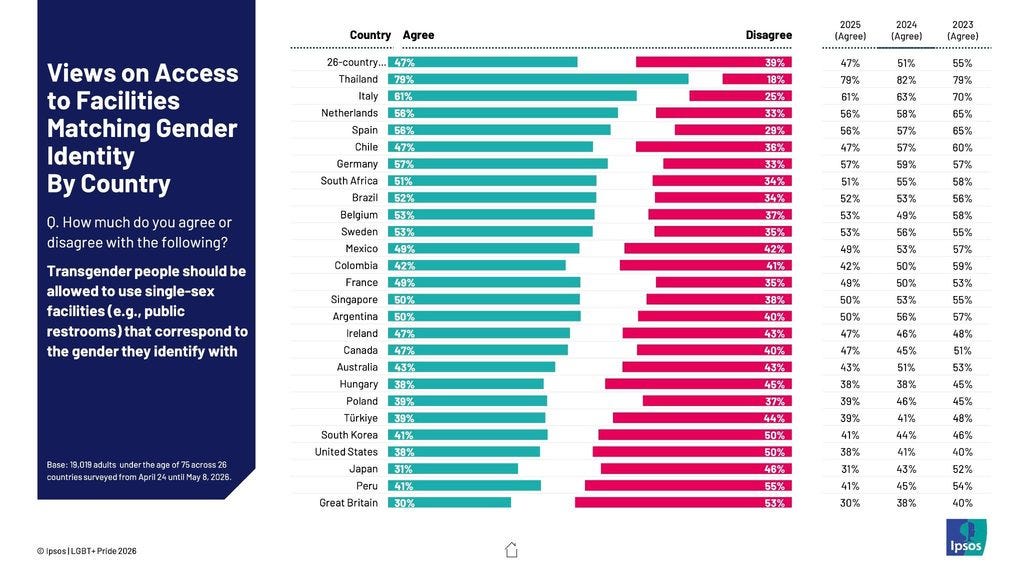
Great Britain is generally near the top on gay, lesbian and bisexual acceptance, and at the bottom on trans demands such as access to female sport.
Ipsos says:
“Majorities in the 26 countries surveyed continue to support legal measures to prevent discrimination against lesbian, gay and bisexual people. Meanwhile, support for same-sex marriage remains a global cornerstone of acceptance.
“Where we continue to find diverging views is on transgender access to single-sex facilities, healthcare provision and participation in sport.”
Britain is increasingly trans-sceptical
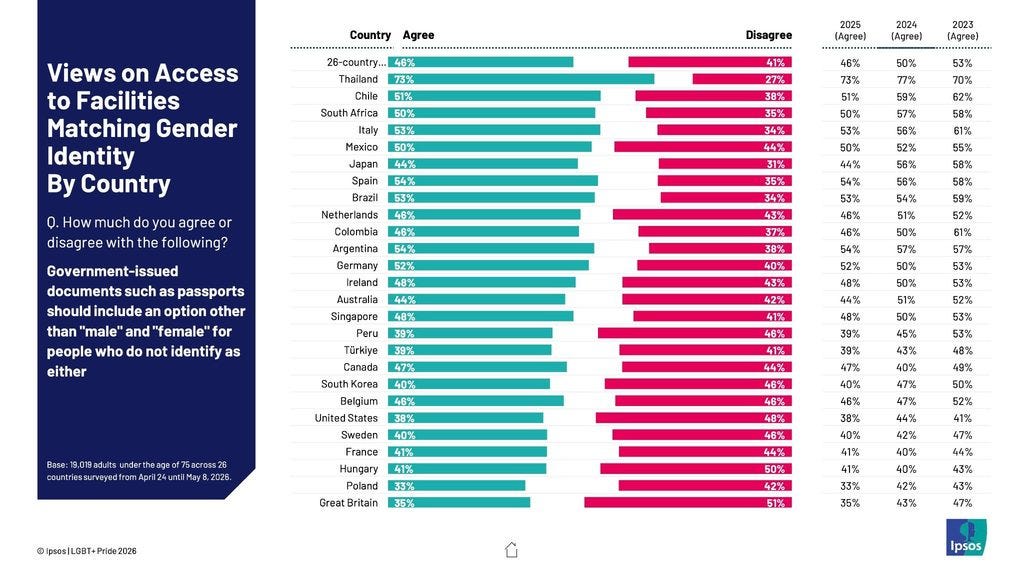
British respondents are strongly in favour of protection from discrimination for LGB and T, and slightly ahead of the global average. But when it comes to specific trans-related demands, like access to single-sex facilities and sport based on gender identity, British respondents are much less accepting.
Support for specific transgender demands is falling steadily
Support globally for laws to protect transgender people from discrimination has risen from a 55 percent average in 2021 to a 73 percent average in 2026, but this is not reflected in demands for special provision.
Ipsos says:
“We see widespread agreement that transgender individuals face discrimination, but divergence on policy-related matters such as access to single-sex facilities and participation in sports, highlighting ongoing societal debates. For instance, support for trans athletes competing based on their gender identity has dropped from 32 percent in 2021 to 22 percent in 2026, with opposition the dominant view in almost all countries, including historically supportive ones.”
Increasingly strong support for single-sex sport
Support for “transgender athletes competing based on the gender they identify with rather than the sex they were assigned at birth” averages 22 percent across all countries, a much lower level than for any other question in the survey. This support has fallen steadily since the survey began in 2021. Britain is near the bottom at 15 percent.
Watch an animation of changing support for transgender athletes competing based on gender identity.
Has growing awareness led to growing resistance?
The survey does not address awareness or understanding of the issues, or the media context. But it shows that British respondents distinguish between gay and trans demands. It may indicate, too, that they grasp the difference between “free from” and “free to”, with strong support for protections but very little support for people being permitted to enter opposite-sex provision based on identity.
It may be that increasing awareness of transgender demands in the UK, and perhaps the high profile of legal cases such as the Supreme Court judgment in For Women Scotland, has helped to clarify that being free to live as you wish has limits, where other people’s rights are affected.
It isn't over until women are not punished by organizations for voicing their concerns a man is in their private spaces. This is clearly an erosion of woman's rights and a movement to marginalize women's voices. Time to complain and post the response on social media. Time to sue.
Writing from Australia I see the institutional capture has been effective here. I was at Sal Grover's three day trial, and as a former lawyer, I knew she would lose, as she did with her appeal. I doubt whether her High Court appeal will be successful. Our idiotic federal statute that the Julia Gillard government amended to remove the definitions of man and woman and replace them with one nebulous term "gender identity" is transworld's success story here. It will take political will to overturn that and revert to reality and few politicians from the major parties have backbones. PS the One Nation party, who has vowed to overturn the amendment is fighting the good fight but has as much chance as the UK's Reform of achieving government. LGB is natural, trans is nothing but fantasy.