


Sex Matters is bringing a judicial review against the Crown Prosecution Service (CPS) for its unlawful guidance on sex by deception.
The guidance concerns the rare cases of sexual assault involving deception as to sex. We say the guidance is unlawful because it conflates the concept of subjective gender identity with objective sex and is confusing and incoherent.
The CPS asserts that “questions of deception and consent may involve more complex issues where the suspect is trans or non-binary”. This is wrong in law and could lead to both over-prosecution and under-prosecution, as well as encouraging young people to believe that their asserted gender identity overrides their sex in relation to other people’s sexual consent and sexual orientation.
That the CPS is defending its guidance is perhaps not surprising when you realise how deeply embedded in CPS policies and guidance is the idea of keeping trans people’s sex a secret and forcing others to pretend they have changed sex.
Twenty years ago the police and CPS were still willing to recognise the role of sexual fetish in cross-dressing and transgenderism. As guidance from the Association of Chief Police Officers said in 2005:
“Not every male or female that dresses as the opposite gender (transvestite) do so because they wish to permanently be defined in the opposite gender (e.g. transgender). Some do it as a fetish or for sexual gratification, some are simply driven by an unexplained urge to dress as a woman and are considered to be transvestites, but will have no desire to change their gender.”
The criminal justice system then embarked on a long process of forgetting, offence-taking, confusing itself with ever-changing terminology and ignoring the law.
An institution loses its way
In 2007 the CPS published its Policy for Prosecuting Cases of Homophobic and Transphobic Hate Crime. It defined “transphobic” as:
“A fear of or a dislike directed towards trans people, or a fear of or dislike directed towards their perceived lifestyle, culture or characteristics, whether or not any specific trans person has that lifestyle or characteristic. The dislike does not have to be so severe as hatred. It is enough that people do something or abstain from doing something because they do not like trans people.”
It defined a transphobic incident as:
“Any incident which is perceived to be transphobic by the victim or by any other person.”
The CPS did not consider that women might rationally fear men who overstep boundaries, or that people might be free to “do something or abstain from doing something” because of a person’s sex, not because of a generalised dislike of trans people.
In 2013 the McNally case established that deception as to sex could vitiate sexual consent. But the CPS was too busy taking directions from trans organisations to be clear about the law.
In 2014 it published the CPS Transgender Equality Management Guidance which drew on advice from the civil service trans and intersex network “a:gender”, and the lobbying groups GIRES, Press for Change and Mermaids.
This document wrongly said:
“Under this legislation [the Data Protection Act 1998], data relating to an individual’s gender reassignment (which includes a change of gender status and name) is classed as ‘sensitive information’, and therefore attracts a higher degree of protection than usual, especially when a Gender Recognition Certificate is held (see Gender Recognition Act below).”
This is the same mistake the EHRC has made in its new draft code for service providers this year.
In its Guidance on Prosecuting Cases of Homophobic and Transphobic Crime (which included guidance on cases with transgender suspects), the CPS said:
“Whether the trans person is a victim, witness or defendant, the CPS’ policy is that the person will be addressed in terms that reflect his or her present gender status. So, a trans woman, although having a birth certificate that shows her to have been born a male, should be addressed and charged and/or indicted, if appropriate, as a woman.”
In July 2019 the CPS published a Trans Equality Statement, the aim of which it said was to “sustain the confidence of communities”. It boasted that:
“The CPS has worked for a number of years with a wide range of Trans organisations nationally and locally.”
and stated that:
“Prosecutors should address Trans victims, witnesses and defendants according to their affirmed gender and name, using that gender and related pronouns in all documentation and in the courtroom.”
The Trans Equality Statement says that “misgendering” is a potential basis for a transphobic hate crime. And the prosecution guidance on homophobic, biphobic and transphobic hate crime says that the police and CPS “have agreed to treat unauthorised breaches under s22 Gender Recognition Act 2004 as potential hate crimes if the alleged victim or any other person perceives them as such”. That means that simply referring to a trans person’s sex is viewed as a potential “hate crime” by the CPS and police.
In 2020 the CPS produced an education pack for secondary schools, which promoted the idea that “wearing anti-LGBT+ badges or symbols” and “showing or distributing anti-LGBT+ leaflets, comics or other propaganda” could be hate crime. The pack had been developed with Stonewall and Gendered Intelligence.
One of the teaching exercises featured a video scenario where an adult male wearing women’s clothing goes into the women’s toilets. Two young women at the sinks whisper their discomfort: “What’s he doing in here? This is the Ladies.”
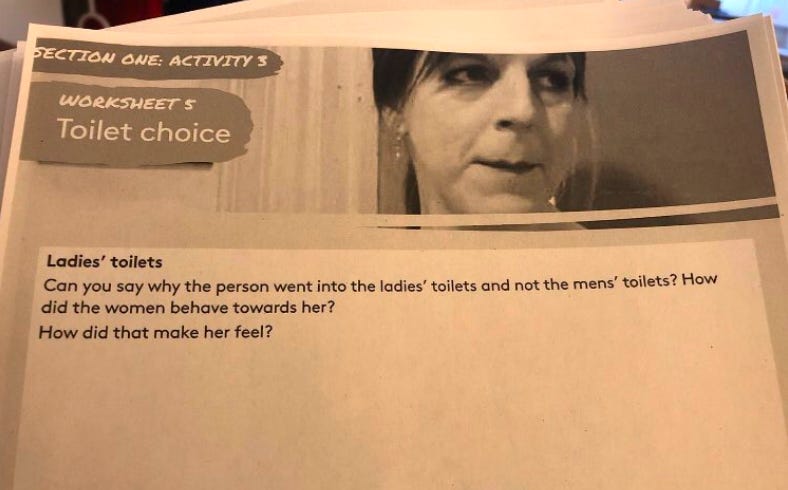
The class discussion guidance says:
“Ask the students what happened in the clip. Thinking about how the girl in the clip was treated, can the class understand why she might have felt hesitant about going into the toilets?” [By “girl”, it means the adult man.]
The worksheet for school children asks:
“Can you say why the person went into the ladies’ toilets and not the mens’ toilets? How did the women behave towards her? How did that make her feel?”
The guidance was only withdrawn after a 14-year-old girl brought a legal claim.
In 2021 the CPS published guidance for prosecutors on same-sex sexual violence and sexual violence involving a trans complainant or suspect/defendant, in which it said that the idea that “trans women” are men who want to deceive straight men into having sex “is part of a wider transphobic myth that trans women are ‘dangerous’”.
It also says:
“It is not uncommon for men who identify as heterosexual who engage in sexual activity with a trans woman to feel disgusted with themselves, and they may then react with violence towards the trans woman or to accuse her of rape. Gay men who have sex with trans men can also become violent and aggressive, and sexual violence can occur as a result.”
In 2022, when the CPS appointed Sophie Cook as its “speak out champion”, concerns were raised that he had a history of derogatory statements towards gender-critical women.
In 2022 the CPS updated its legal guidance on domestic abuse. It gave “withholding money for transitioning” and “refusing to use their preferred name or pronoun” as examples of domestic abuse against transgender individuals.
In 2024 these two statements were dropped in an update of the guidance, after the think-tank Policy Exchange pointed out that they do not constitute criminal offences. Instead the guidance now says that it might be a crime to refuse to use a family member’s preferred name “with the intention of causing emotional or psychological distress, particularly where the victim has obtained a recognised Gender Recognition Certificate”.
Of course a gender-recognition certificate does not direct how family members think and talk about a person.
Despite the documented instances of crimes with transgender perpetrators (including a disproportionate number of sexual offences), the experiences of “trans widows” and children of transitioners, which can include domestic abuse, and the fact that transgender perpetrators of homicide outnumber transgender victims, the CPS does not have any guidance that recognises clearly that “trans women” are men and “trans men” are women, and that transgender individuals may be perpetrators of crime.
There is increasing attention on non-contact deviant sexual behaviour as a risk factor for offending. But when recast as an expression of gender identity it may be overlooked or even celebrated, and those concerned by it cast as “transphobic”.
In 2022 Lionel Idan, CPS Hate Crimes Lead, told Pink News about gaining a sympathetic understanding of the behaviour of a man stealing women’s underwear:
“I remember one of my early experiences, it must have been 2006, I met with the chair of my local transgender advocacy group. She really made me think about the way we do things in a different light. She said, ‘Lionel, back when I was younger, I couldn’t walk into a shop and buy women’s lingerie. And so I used to have to steal items off of clotheslines’ … I said, ‘Of course, I’d have prosecuted you.’ And she said, ‘There you go. Now, you know the context. I had to steal, not because I’m a thief, but because I couldn’t buy what I needed for my identity.’ ... That was one of the moments where I realised, in the job I do, that to better understand lived experience is absolutely crucial.”
The frightening experience of a woman whose underwear was stolen off the line did not seem to trouble Idan.
Sex by deception
Individuals who lie about their sex online or in person in order to encourage another into a sexual act are disregarding consent, whether their victims are male or female, gay, straight or bisexual.
That the CPS can’t or won’t see this from the victim’s point of view is the result of 20 years of training itself to forget what it once knew about sexual fetish and deviant behaviour, to view “gender identity” as equivalent to sex, and to view gender-critical (that is, truthful) speech as a hateful act.
This whole movement ,the most misogynistic and homophobic ever ,just makes my blood boil and it's completely enraging that the CPS ,of all institutions ,has fallen for it ,hook , line and sinker. Good luck with the challenge .
Thank you for setting out the background to the CPS' guidance so clearly. Hard to countenance that the organisation that assists in determining whether a crime can be prosecuted has been influenced in this way and to such an extent.