

Update from Maya
Last week saw the news that the “Pathways” puberty-blocker trial has received ethical approval. We have written about the trial.
Baroness Cass, who played such a big role in closing the Tavistock GIDS clinic, defended the trial, saying: “Given that there are clinicians, children and families who believe passionately in the beneficial effects, a trial was the only way forward.” But of course a trial is not the only way forward, and an ineffective trial is no way forward at all.
The trial is designed to give blockers to every participant (only the timing differs). It takes for granted that pubertal suppression is the correct treatment and will only test the difference between getting them “now” or “later”. As Dr Emma Hilton has said: “If this trial had been submitted to the Cass Review as one more observational study, it would have been graded low quality and filed under ‘inconclusive’.”
The ghoulish history of blocking children’s puberty is littered with such poorly designed and badly analysed trials. Rather than stopping the practice, their effect was to license it.
The 2011 Tavistock GIDS study of 44 children opened the floodgates to thousands of children getting blockers. The finding that puberty blockers did not improve the wellbeing of the children acting as test subjects was not made public until 2020. And the NHS has failed to track and assess the wellbeing of the much larger number of children put on that supposedly still experimental treatment.
Since the Cass Review was published, the results of another study have emerged. In a US trial designed by gender clinician Johanna Olson-Kennedy, 94 adolescents recruited between 2016 and 2019 were given puberty blockers for two years. Olson-Kennedy told the New York Times in 2024 that publication was delayed because the results were not favourable. They were finally posted in May 2025: “Depression symptoms, emotional health and child behaviour checklist constructs did not change significantly over 24 months.”
The Pathways protocol does not cite this study in the references, and the authors seem unaware of it.
This is a pantomime of medical research. Like the US trial, Pathways considers whether blocking puberty improves children’s short-term wellbeing and mental health. Children will be asked questions such as “Have you felt full of energy?” and “Have you had fun with your friends?”.
But as transactivist Erin in the Morning wrote about the US study, improving short-term mental wellbeing is not what puberty blockers are for: “Ultimately, the purpose of puberty blockers is not to ‘improve’ a trans youth’s mental health…. Puberty blockers pause physical changes, ensuring that when a transgender youth is ready to begin hormone therapy, as determined by their medical team, they won’t have undergone unwanted pubertal changes.”

The Cass Review was published in April 2024, almost exactly a year before the Supreme Court pronounced that sex in law remains biologically determined. The question of what can lawfully, ethically and in good faith be promised to these children in terms of social transition has never been answered.
The practice of giving children puberty blockers is based on doctors’, parents’ and children’s wishful thinking about the degree to which other people, and institutions, can be forced to accept a person “as the opposite sex”.
We called on Baroness Cass to consider this question when carrying out her review, but were told it was outside her mandate. Following the For Women Scotland Supreme Court judgment the answer is even clearer.
On 28th April, together with Transgender Trend, LGB Alliance and Genspect, we wrote to Sir James Mackey, the CEO of NHS England, and Wes Streeting MP, Secretary of State for Health and Social Care. In that letter we explained the implications of the Supreme Court judgment and asked for the trial to be cancelled.
Recruiting children to a study that is based on a mis-selling of rights, and which forecloses their chances for adult sexual function and fertility, is unconscionable. It is a breach of the good clinical practice necessary for a lawful trial. This week we wrote to Streeting again urging him to stop the trial.
Maya Forstater
Institutional bias at the BBC
Our briefing to the Culture, Media and Sport committee looks at the BBC’s bias on transgender issues, from “preferred pronouns” that report on male murderers as if they were women, to the promotion of transgender ideology to children.
Why won’t the minister withdraw the outdated code of practice?
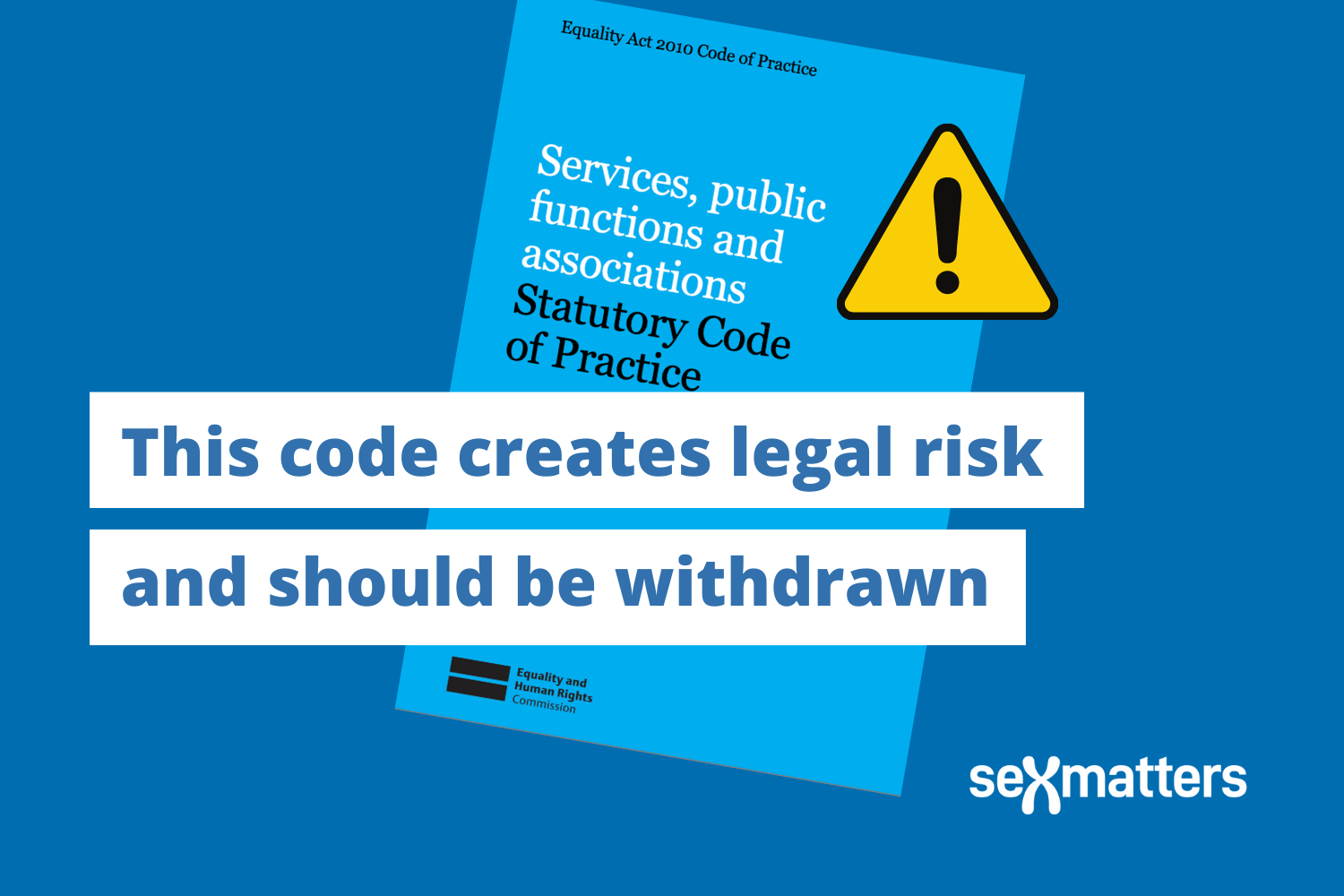
After For Women Scotland, the EHRC has admitted that its 2011 code of practice for service providers, which is still in force, is wrong in law. It has asked the Minister for Women and Equalities to revoke it before it does any more damage – so why hasn’t she?
In the news
The release of details on the upcoming NHS England trials of puberty-blocking drugs for children dominated the news this week. As quoted by David Churchill in the Daily Mail, Eleanor Hayward in The Times, Carole Malone in the Daily Express and Elizabeth Ivens in the Mail on Sunday, Maya Forstater said that the trial was unethical, and that the only reason to research puberty blockers is to be able to offer long-term medical support to those who have already been exposed. Tim Sigsworth for The Telegraph reported that the trial will ask children if they are “two-spirit”, which Maya said demonstrates the lack of seriousness in its scientific basis. Helen Joyce and Maya were both interviewed by GB News on the story.
Naomi Cunningham’s interview on BBC’s Scotcast was covered widely by the media. BBC News, Alistair Grant for The Scotsman, Rebecca McCurdy for The Herald, Douglas Dickie for the Scottish Daily Express and Marc Horne and John Boothman for The Times all covered Naomi’s comments that the Scottish Government is in denial regarding sex-based rights following the For Women Scotland judgment.
Daniel Martin for The Telegraph revealed that the Minister for Women and Equalities, Bridget Phillipson, confirmed to Baroness Kishwer Falkner, chair of the Equality and Human Rights Commission (EHRC), that she will not withdraw outdated EHRC guidance. Falkner had communicated this in a letter to Sex Matters, in which she said that she shared concerns about the 2011 code of practice being out of date.
Martin Beckford for the Daily Mail reported that the Cabinet Office paid £3,244 to organisers of Pride events across the UK so that groups of government employees could attend. Fiona McAnena said that the move raises questions about civil-service impartiality.
Writing for The Times, Mary Wright broke the news that Scouts Scotland is ignoring the Supreme Court ruling and allowing children and adults to use the toilets and sleeping quarters of the opposite sex. Helen said that the policy is a legal case waiting to happen and a huge failure of safeguarding.
Fiona went head-to-head with transactivist Paul Levene on Patrick Christy’s show on GB News to debate the trans-identifying male athlete who competed in the World’s Strongest Woman contest (he was later disqualified).
Want to get our weekly email update? Sign up now!