

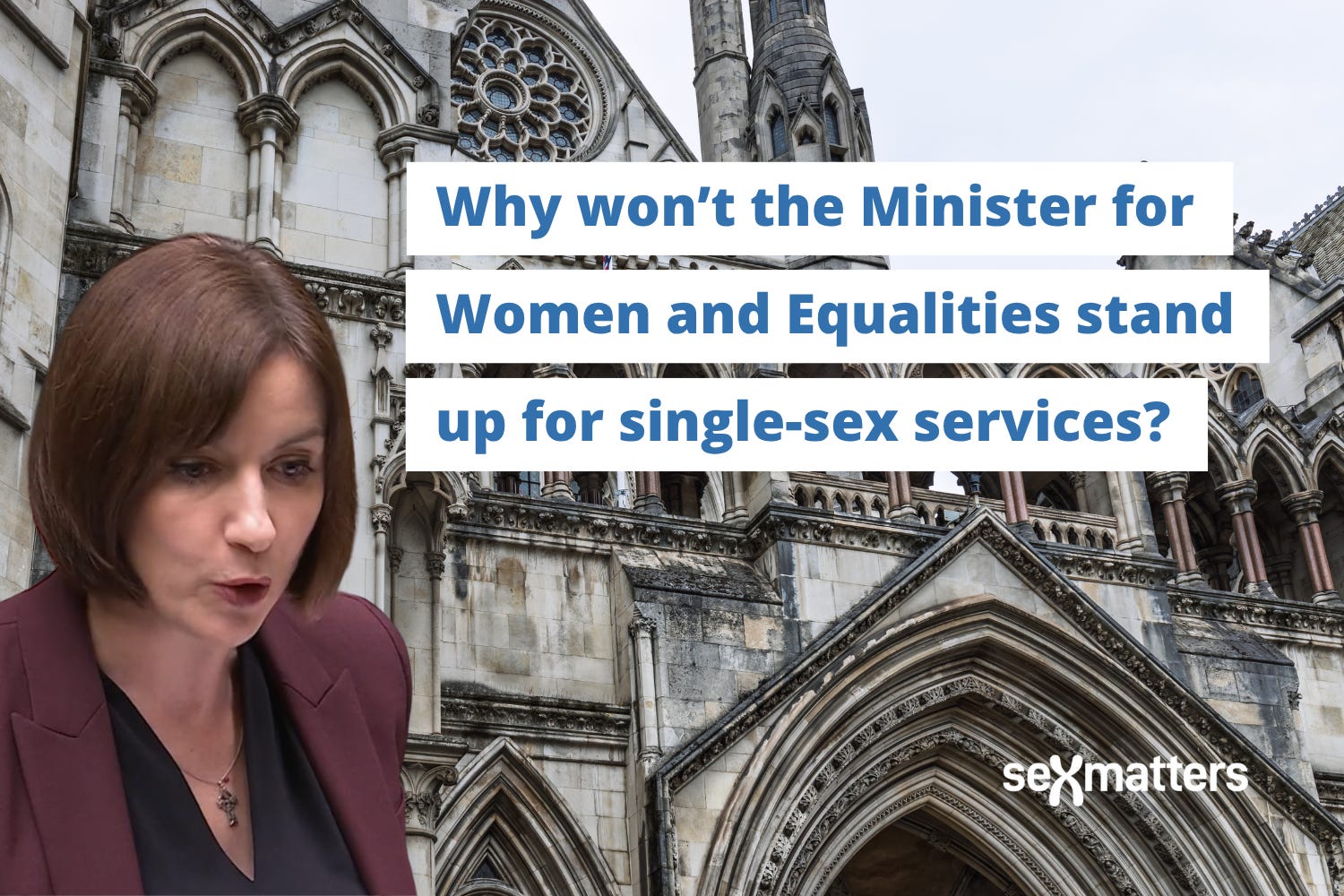
On 12th November 2025 the Prime Minister responded to a question in Parliament about the For Women Scotland case, saying that “the Supreme Court ruling must be implemented in full and at all levels”.
Yet the following day, counsel for the Minister for Women and Equalities put forward arguments in the High Court that led Mr Justice Swift to say she was “trying to rewrite For Women Scotland”.
Zoë Leventhal KC, making submissions on behalf of Bridget Phillipson in the case of Good Law Project and others v Equality and Human Rights Commission, denied this. But she presented an extraordinary series of convoluted arguments that seemed designed to create confusion and uncertainty and to undermine the basic duty of employers and service providers to ensure that single-sex facilities for women offer adequate privacy from men.
In its manifesto the Labour Party had promised to “continue to support the implementation of its single-sex exceptions”. And on 5th May, following the Supreme Court judgment, Phillipson had written to the Scottish Government saying:
“The UK government has always supported the provision of single-sex services based on biological-sex. The ruling brings clarity and confidence, for women and service providers, such as hospitals, refuges and sports clubs.”
But now the government is backtracking.
Following the Supreme Court judgment in April, the Equality and Human Rights Commission (EHRC) published an admirably clear interim update on single-sex facilities. It said, in short, that women’s toilets are for women, men’s toilets are for men, and those who don’t wish to use the correct toilet for their sex should use the unisex option. It reassured employers and service providers that if they offer all three and have clear rules, they can be sure they are meeting everyone’s needs and not breaching the law.
The Good Law Project (GLP) says this sensible advice is wrong in law and “transphobic”, and that it breaches trans people’s human rights. It has brought a legal challenge together with three anonymous individuals who felt upset when their employer responded to the judgment by telling staff who didn’t wish to use the correct facilities for their sex to use the unisex facilities.
In the government’s intervention in the case, the Minister for Women and Equalities declined to back the EHRC in defending its update, instead entering a “neutral” plea on the question of whether its advice to service providers and employers was correct in law.
Questioning the exceptions
The government’s legal submissions appear to be a desperate search for a loophole that would enable service providers and employers to continue to allow trans-identifying men into women’s spaces. The written submissions call single-sex services “trans-exclusive” and seem set on undermining legal certainty and reinventing the argument for “case-by-case” decision-making:
“The premise of the trans-exclusive interpretation of the EA 2010 appears to be that, absent lawful reliance on the [single and separate sex service] exceptions, a [single-or separate sex service] will amount to direct sex discrimination of men and/or women.”
This was up till now an uncontroversial statement of the obvious. If you put up a sign that says “women only” or “men only” you are discriminating against members of the opposite sex by excluding them, and the Equality Act provides single-sex and separate-sex exceptions to allow this.
The EHRC’s code of practice for services, which has been in place since 2011, contains a section titled “Single-sex only services”. It says:
“The Act provides that the prohibition of sex discrimination does not apply where services are provided exclusively to one sex, as long as to do so is a proportionate means of achieving a legitimate aim, and at least one of the conditions set out below applies…”
The fifth of those conditions is:
“The service is for, or is likely to be used by, more than one person at the same time and a woman might reasonably object to the presence of a man (or vice versa).”
The example given is:
“Separate male and female changing rooms or any service involving intimate personal health or hygiene.”
This clearly covers male and female toilets.
But, in a piece of logic that appears to have been sourced from transactivist social media, the government’s submissions now argue that perhaps the single-sex and separate-sex exceptions don’t apply to such everyday facilities as separate men’s and women’s toilets at all.
“The first question in law must logically be whether a [single or separate sex service] amounts to direct sex discrimination. If it does not, then there is no need to consider the Exceptions.”
So it says that you have to start with an individualised, fact-sensitive determination. In most cases men don’t want to use the ladies’, so there is no less favourable treatment in not allowing them to. In oral submissions Leventhal said that unless a claim of sex discrimination was made out:
“you wouldn’t get to the analysis of having to maintain a single-sex exception based on an exception to discrimination that isn’t present.”
This is starting at the wrong end of the argument for a respondent (such as a service provider or employer). The purpose of the single-sex and separate-sex exceptions is to give these duty bearers a safe harbour to offer straightforward, familiar single-sex and separate-sex services including toilets, changing rooms and showers without fearing that they are breaching the sex-discrimination provisions and without having to go through complex legal arguments to consider whether any specific individual could be lawfully excluded.
The Schedule 3 exceptions can be used in order to provide a separate-sex or single-sex service, wherever the service satisfies at least one of the “gateway” conditions and is a “proportionate means of achieving a legitimate aim” to offer a service designed in this way, rather than to be provided to both sexes together. As the notes to the relevant part of the Equality Act say:
“This paragraph contains exceptions to the general prohibition of sex discrimination to allow the provision of single-sex services.”
Now the government is arguing that the question of whether the exceptions apply depends first on determining whether an individual man can prove that he suffered less favourable treatment on the basis of sex by being excluded from a women’s space. If he didn’t then no unlawful discrimination occurred. If he did then the exceptions can kick in and no unlawful discrimination occurred. This is a pointless diversion from the basic purpose of the law.
The only purpose of this argument seems to be to try to create uncertainty and blur the rules about whether an apparently single-sex service is a single-sex service at all.
Creating uncertainty
The Minister for Women’s legal team then threw more transactivist talking points at the EHRC’s simple clarity.
Perhaps single-sex services need to allow for “derogations”, the submissions argue. Both GLP and Leventhal pointed out that mothers are allowed to take their infant sons into the women’s changing rooms at the swimming pool, and suggested that this created the possibility of allowing grown men into female-only spaces.
“Now, that’s a point that perhaps ought to be addressed, because there may well be a relevant distinction between those two scenarios,” said Mr Justice Swift.
“I don’t wish to advance the point any further, my Lord,” said Leventhal.
“So he’s got the interesting bit, and you’re saying you’ve got nothing more to say?” replied the judge.
But many women’s services, including women’s refuges, admit young children of either sex. Using this to introduce uncertainty about whether adult men should be allowed in “as women” is absurd.
The government’s submissions included two further ridiculous scenarios: “A theatre attendant permits a pregnant woman who faces a queue for the women’s lavatory in the interval to use the men’s lavatory”, and “A peripatetic female massage therapist who only provides massages to women makes an exception for a man with whom she has a pre-existing professional relationship.”
“Could we come to an example much closer to home? Because I always find they help,” said Mr Justice Swift, seemingly exasperated by the government’s diversion from the main point.
“So the minister’s submission… is that a single-sex provision, a provision which is open to, say, women and trans women, is still a single-sex provision. Is that right?... Because that’s what you appear to be saying,” he said.
Leventhal replied No, but the government’s submissions seemed to dodge back and forth around this question, sometimes suggesting that such provision was single-sex with “derogations” and sometimes suggesting that although described as for “men” or “women” they were not actually separate-sex or single-sex in the sense meant in the Equality Act. On whether a service provider could provide a women-only service that allowed in trans-identifying men, she said: “You may... You may be unable to... There’s a possibility... You might nonetheless need to look at the fact-sensitive issues”.
None of this makes sense in the real world, where service providers need to be clear to everyone whether a service or space is for men, women or both sexes. This is essential to avoid creating situations that are likely to be hostile, humiliating and degrading – for women or for men who wish they were women, or indeed for both – and unworkable for staff.
Rewriting the law
The government seems to be trying to stick to the faulty interpretation of the law that it advanced before the For Women Scotland judgment.
Last year members of the public sent in 404 bad policies in response to a call for evidence from the previous government.
The Office for Equality and Opportunity, which has long been the prime promoter of Stonewall law throughout the civil service, concluded that the majority of the policies which allowed those with the protected characteristic of gender reassignment to use single-sex spaces that “correspond with their self-identified gender” were “correctly interpreting the Equality Act’s single-sex spaces provisions”.
The government’s interpretation at the time was that policies were unlawful only if they suggested that allowing trans-identifying men into women’s spaces was mandated by the Act.
The Supreme Court judgment has made clear that this interpretation was wrong. This is what was reflected in the EHRC’s interim update.
The government should know that if it won’t comply with the law, it is going to end up in court.