

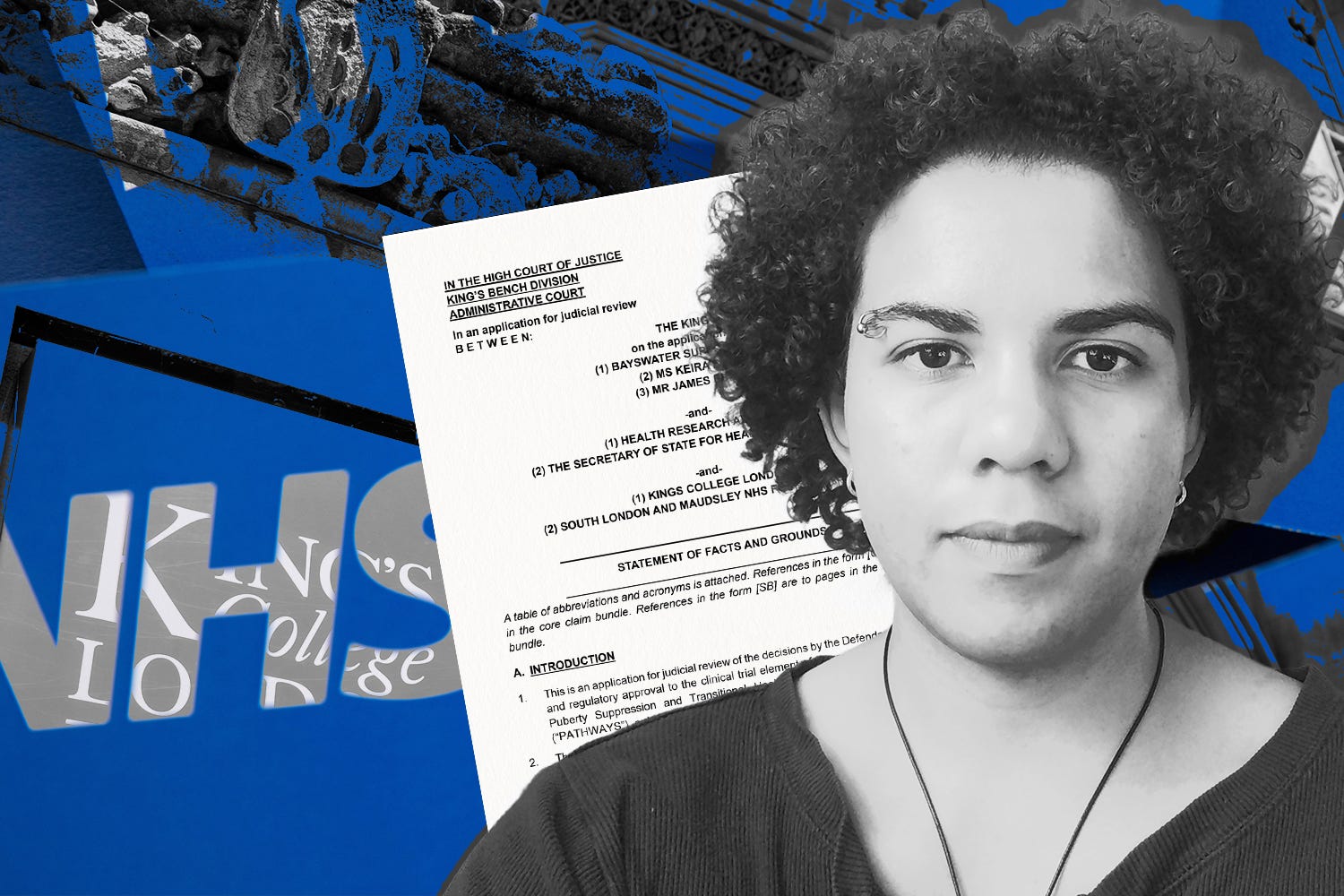
The King’s College London “Pathways” clinical trial of puberty blockers has been paused because of safety and ethical concerns raised by the Medicines and Healthcare products Regulatory Agency (MHRA).
Sex Matters has written to the MHRA and is organising a lobby day on Tuesday 10th March with the Women’s Rights Network and LGB Alliance. (Sign up at the WRN website.)
The decision to pause the trial came not long after Bayswater Support Group, Keira Bell and James Esses filed an application for judicial review against the Health Research Authority (HRA) and the MHRA challenging the lawfulness of their decision to approve the trial.
The key question the regulators were required to test before approving the study was whether the “foreseeable risks and inconveniences” of the drug trial for patients justified the “anticipated benefit” for individuals in the trial and other potential patients.
There has been only partial disclosure of the minutes and papers of the decision-making process that led to the trial being approved. But what they reveal is a shambolic process in which the research ethics committee’s members and regulators failed to establish that there was any clear rationale for interfering with the natural pubertal development of healthy children before giving the study the green light.
The research ethics committee (REC) held only one full meeting, on 4th September 2025, and after that made decisions in a dwindling sub-committee. At the first meeting, the members accepted the assurance of the researchers that they “were confident that the risk/benefit balance was appropriate for the study” and that “there was no data at present on the cognitive impacts of puberty blockers”.
The MHRA letter seems to accept that this confidence was misplaced.
The legal challenge
The claimants – Bayswater Support Group, Bell and Esses – say that the claim that benefits outweigh risks was inaccurate and significantly misleading because there is data on the cognitive impact of puberty blockers from animal studies, and other established risks of harm of puberty blockers that were not considered.
They also highlight that at some point last year the MHRA issued a written notice to the trial sponsors which set out 22 grounds for not approving the trial, including that the benefit of the treatment was not adequately identified. The Commission on Human Medicines (CHM) agreed with this and at a meeting on 18th September 2025 concluded that:
“On the evidence before them, the CHM had reason to think that on grounds relating to safety they might be unable to advise the grant of a Clinical Trial Authorisation for this trial at present.”
But following further communications from the trial sponsors, the MHRA and CHM appear to have changed their minds. There has been no disclosure of how this happened.
The claimants highlight the many experts who raised concerns and were ignored. The Clinical Advisory Network on Sex and Gender (CAN-SG) engaged in extensive correspondence with both the HRA and the MHRA, and also wrote directly to the chair of the REC arguing that the anticipated benefits of the trial did not justify the risks, and highlighting the availability of alternative sources of data (the data-linkage study) and less harmful interventions that could be carried out. However, the HRA did not provide the REC with CAN-SG’s correspondence, on the basis that all these concerns would be covered in the application for ethical approval, and instead treated it as a “complaint”. The REC’s minutes show there was no consideration by committee members of the concerns raised by CAN-SG.
Professor David Curtis, together with nine other clinicians and researchers with expertise in neuroendocrinology, psychiatry, psychology and medical ethics, also wrote to the HRA raising concerns – in particular about the effectiveness of a two-year follow-up period for the proposed trial and the risk of serious and irreversible harm. The HRA informed him that it had shared the letter with the chair of the REC who had decided there was no basis to share it with the rest of the REC.
Does the trial balance risk and benefit?
In order to approve the trial the REC was required to consider whether the anticipated benefits justified its risks, and whether there was “some direct benefit” for the group of patients involved in the trial. The minutes show that they did not do this, but accepted the research team’s assurance that the risks and benefits would be assessed on a case-by-case basis by clinicians.
They also did not consider the broader risk entailed by putting children on a pathway to cross-sex hormones and social and medical transition. The desire to undergo this pathway of transition is one of the requirements of participants in the study. But instead of considering the full risk, the REC asked for “transition” to be taken out of the title of the study, and treated puberty blockers as a two-year intervention to improve a child’s mood and social functioning.
The Participant Information Sheet for children says in answer to the question “What might be good about taking part?”
“We do not know whether the treatment may help you…“
The trial is paused
On 11th February the MHRA wrote to the trial sponsors to raise concerns regarding the trial. On 23rd February Wes Streeting, the Secretary of State for Health and Social Care, told Parliament that the preliminary work to establish the planned “Pathways” puberty-blocker trial had been paused.
The judicial-review claim and the MHRA’s letter focus on the grave foreseeable physical risks and likely harms caused by puberty blockers on cognition, bone mineralisation and fertility.
The MHRA letter correctly recognises that puberty blockers are the start of a medical pathway towards transition:
“It is likely that further GRHa treatment could be needed for many years (particularly if participants are significantly below the age of 16 at trial completion) as a bridging measure as cross-sex hormones are only prescribable from the age of 16.”
The idea of social transition remains unexamined
Any consideration of the risks and purported benefits of any part of this treatment pathway must assess whether the expected destination is realistic.
But the officials have not yet considered whether the fundamental promise being made to children that they can “live as the experienced gender” – and that it may be worth being sterilised and risking adult sexual function for this – is achievable.
Medical transition has been promoted based on a widespread misunderstanding of the laws that protect everyone’s human rights. This was made absolutely clear by the Supreme Court’s judgement on 16th April 2025.
We wrote to the Secretary of State for Health and Social Care last year, on 28th April and on 24th November, and on 16th February of this year, raising concerns about whether parents and children could meaningfully assent or consent to medical treatment based on hoped-for outcomes which simply cannot be achieved within the framework of UK law, and asking him to send the study back for further ethical consideration.
The clarified interpretation of the Equality Act and the recognition that other people have human rights rules out the promise that a boy can grow up to be a woman or a girl can grow up to be a man. Individuals cannot expect to use opposite-sex services and spaces, or demand that other people treat them as if they were the opposite sex, whatever physical interventions they undergo.
On 13th February 2026 the High Court confirmed that the EHRC was correct to say that separate-sex facilities are lawfully provided on the basis of sex, not gender identity, and the Secretary of State for Education has published a new version of the statutory safeguarding guidance, Keeping Children Safe in Education, which confirmed that children cannot lawfully be permitted to use opposite-sex facilities at any time during their school career.
The messages being presented to children and the promises being made to patients must be reassessed. Providing medical interventions with known physical and cognitive harms in pursuit of unachievable goals is unethical and likely to be unlawful.
What now?
There will now be discussions between the MHRA and King’s College London to address the concerns raised in the MHRA letter.
Wes Streeting, the Secretary of State for Health and Social Care, will review the outcome of those discussions, taking clinical advice. He has said:
“The clinical trial will not start to recruit until the issues the MHRA raised have been resolved. It will only be allowed to go ahead if the expert scientific and clinical evidence and advice conclude it is safe to do so.”
On Monday 9th March there will be a Westminster Hall debate on the puberty-blocker trial and on Tuesday 10th March there is a mass lobby of Parliament in Westminster.
Now is the time to raise concerns with your MP about the trial, and to ask for a meeting and plan to come to the lobby day if you can.
Sign up for the lobby day via the Women’s Rights Network, which will provide all the information you need.
Thank you for this. It contains a lot of information I was not aware of. They are selling children an unrealistic future.
What an incredible administrative shambles surrounded the proposals for this deeply unethical clinical trial: plus disingenuous demand by the so-called Research "Ethics" Committee to omit the word "transition" from the trial's title...
And an admirably clear letter from Maya Forstater / Sex Matters: thank you. All credit too to Keira Bell and James Esses for their sterling legal work.