

The judgment in Sandie Peggie vs NHS Fife and Dr Upton has been published.
We are pleased that Sandie Peggie has won her claim of harassment against NHS Fife, and that the hospital trust was criticised for its terrible handling of the complaint against her.
This is a long judgment and it will take time to analyse it fully. But overall we are disappointed in the tribunal’s approach, which sought to reach a spurious “balance” between a woman’s right to undress with privacy and dignity, and the right of an employee with the protected characteristic of gender reassignment not to be discriminated against in employment.
We hope that parts of the judgment will be appealed.
The idea that a woman finding herself unexpectedly or unwantedly in a “female” changing room with a man must consider questions of human rights or the protected characteristics in the 2010 Equality Act is ridiculous and unworkable.
The way that an employer should protect both of their rights is to set clear rules about whether spaces are single sex or mixed sex.
The case demonstrates that employers with ambiguous policies are putting themselves in legal jeopardy. But the tribunal has failed to provide them with the clarity they need in order to be confident that they can simply and clearly say No to men who want to use women’s spaces.
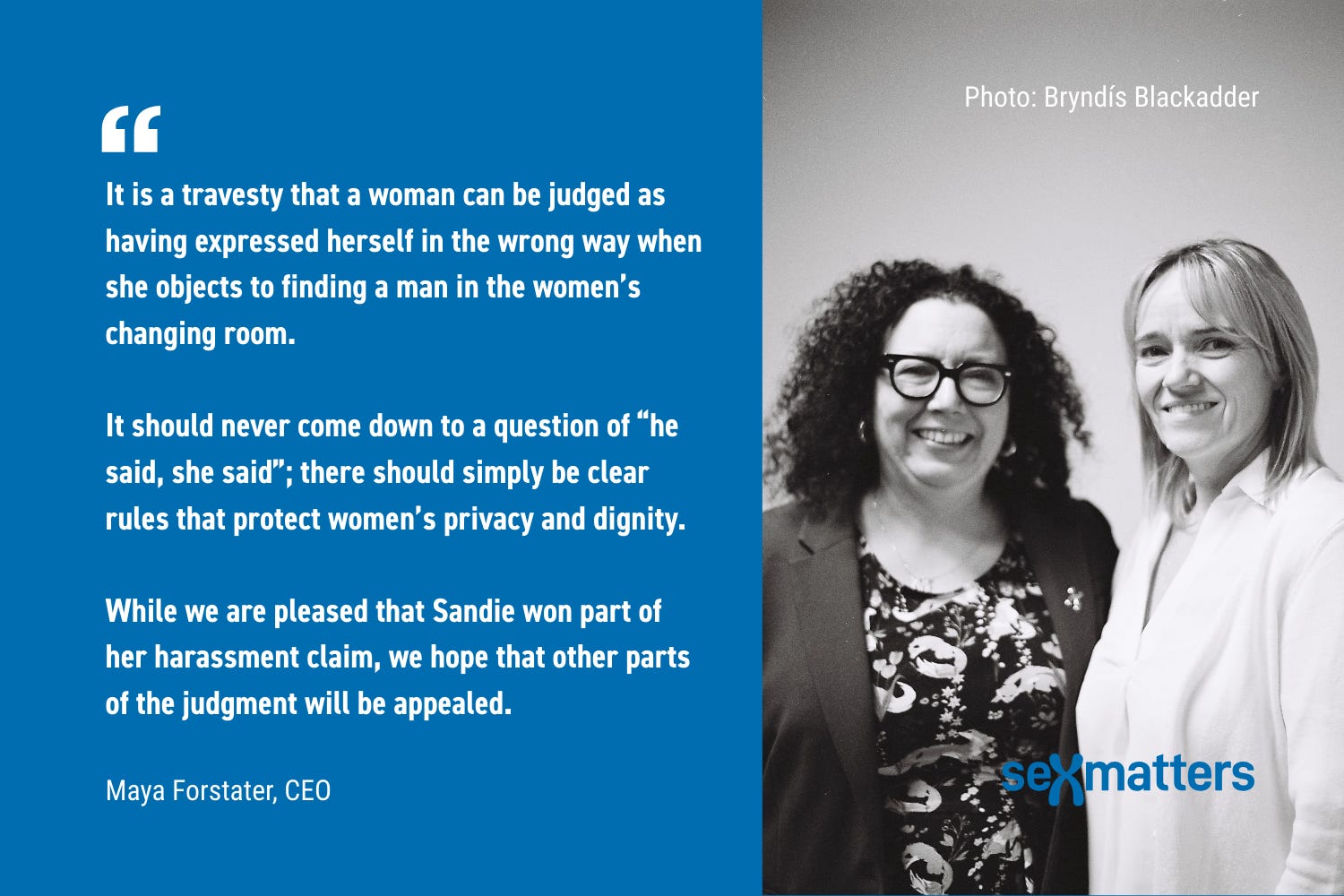
It is a travesty that a woman can be judged as having expressed herself in the wrong way when she objects to finding a man in the women’s changing room. It should never come down to a question of “he said, she said”; there should simply be clear rules that protect women’s privacy and dignity.
Sandie Peggie has said:
“I am beyond relieved and delighted that the Tribunal has found that my employer Fife Health Board harassed me after I complained about having to share a female only changing room with a male colleague.
“The last 2 years have been agonising for me and my family. I will have much more to say in the coming days once I’ve been able to properly consider the lengthy judgment and discuss it with my legal team. For now, I am looking forward to spending a quiet few days with my family.”
Sandie’s bravery is an inspiration, but it shouldn’t require bravery for women to be able to say to their employers, clearly and in natural language, that male colleagues – men, in other words – have no place in spaces that exist for the safety, dignity and privacy of women.
There are thousands of women like Sandie all over the country. The only way to break the pattern of harassment of women who object to men in women-only spaces is to have clear rules and expect everyone to follow them.
This problem cannot be solved by leaving individual women to upend their lives, fundraise to take court cases and then endure cross-examination and public scrutiny – all simply to win back what was a right that was beyond question until recently, and which most people still support.
The Health and Safety Executive now urgently needs to step up and provide clear guidance to employers on workplace toilets and changing rooms. Employers cannot be expected to make complex human-rights determinations about whether particular men are allowed into women’s changing rooms, and then wait and see if any individual women complain.