

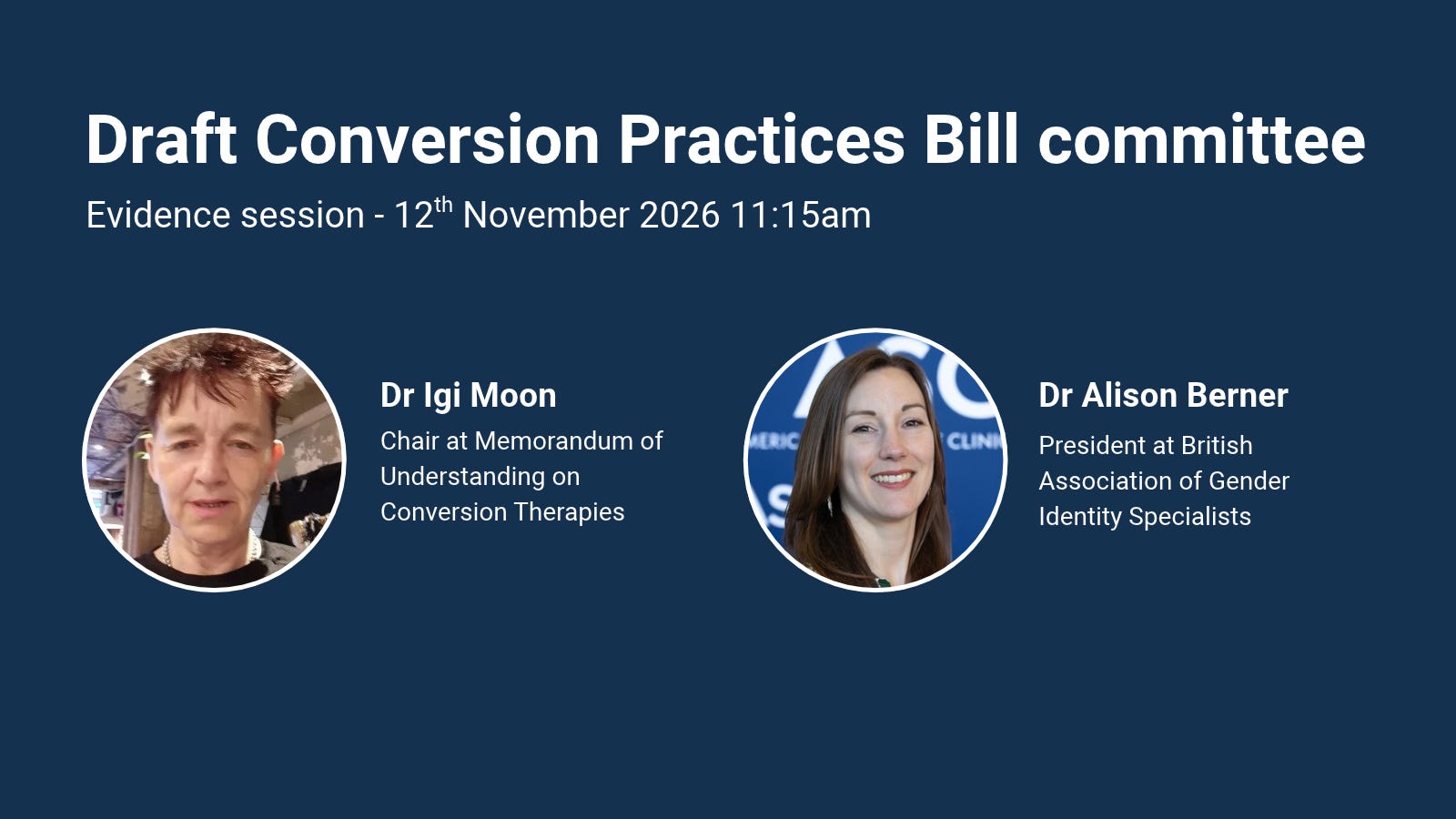
On Thursday 12th November the joint committee of MPs and peers examining the draft Conversion Practices Bill held its third evidence session. It heard two panels of two witnesses. The first was Dr Igi Moon, chartered counselling psychologist and chair of the Memorandum of Understanding (MOU) coalition on conversion practices, and Dr Alison Berner, medical doctor and president of the British Association of Gender Identity Specialists (BAGIS).
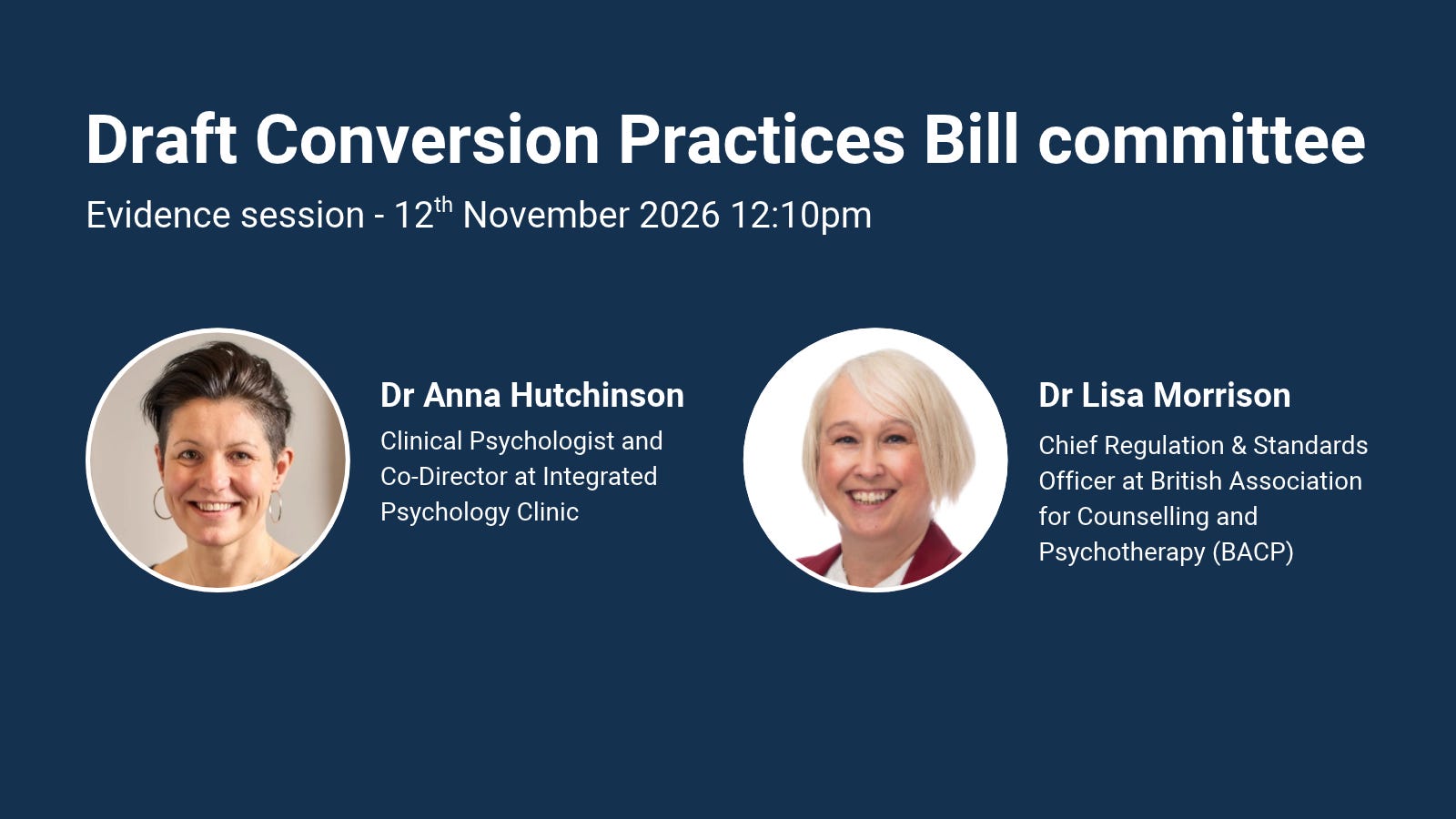
The second was Dr Lisa Morrison, chartered psychologist and chief regulation ad standards officer at the British Association for Counselling and Psychotherapy (BACP), and Dr Anna Hutchinson, clinical psychologist and former senior psychologist at the Tavistock Gender Identity Development Service (2013 to 2017), who raised concerns about practice there.
Moon works for Gender Plus, a private clinic set up by gender-affirmative clinicians who left the Tavistock. It treats 16- and 17-year-olds with cross-sex hormones. Berner works as a gender doctor at the Tavistock and Portman adult gender identity clinic. Both BAGIS and BACP are signatories to the MOU. Hutchinson is a UK adviser to the Society for Evidence-Based Gender Medicine and has provided training to the new teams at the hubs set up to replace the Tavistock service.
A profession split
Hutchinson described a profession that is “profoundly split” on what appropriate practice is:
“Gender-affirming care is different from psycho-therapeutic practices because it includes quite a significant medical pathway. I am being crude; there are different ways to practise, but crudely, a gender-affirming care approach would start by affirming someone’s gender identity, possibly helping a young person socially transition, and then medically helping a young person alter their body to be more aligned with their gender identity through puberty blockers, cross-sex hormones and surgeries on sex characteristics and secondary sex characteristics. That is an exceptional medical pathway for something like an identity or a subjective experience. We would not offer anything that invasive for other identities, subjective experiences or psychological or psychiatric diagnoses, and certainly not with children in development.”
Moon, who would describe herself as gender-affirming, had neatly illustrated the point during the previous part of the evidence session: “When I say ‘affirmation’, I think we mean acceptance and empathy.” She also said it was unhelpful to identify a difference between exploration and affirmation.
Caution labelled conversion
Moon set out her support for the bill as, in part, uniting the profession:
“I think that the bill offers an opportunity for us to bring an end to practices that are not acceptable and build on that together – we have a vision, so we have this as a plan and we collaborate; that is what we do in therapy.”
Hutchinson highlighted the accusations of “conversion practices” already levelled at clinicians who work with young people in a developmentally informed way:
“Some people on the more gender-affirming side have started to use some quite emotive rhetoric towards anybody who wants to look at the evidence base or think in a developmentally informed way about the gender-affirming approach. The term ‘conversion therapist’ has been inaccurately thrown around quite a lot in this field. Wes Streeting and Baroness Cass have been called conversion therapists, and every practitioner I know who works in the field in a developmentally informed, ordinary way has already been called a conversion therapist.”
The prospect of a ban on “conversion practices” concerned her, she said, because it would make clinicians afraid of approaching the gender-identity aspect of a young person’s life in the same way that they would other aspects of their identity.
No witness gave the committee examples or numbers of cases of conversion practices in healthcare settings. Morrison said BACP was “not aware of any complaints that have solely focused on or covered conversion practices”. Berner said members had sent BAGIS anonymised accounts, mostly involving young people, but gave no examples.
Hutchinson said that in her clinical practice she had not encountered abusive conversion practices as the bill describes them:
“I have worked with hundreds to thousands of young people and with many colleagues who have worked with young people exploring their gender and who identify as trans. I have to be honest: I have never heard of any experience of abusive conversion practices as described by this bill. I have heard, obviously – we see it a lot – of high-conflict environments where families are very concerned about their children, and sometimes that does verge into worrying territory, but I cannot say that I have seen exorcisms and abuse. That does not mean it is not happening, but that is my personal clinical experience.”
Who decides the standard?
Moon and Berner were confident that the healthcare exemption in clause 1(3), which protects conduct in the course of healthcare services unless it “falls far below the standards reasonably expected of a person in their position”, leaves therapists room to work.
Berner described the threshold as “akin to gross negligence”, which matches the government’s explanatory notes for the bill. Her answer to any remaining risk was regulation and guidance. “The devil will be in the detail of the guidance,” she said.
Both agreed that “the healthcare exemption should only apply to regulated healthcare professionals”, the amendment Stephen Kiely of Stonewall proposed in the first session. Morrison asked for the bill to refer to practitioners on registers accredited by the Professional Standards Authority. That is not what the draft bill says. Clause 1(9) covers “all forms of health care services provided for individuals”, and the explanatory notes say this includes “regulated or unregulated professionals”. The supporters’ proposal would make the safe zone dependent on registration with bodies whose standards, on Hutchinson’s evidence, are in dispute.
Hutchinson’s concern was that clause 1(3) refers to what is reasonably expected “of a person in their position”, but does not say whose view of that counts. In gender identity, Hutchinson said: “There is quite a big divide on what the correct standards are…. In a divided field, who gets to decide what standards are reasonably expected?” She suggested that if the government is following the Cass approach, “maybe that needs to be made clear in the bill”.
The potential for career-destroying complaints
Hutchinson accepted that it would be unlikely for any decent clinician to truly fall “far below” standards reasonably expected. But that did not mean clinicians would be safe: “It does not matter if you meet the legal threshold for criminalisation if working in this field means that you are more likely to be accused of conversion therapy.”
Once accused, she explained, a clinician has to deal with their regulator, which is costly in money, time, stress and harm to reputation. With such disagreement over accepted standards, the likelihood is that courts would end up deciding, which means unfortunate individuals becoming test cases. That, she said, would leave therapists “very afraid to work in this area, in case they may be that first person”.
Berner also raised vexatious complaints as a reason for the healthcare exemption. But the exemption only provides a defence once a complaint is being investigated or prosecuted; it does nothing to stop one being made in the first place.
Parents are not protected
Naz Shah MP pointed out that the healthcare exemption creates a gap between the treatment of therapists and parents: what a therapist says may be protected when a parent who says exactly the same thing is not. Hutchinson agreed, pointing out that, in such conversations, the motive of a lot of parents is “to keep children safe”.
Morrison, whose organisation backs the bill, said that “ordinary parenting, family discussions, pastoral conversations or expressions of belief concerning sexual orientation and gender identity do not in themselves constitute conversion practices”, and that making this clear is “possibly something that needs greater exploration in the draft bill”.
The Minister for Women and Equalities’ insistence that the bill will not affect parenting is not reflected in its wording.
Related content
Conversion Practices Bill should be tougher, supporters say
Criminalising parents who don’t affirm – the first evidence session
So, how do therapists see the client making an informed choice, with a ban hanging over what can be explored in therapeutic discussion?