

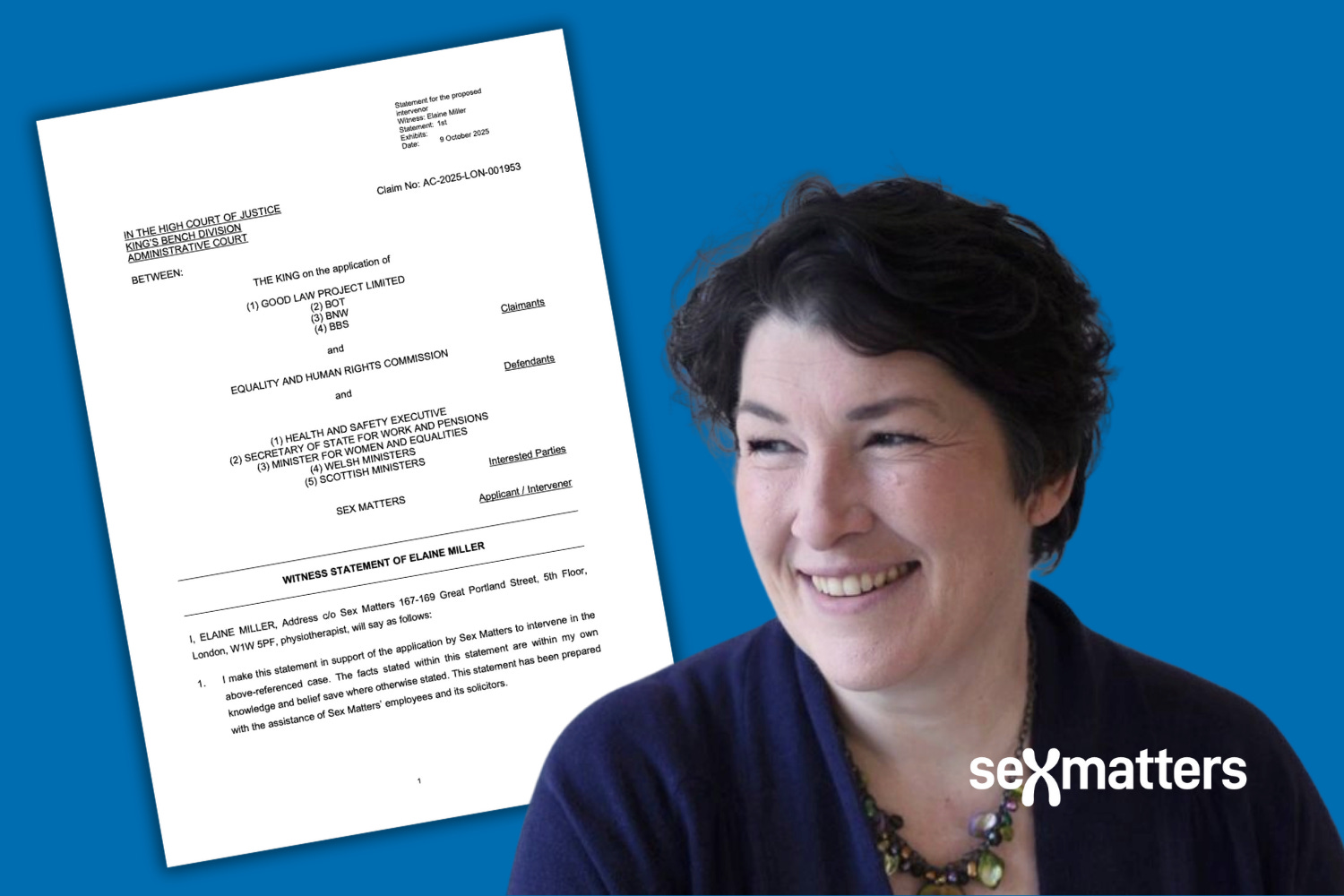
Sex Matters intervened in the High Court case brought by Good Law Project (GLP) and three anonymous claimants against the Equality and Human Rights Commission (EHRC). As part of our intervention, we submitted evidence from physiotherapist Elaine Miller, which focused on women’s biology.
Miller is a fellow of the Chartered Society of Physiotherapy, an expert in pelvic floor dysfunction and a long-time campaigner for women’s health. Her witness statement sets out, with clinical clarity and years of professional experience, why women and girls need female-only spaces throughout their lives.
A clinician’s perspective on dignity and women’s health
Miller explained that embarrassment was one of the biggest barriers to women seeking help for pelvic-floor problems. Many women minimised symptoms such as leaking, pain or prolapse because they felt shame.
Her own career, as both a physiotherapist and the creator of a successful comedy show about pelvic floors, has taught her how powerful stigma can be. Through her clinical work and public engagement she has met thousands of “sub-clinical” women: those living with hidden, untreated symptoms because they were too embarrassed to speak up. This insight into women’s experiences has shaped her evidence about the importance of single-sex toilets.
Six areas where women’s biological needs require privacy
Miller highlighted six areas where women’s and girls’ specific and often hidden needs make single-sex toilets essential:
1. Privacy and dignity from childhood onwards
Girls and women are generally far more private about bodily functions. Research shows that many schoolgirls are scared to use toilets at all: some restrict how much they drink during the school day to avoid the anxiety and embarrassment of being overheard, rushed or exposed.
Mixed-sex toilets increase this anxiety. Girls reported avoiding school toilets entirely and as a result suffering harm to their health including dehydration, urinary-tract infections, constipation and pelvic-floor dysfunction.
2. Menstruation
Nearly all women menstruate for decades of their lives, and managing periods requires space, time and privacy. Miller explained that:
Young women are embarrassed to carry or open period products.
Women are anxious about leaking: heavy bleeding affects around 30% of women and often causes visible accidents.
Women may need to clean blood from their hands or clothing. Doing so in a space where men may enter increases shame and distress.
3. Incontinence
Incontinence affects women disproportionately. Menopause, pregnancy and childbirth significantly increase urinary and faecal incontinence. Up to 60% of women experience urinary leakage and 45% of women with anal birth injuries have long-term symptoms.
Managing incontinence often involves:
changing pads or liners
removing and cleaning underwear
applying creams
self-catheterisation or insertion of anal plugs.
These are intimate, sometimes distressing tasks that clearly require privacy from men.
4. Post-pregnancy conditions and prolapse
Up to half of women experience some degree of pelvic-organ prolapse.
Many need to “splint” – manually support tissues to allow the bowel to empty. This deeply private and difficult process may be impossible in a mixed-sex toilet, leading women to avoid toileting altogether and risk serious harm to their health.
Some women use vaginal pessaries, which requires washing hands, applying lubricant, squatting or placing a foot on the toilet and inserting the device. This process demands concentration, calm and privacy.
5. Pregnancy and miscarriage
Pregnancy increases frequency and urgency, and unexpected bleeding is common.
Miscarriage, which is experienced by up to one in four women, causes heavy bleeding and often devastating emotional distress. Miller explained that dealing with this in front of men is likely to be experienced as degrading. Using a single-occupancy accessible toilet is not a safe substitute for a multi-user facility, because a woman who faints or collapses is less likely to be found.
6. Caring responsibilities
Women are more likely to take toddlers, young girls, disabled daughters or elderly mothers to the toilet. This often involves:
helping with clothing
cleaning up accidents
keeping doors unlocked for safety.
A mixed-sex environment increases risk, stress and vulnerability for both the woman and the person she is supporting.
Conclusion
Miller points out that men commit the vast majority of voyeurism, indecent exposure and sexual assault. Research shows that men who identify as women retain male-typical patterns of offending. Any man can be a risk.
In a genuinely single-sex space, a woman who sees a man can challenge him or seek help to have him removed. But “trans-inclusive” policies make this impossible because the man can simply say he identifies as a woman.
Miller concludes that women’s relationship with toilets is shaped by female biology, from puberty to old age. Women need space to manage bleeding, leaking, pregnancy, miscarriage, caring duties, pain, prolapse and embarrassment.
“Women’s lives are shaped by biology. Their toilets must reflect that.”
Single-sex toilets are not a luxury. They are a practical, compassionate and necessary part of public life for half the population.
“Women require privacy in bathrooms for reasons of dignity, and so that when they have to undertake activities that may be embarrassing or undignified, they know that they are doing so only in the presence of other women — who are more likely to have had similar experiences.”
Read Elaine Miller’s witness statement

Toilets matter: three witness statements