

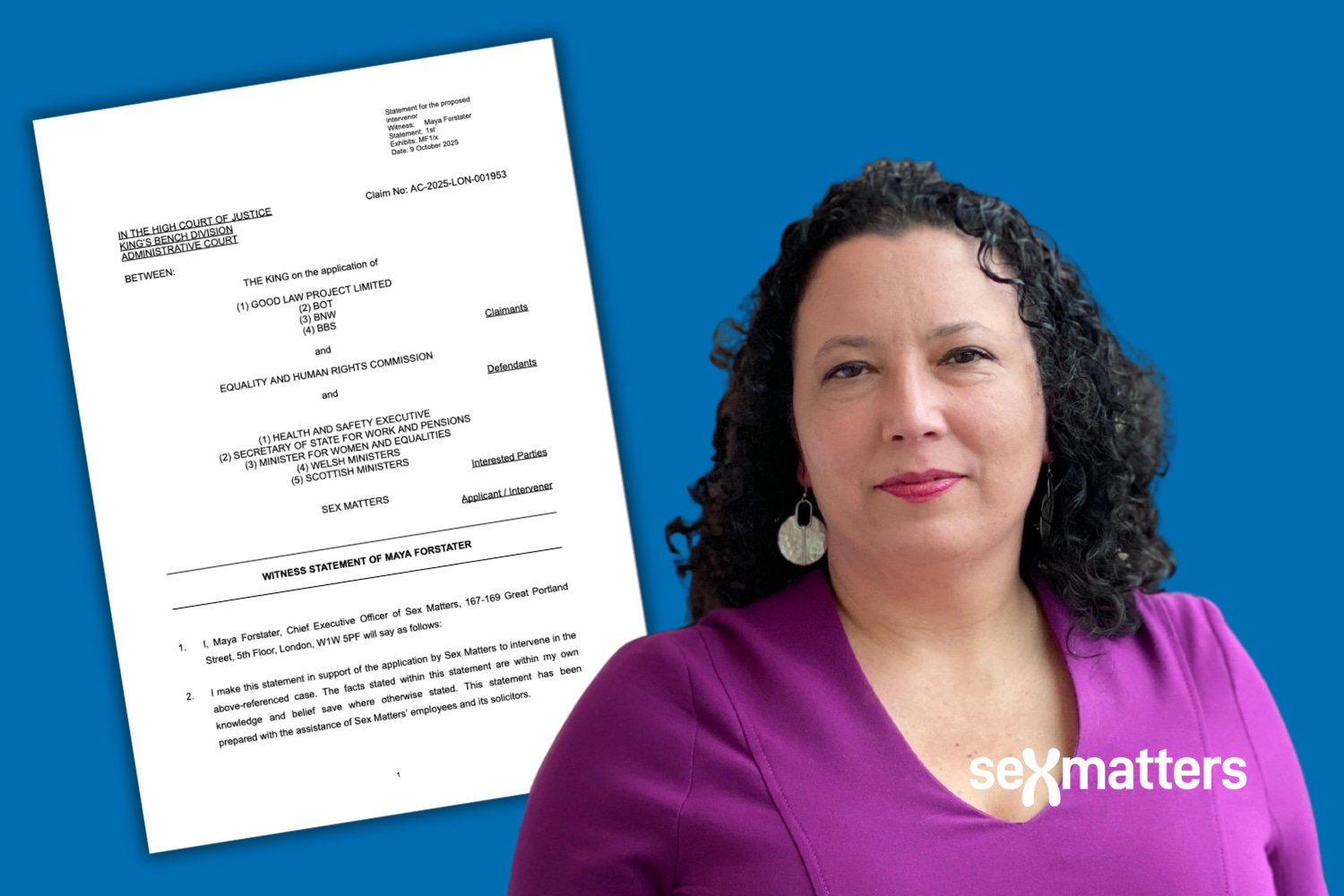
Sex Matters intervened in the High Court case brought by the Good Law Project (GLP) and three anonymous claimants against the Equality and Human Rights Commission (EHRC). As part of our intervention, we submitted evidence about why single-sex services are essential for women and girls.
Sex Matters CEO Maya Forstater provided detailed evidence explaining why clear, lawful guidance matters urgently for women, service providers and employers across the UK.
Her witness statement highlights years of confusion, misinterpretation and pressure that had left women’s rights to privacy and dignity undermined.
How misguided guidance took hold
Forstater’s witness statement sets out how, for more than a decade, public-sector guidance on single-sex services had been shaped not by common-sense or legal reality, but by lobbying and misinformation.
Policies from the EHRC, Government Equalities Office, ACAS, NHS Confederation, local authorities, large employers and major charities had:
assumed that “trans inclusion” meant allowing trans-identifying males into women’s services
wrongly claimed that preventing this was illegal
discouraged service providers from applying sex-based rules
ignored or dismissed women’s rights to privacy, dignity and safety.
Women who raised concerns were routinely labelled “transphobic”, threatened with disciplinary action or told they were creating a hostile environment. As Forstater noted, almost a dozen tribunal cases have already confirmed that gender-critical people were being subjected to unlawful discrimination.
In this climate, single-sex services that women rely on such as changing rooms, toilets, hospital wards, refuges, gyms and hostels became contested or quietly abandoned.
Why sex matters in law and life
Forstater’s evidence restates the basic facts that have become strangely controversial: humans are biologically male or female, sex does not change, and sex differences matter.
She explains, for the avoidance of doubt, that:
males are, on average, stronger, larger and more physically powerful than females
men commit the vast majority of violent, sexual and voyeuristic crimes
women and girls routinely manage menstruation, pregnancy and other intimate needs
most people can reliably perceive another adult’s sex
“transition”, with or without hormones or surgery, does not change someone’s sex
research shows that trans-identifying men retain male-pattern offending rates.
These facts underpin the legal provisions for single-sex services. They are also why women, far more than men, rely on clear boundaries for privacy, safety and dignity.
Why everyday single-sex services matter
The evidence drew on Sex Matters’ survey on why single-sex services matter as well as public surveys that showed just how important single-sex spaces were to women. Thousands of women described:
discomfort and fear when men entered female spaces
the need for privacy when changing, showering and using the toilet
religious modesty requirements that made mixed-sex provision unusable
feeling unsafe in gender-neutral toilets at work or in public buildings
stopping exercise, avoiding venues or risking their health because they could not rely on female-only facilities.
Women also described pressure to remain silent. Many said they feared disciplinary action, loss of employment or social ostracism for objecting to male people in women’s spaces – even when those objections were grounded in law.
The landscape of confusion and fear
Forstater’s evidence highlighted the consequences of unclear or unlawful institutional policies.
Women and girls face unexpected encounters with male users in women’s toilets and changing rooms.
Employers claim that the law requires them to allow access based on self-identified “gender identity”, although the law requires no such thing.
Staff are told to use the facilities they “feel most comfortable in”, without regard for sex.
Organisations ignore the availability of unisex facilities and insist that “trans inclusion” requires access to opposite-sex spaces.
Women are blamed or disciplined for objecting to self-ID policies, even when they are frightened, vulnerable or recovering from trauma.
This confusion extends across workplaces, schools, universities, hospitals, councils, gyms and shops.
What changed after the Supreme Court judgment
The Supreme Court ruling in the case of For Women Scotland confirmed what the law had always meant: under the Equality Act, sex means biological sex. Services may, and sometimes must, be provided on the basis of sex.
Following this, many organisations began updating their policies:
The Houses of Parliament confirmed that single-sex facilities must be used according to biological sex.
NHS Fife issued new instructions for staff to use sex-based facilities.
Universities such as City St George’s and Reading brought their policies into line with the law.
Virgin Active changed its club rules to comply with sex-based requirements.
Yet others stalled, insisting they needed further guidance or prioritising “trans inclusion” messaging over compliance.
Why clear national guidance is needed
Forstater’s evidence shows that women and girls cannot depend on piecemeal, contradictory or ideologically driven policies. Workplaces, schools, hospitals, shops and public bodies need:
clear, lawful, practical guidance
rules aligned with biological reality
protection for staff who enforce those rules
reassurance that providing single-sex spaces is not unlawful discrimination
confidence to communicate policies openly and fairly.
Otherwise women will continue to face unsafe conditions, social punishment for objecting and barriers to full participation in public life. Women’s rights to privacy, dignity and safety are not optional extras. They are fundamental human rights, recognised in law and essential for equality.
Sex Matters intervened in the case to ensure that the court heard not only abstract legal arguments but also the voices of women who have suffered from unlawful policies.
Read Maya Forstater’s witness statement

Toilets matter: three witness statements