

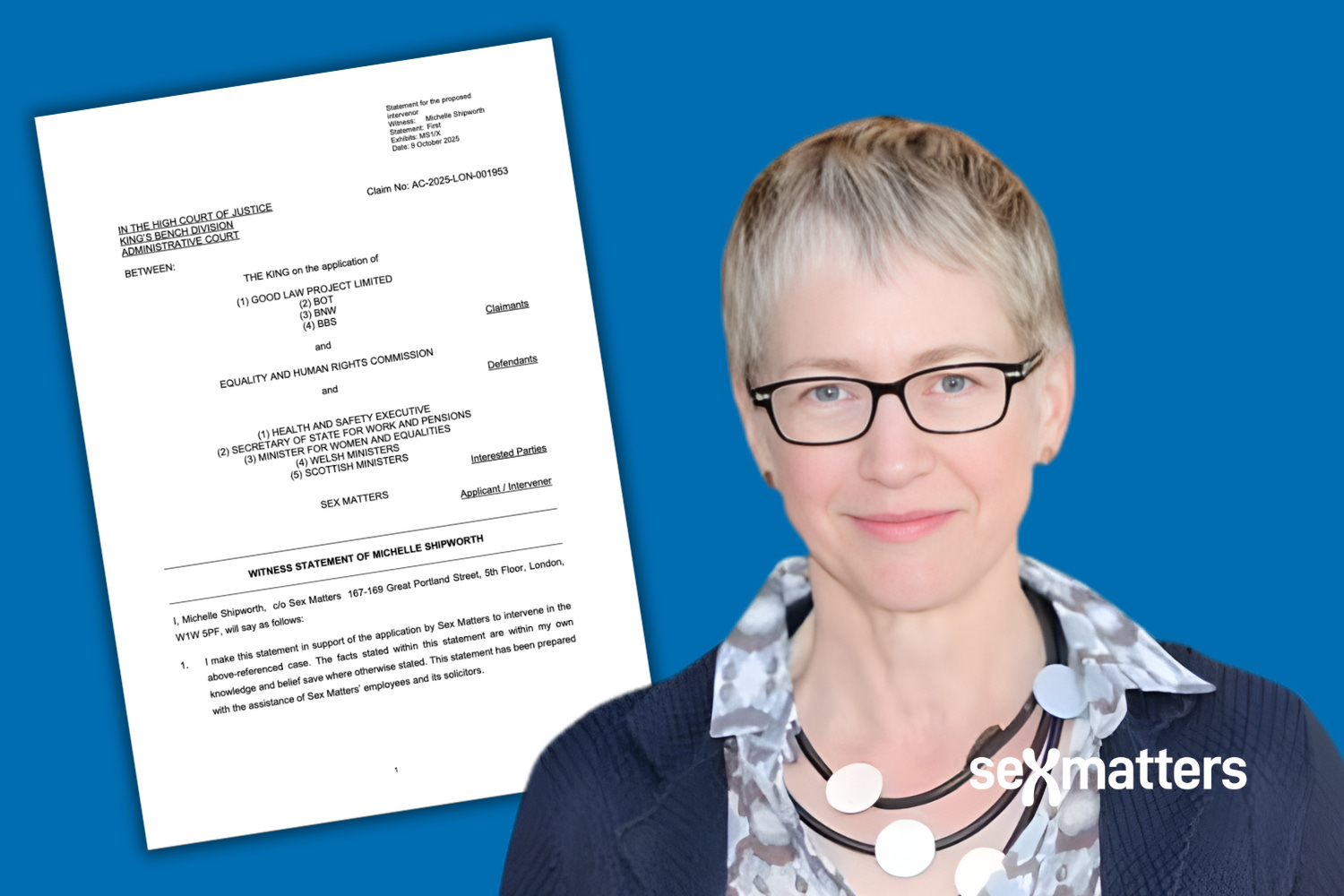
Sex Matters intervened in the High Court case brought by the Good Law Project (GLP) and three anonymous claimants against the Equality and Human Rights Commission (EHRC), which was heard in the High Court on 12th and 13th November, with judgment reserved. As part of our intervention we submitted evidence about why single-sex services are essential for women and girls.
One of the most powerful testimonies came from Dr Michelle Shipworth, an associate professor at University College London (UCL). In her witness statement she explained how her painful personal experience illustrates why women need private, safe, single-sex toilets and changing rooms.
A traumatic attack in a women’s toilet
In her early twenties, Shipworth was violently attacked by a man who had entered a women’s toilet in a Melbourne shopping arcade. He hid in a cubicle, waited until she was washing her hands and then shot her in the back with a crossbow before holding a knife to her throat.
She survived by talking to him and convincing him someone else was about to enter. Her attacker went on to serve several years in prison for that attack and for the murders of several other women.
For Shipworth, the consequences of that attack have been permanent. She required therapy for post-traumatic stress disorder and to this day experiences fear and hypervigilance when she encounters a male person in a space marked for women.
In her witness statement Shipworth writes:
“As a naive young woman, I had not appreciated the risk and as such it had not occurred to me that I needed to challenge a man in the women’s toilets. However from that point on I realised that some men are dangerous, and importantly, that it is impossible to tell in advance which ones pose a risk.”
She emphasises that her experience, though extreme, shares important similarities with experiences women commonly suffer. Male violence against women is common. Surveys show that more than 80% of young women have experienced sexual harassment in public spaces. A 2021 estimate from the Office for National Statistics suggested that one in three women had experienced harassment in the preceding year.
As a result, many women maintain heightened vigilance when they are in public. This vigilance is heightened when in enclosed spaces – such as toilets and changing rooms. For this reason, and also because they are places where women must undress, women reasonably expect safety and privacy to be provided by excluding all men.
Why single-sex spaces matter
Shipworth’s statement explains clearly why single-sex spaces are crucial for the inclusion of women in public life.
She notes that her own experience illustrates that even when a space is designated female-only, men intent on causing harm may still enter. But removing female-only designation entirely, or making the space open to any man willing to claim that he identifies as a woman, increases the risk of harm to women, and women’s vigilance and fear. Women cannot assume that any particular man entering a women’s toilet is harmless, and when men are entitled to enter they can do nothing to protect themselves except self-exclude. Women cannot know a man’s motives, and should not be asked to make risk assessments in vulnerable situations.
She also raises concerns about voyeurism and covert filming, crimes that have become much more common in recent years. Mixed-sex spaces make it easier for predators to access and hide recording devices. The Voyeurism (Offences) Act 2019 recognised this growing problem.
Challenging unlawful policies at UCL
Shipworth describes her attempts to persuade her employer to comply with the Equality Act and health and safety law. For years, University College London (UCL) policies told staff and students that anyone could use male- or female-labelled facilities based on self-identification, and that objecting to this could constitute harassment.
Despite Shipworth having repeated meetings with managers, providing them with detailed evidence and bringing to their attention the For Women Scotland Supreme Court ruling, which confirmed that the Equality Act protects single-sex spaces according to biological sex, UCL has failed to withdraw this unlawful guidance.
Shipworth writes powerfully about the emotional toll of being told to seek counselling rather than having her employer uphold her legal rights:
“Being offered counselling by my employer to cope with the prospect of encountering a man in my workplace ‘female-only’ toilets and change rooms, due to my employer’s determination to ignore the law feels surreal, amongst other emotions.”
Why Shipworth’s evidence matters
Shipworth’s testimony is an extreme example of a universal experience for women, not an outlier that, though ultimately shocking, has no relevance for the rules governing women-only spaces. It highlights the reason why women need single-sex facilities, and why their provision has long been established in law.
Her story shows that:
the risk posed by men in women’s spaces is real, not theoretical
women cannot be expected to distinguish harmless men from dangerous ones
the presence of a male person, whether trans-identifying or not, can cause anxiety and trauma
organisations must comply with the Equality Act and health and safety law, not rely on self-identification policies that disregard women’s rights.
Read Michelle Shipworth’s witness statement

Toilets matter: three witness statements