

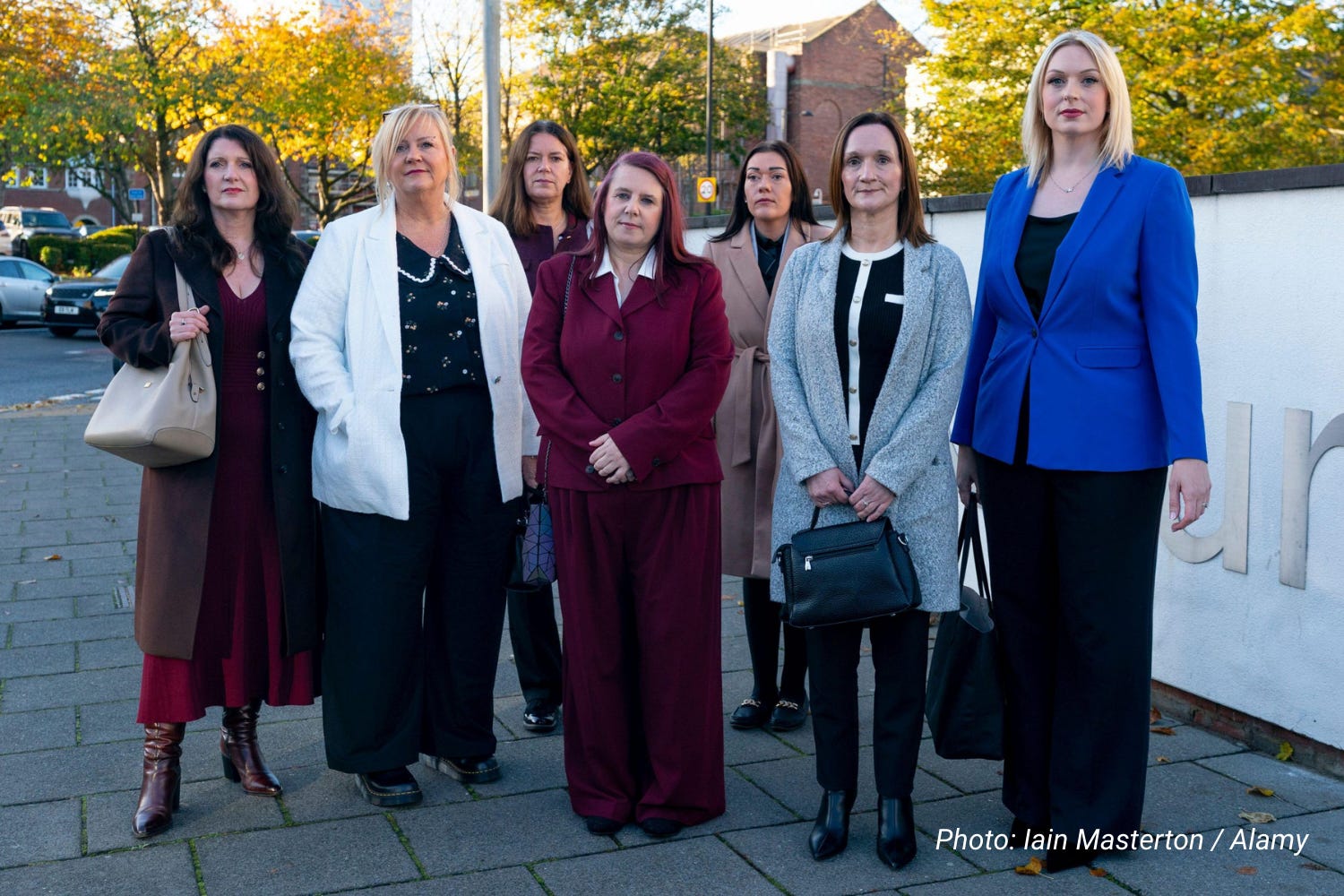
The Darlington nurses have won their employment-tribunal claim against County Durham and Darlington NHS Foundation Trust.
The judgment concludes that Darlington Memorial Hospital’s Transition in the Workplace policy, which allows transgender staff to use the changing room of their choice, is unlawful.
Similar policies are in place in workplaces across the country. They have been promoted by the government and by the civil service, which to date has refused to withdraw its own version of the policy.
In Darlington the policy led to a trans-identifying man, Rose Henderson, being allowed to use the female changing rooms. Dozens of female staff complained and eight nurses brought this claim.
The problem is the policy
The tribunal, led by Employment Judge Seamus Sweeney, found that the hospital had engaged in unlawful indirect discrimination and harassment by having the policy. The judgment says:
“Having considered the Equality Act we can see nothing there that would render ‘lawful’ a policy that gave biological males the choice to use a female changing room, effectively overriding the objection of female colleagues.”
And
“The Equality Act 2010 protects those with the protected characteristic of gender reassignment from discrimination, harassment and victimisation, in the same way that it provides such protection to those of other protected characteristics. However, that does not translate into a positive ‘right’ on the part of a trans woman to use the female changing room (or for that matter of a trans man to use the male changing room).”
In writing its unlawful policy, the trust drew on guidance from NHS England, the NHS Confederation and NHS Employers. Shockingly, as the tribunal notes, the staff responsible for the policy were unaware of the content of the Workplace (Health, Safety and Welfare) Regulations 1992, which require adequate provision of toilets, showers and washing facilities for women and men. It did, however, consult with the LGBTQ+ Staff Network Group.
The policy tells trans-identifying staff they can use the toilets and changing rooms that match their gender identity. To managers, it says that transitioning staff are “legally allowed to use any toilet facility they prefer and the choice should be theirs”.
When the nurses complained, their concerns “effectively went nowhere”, the tribunal found. The judgment documents the familiar story of managers passing the problem around rather than solving it, because the obvious and practical solution of giving the trans employee somewhere else to change was viewed as off-limits:
“From all the evidence we have seen, it is obvious to us that operational managers did not know how to resolve this situation at a local level. They believed that any resolution was beyond their capacity. They needed others, particularly senior HR and legal professionals to provide the solution for them, whatever that might be.”
Advised from on high that trans-identifying staff have a legal right to change where they wish, managers discounted everyone else’s rights.
Single-sex spaces matter for women
The tribunal accepted the evidence of Professor Jo Phoenix (who is a member of Sex Matters’ advisory group) that women are more likely to experience fear, distress or humiliation by having to change in front of a member of the opposite sex than men are.
The judgment says at paragraph 266:
“We accept that, as a general rule, considerably more women than men feel or would likely feel personal insecurity, distress and fear if required to change clothes in a communal changing room shared with a member of the opposite sex. This reflected many of the accounts given by the Claimants in this case. We accept that this is rooted in the different cultural and societal experiences of women compared to men. Further, we accept that women will feel things differently at different stages of life as their relationship with their bodies (comparative to men) changes with age. There will be moments of acute awareness and sensitivity on the part of women that do not apply to men, for example during menstruation, during pregnancy or during menopause. During these periods, women may and very many do experience physical reactions, such as bleeding, incontinence, sweating or heightened emotions, which inevitably has an effect on their sense of self. They are inherently private matters and can affect women’s perceptions of self and dignity. The relationship between a woman and her body is very different to the relationship between a man and his body.”
And at paragraph 270:
“We accept – as does the Respondent – that women are more likely to have experienced sex-based harassment and sex-based violence than men. It will come as no surprise to anyone that this is so. The risk posed to women generally by this state of affairs causes a reaction in many women and leads them to adjust their own behaviour according to the circumstances. Women do not have to experience sex-based harassment or violence personally. The experiences of some women can and does have an impact on others. Depending on the circumstances, a woman might experience fear and distrust in the presence of a man even though, objectively, as a matter of fact, the man is an entirely innocent actor. We take an example that we can all recognise, of a woman walking alone on a street at night, whereupon she notices an approaching male. She crosses the road to avoid the man, holding her keys in her hands in the event she needs to defend herself or she phones someone or pretends to do so. The approaching male is a perfectly decent and innocent person with no intention to harm anyone and is oblivious to the woman on the street. He would feel offended at the thought that someone might regard him as potentially harmful. But it is not the individual’s character that dictates the reaction in the woman. It is not the man himself but the fact that he is a man. The difficulty for the woman in this example is that she is unable to police the character or the intent or motivations of the approaching male. She is fearful of the risk presented in the knowledge of women’s experiences in life generally. Her reaction does not depend on personal experience, although of course it may be explained by this. The Tribunal is able to draw on its own experiences of life in recognising these fearful, defensive, precautionary traits in women in certain circumstances. They are not irrational reactions. On the contrary, they are entirely rational, based on the lived experiences of other women generally. Many women will feel anxious and may take extra precautions in what men might regard as normal situations.”
This finding opened the door to a successful claim for indirect discrimination and harassment.
Indirect discrimination
Indirect discrimination occurs when an employer adopts a policy, criterion or practice (PCP) that puts a group at disadvantage related to a protected characteristic. The tribunal considered two PCPs:
The trust gave staff access to single-sex changing rooms on self-declared gender identity.
The trust prioritised the perceived rights of transgender employees to use changing facilities based on their self-declared gender identity over the rights of other employees to have use of a single-sex facility.
The first was not in doubt. The second was very much in dispute. The trust said it was balancing everyone’s rights, but the tribunal concluded that:
“The Respondent did in fact prioritise the perceived rights of transgender employees to access changing facilities of their choice over the right of other employees to access a single sex changing facility based on biological sex. This is clear from the wording of the policy, the way in which it was implemented and the attitudes and mindset of those who developed, reviewed,approved and owned the policy.
“Those nurses who raised legitimate concerns were told that they had to accept the fact that the NHS was inclusive. The attitude of senior Workforce Development managers was that staff needed to be educated and to improve their awareness of trans rights. This prioritisation was plain to see and was baked into the TIW policy.”
The judgment notes that the claimants did not need to point to an actual or hypothetical male comparator who had been (or would be) treated more favourably by application of the policy in order to show that it was unlawful:
“The objective of the law against indirect discrimination is not to achieve formal equality of treatment. Indirect discrimination law looks beyond that formal state of equality towards substantive equality of results. Something that appears to the observer to be neutral on its fact, that applies equally to both sexes, may have a disproportionately adverse impact or effect on those of a particular group (or in the language of the Act, of a particular ‘protected characteristic’). This is often referred to as ‘group disadvantage’.”
Harassment
Harassment is defined in the Equality Act as “unwanted conduct related to a relevant protected characteristic” that has the “purpose or effect of violating a person’s dignity, or creating an intimidating, hostile, degrading, humiliating or offensive environment for them”.
Allowing a man into the women’s changing room was clearly unwanted conduct.
The judgment placed the blame squarely on the hospital, saying that Henderson was just doing what he had been allowed to do. It found that he personally did not behave improperly, but that the discomfort and fear of the claimants for their own dignity, bodily integrity and privacy was genuine and reasonable.
The 1992 regulations
The tribunal also noted that the hospital was in breach of the 1992 workplace regulations, which require employers to provide adequate and suitable facilities for men and women. It said these should be interpreted consistently with the Equality Act (as clarified by the Supreme Court):
“We are satisfied that, in keeping with the need for a coherent and workable structure, to enable those who have to regulate their conduct and comply with statutory duties, the meaning given to ‘men’ and ‘woman’ in those Regulations must logically be the same as under the Equality Act 2010.
“….we conclude that from the moment it permitted Rose to use the female changing room, the Trust was in breach of the 1992 Regulations.”
No use passing the blame onto the bad guidance
The hospital trust tried the argument that it was not acting unlawfully because the circumstances at the time included “guidance from organisations such as the EHRC and the NHS and how those in the Trust understood the various definitions”.
The tribunal said that these considerations could not turn an unlawful policy into a lawful one. It said it was in no doubt that senior people were of the view that Henderson and other trans-identifying people had a right to use the facilities of their choosing, but that this belief was not an excuse.
What next?
The question of financial compensation for the Darlington nurses will now be decided, either by a settlement or another tribunal hearing. And this victory for one group of nurses opens up the issue of wider liability for discrimination and harassment against other female staff.
In March 2025 the trust released a new version of its policy that said:
“Where there is objection from other staff about trans or non-binary staff using single sex changing, showering or toilet facilities due to their religion or belief, careful consideration of balancing the rights under the Equality Act 2010 of both sides must be taken into account by the manager that does not favour one side or the other.”
This new version of the policy remained live only for a matter of weeks. It was withdrawn after the Supreme Court handed down its judgment on 16th April 2025 in the case of For Women Scotland.
On 29th May 2025 the trust was visited by David Purdue, regional chief nurse for NHS England North-East and Yorkshire.
“He said that following the Supreme Court decision, the Health Secretary had asked him to visit the hospital and discuss the changing room situation. He said that the situation had taken much longer to resolve than it should have and that it was unnecessary to wait for any further national guidance on the matter in order to resolve it.”
In July 2025, alternative changing-room facilities were found for Henderson so that the women could return to using the female-only changing room.
The issue that now needs to be resolved is not about a single changing room at the Darlington Memorial Hospital, or a single bad policy.
Individual employers should pay attention to this clear and sensible judgment or they will face similar cases.
The government should act with urgency to withdraw the unlawful civil-service policy and similar unlawful policies across the NHS, local authorities, schools, police services and other public bodies.
This a a great result for the Darlington nurses and women in general. I truly hope this result will help Sandie Peggie in her appeal.
This makes the judgement in both the Peggie and Kelly cases even more problematic. I hope the appeals come soon so that we have legal precedents and dear god can Bridget Phillipson get her finger out