

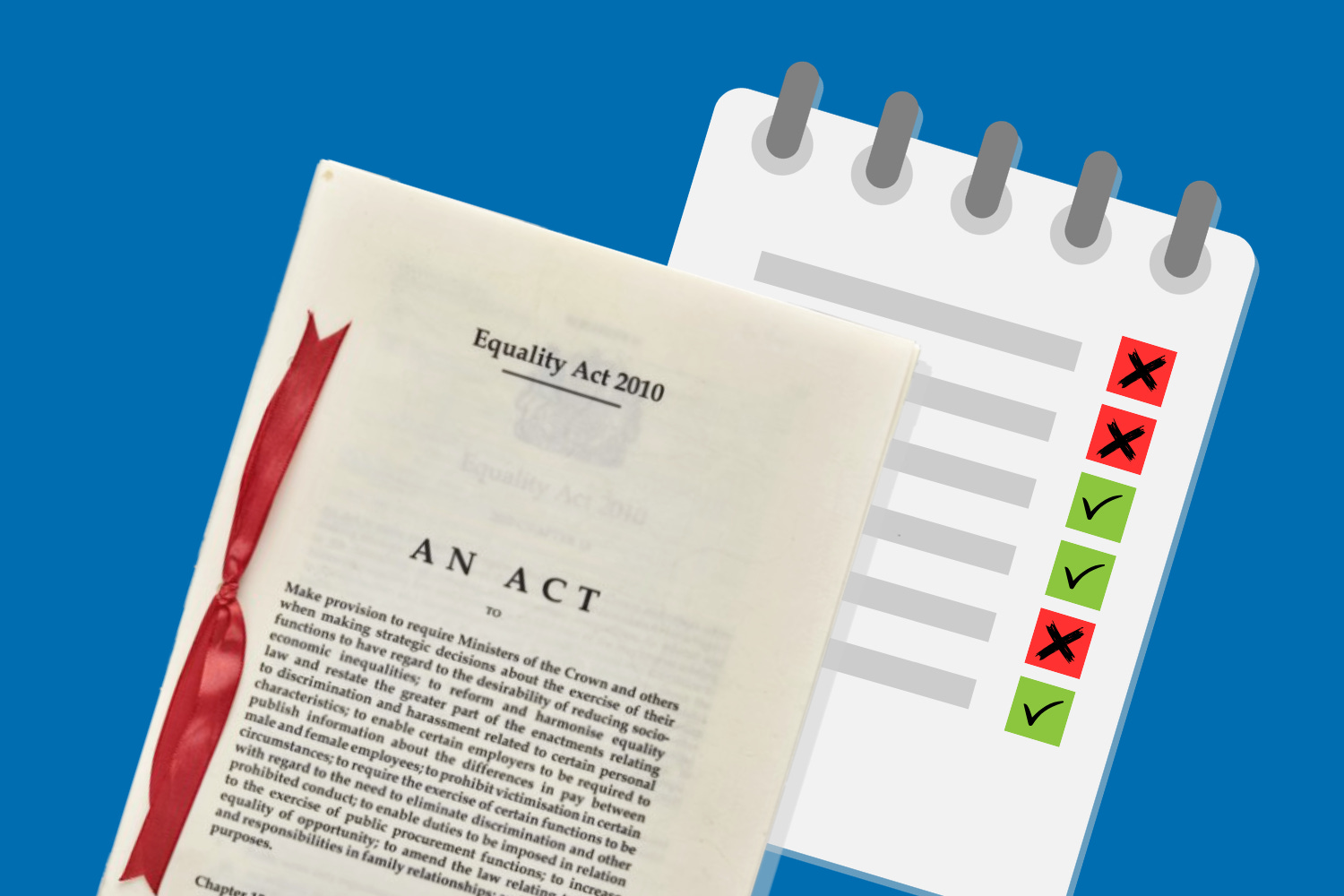
Bridget Phillipson, the Minister for Women and Equalities, has promised to present the new Code of practice for services, public functions and associations to Parliament this month.
The Equality Act is clear, but the guidance needs to combat decades of misinformation – from the Equality and Human Rights Commission and Government Equalities Office among others – as well as National Health Service policies encouraging people who identify as transgender to believe they have a right to access opposite-sex services.
We have set out some points we will be looking for in the guidance when it comes out.
1. Is it clear that sex is immutable and biological?
The protected characteristic of “sex” refers to a man (male) or a woman (female) of any age.
Everyone has a sex, and it cannot change.
When proving sex discrimination, the comparator is a person of the opposite sex.
A person’s sex is ordinary personal information that can be recorded in line with data-protection laws.
Everyone is protected against discrimination based on sex (including the sex that they may be perceived as or associated with).
2. Is it clear that protections against gender-reassignment discrimination do not mean the right to be treated as the opposite sex?
“Gender reassignment” covers people at any stage of a personal process of transition.
Having this protected characteristic does not depend on having surgery or a gender-recognition certificate.
Having this protected characteristic does not provide a right to access services provided for the opposite sex.
3. Is it clear about how the prohibitions against discrimination and harassment work?
It is likely to be direct sex discrimination to exclude someone from a service because they are a man or a woman (that is, to provide the service only to women or only to men), unless an express exception applies.
It is likely to be direct gender-reassignment discrimination to exclude someone from a service for both sexes or for their own sex on the grounds that they are trans, unless an express exception applies.
It is likely to be indirect sex discrimination towards women not to provide a single-sex or separate-sex service in situations where women would be disadvantaged by being offered only a mixed-sex service.
It is likely to be harassment related to sex to expose people to the unwanted presence of members of the opposite sex in situations where they expect same-sex privacy.
It is not harassment related to sex or gender reassignment to have and to communicate lawful sex-based rules and expect people to respect them.
4. Is it clear that single-sex associations and charities are lawful?
It is not unlawful to form associations for people who share a protected characteristic, such as for women only or for men only.
Associations that follow their own lawful rules are not committing unlawful sex discrimination or gender-reassignment discrimination.
Associations that do not follow their own lawful rules are likely to engage in unlawful discrimination or harassment.
It may be lawful to form associations explicitly for combinations of groups of people with different protected characteristics (such as women and transsexuals).
Charities are required to pursue their objects, and these can include meeting the specific needs of people who share a protected characteristic such as women or men.
5. Is it clear that it is lawful to provide women’s and men’s sporting competitions?
It is not unlawful to treat men and women differently in a sport, game or other activity of a competitive nature where the average person of one sex is at a disadvantage as a competitor compared to the average person of the opposite sex due to physical strength, stamina or physique.
In particular, it is not unlawful to arrange single-sex competitions, mixed doubles and team sports with rules specifying the numbers of men and women on the teams.
Organising sporting competitions that are not fair and safe for women and girls is likely to be sex discrimination. This can include only providing a mixed category.
There is no lawful mechanism for allowing men who have reduced their testosterone levels to count as women for the purpose of lawfully conducting sporting competitions.
Women who have taken testosterone may be excluded or treated differently from other women in sporting competitions, where it would not be fair or safe for them to compete.
6. Does it explain why single-sex and separate-sex services are often needed, particularly by women?
Physical differences between women and men can mean that they have different needs.
In many ordinary everyday settings women in particular prefer separate-sex facilities for dignity and privacy.
In any situation that a woman has been told is female only it will be reasonable for her to object to the presence of a man.
Where a service is provided in response to male violence against women it is likely to be lawful to provide it as a single-sex service.
Any service that is not single sex or separate sex – in particular a so-called “single gender” service – is mixed sex.
7. Is it clear about the legal basis for single-sex and separate-sex services?
The guidance should:
set out the reasons for providing a single-sex or separate-sex service
explain that the test of “proportionate means of achieving a legitimate aim” relates to the service itself, and does not require case-by-base application
warn service providers that if they provide a service based on gender identity instead of sex they will not be operating a single-sex or separate-sex service under the Equality Act and will be liable to claims of unlawful sex discrimination
explain that in certain circumstances (where it is a proportionate means to a legitimate aim, such as preventing alarm or distress for other service users) it may be lawful for a trans person to be excluded from a separate-sex service for their own sex.
8. Does it provide practical guidance for duty bearers?
The guidance should:
explain that measures to ensure that trans people are not disadvantaged mean offering a separate unisex option where this is practical
offer guidance on what duty bearers can do to encourage people to follow lawful rules – such as making policies and signs clear – and what to do if they refuse
make clear that staff can operate on the evidence of their own eyes and ears.
Under section 2, might it be worth tackling a common misconception by adding something like: When proving gender reassignment discrimination, the comparator is a person of the same sex who does not have the characteristic of gender reassignment.