


Soon after the enactment of the Equality Act, the Equality and Human Rights Commission produced three statutory codes of practice: one for services, public functions and associations (“the services code”), one for employment and one for equal pay.
During the consultation process, after input from transactivists, a simple clear explanation of the law in the services code was replaced by the instruction that:
“If a service provider provides single or separate sex services for women and men, or provides services differently to women and men, they should treat transsexual people according to the gender role in which they present. However, the Act does permit the service provider to provide a different service or exclude a person from the service who is proposing to undergo, is undergoing or who has undergone gender reassignment. This will only be lawful where the exclusion is a proportionate means of achieving a legitimate [aim]”.
This instruction told service providers to allow people to access opposite-sex spaces and services and was widely understood as meaning that excluding them had to be done on a “case by case” basis. That was never an accurate statement of the law.
Nor was it workable. The only way to operate the policy in practice was to pretend not to be able to notice who was male and who was female, and to silence, punish and exclude women who complained.
There was nothing similar in the employers’ guidance (which only said that when an employee transitions the employer should consider offering them “different” facilities).
But Stonewall and other lobbyists used the legally erroneous services code to tell both employers and service providers that trans-identifying individuals were legally entitled to use opposite-sex facilities, and to adopt a definition of “transphobia” which included not accepting that someone’s “gender identity” could override their sex.
Stonewall even called on the international body for human-rights regulators to discipline the head of the EHRC for doing her job.
By 2022 the EHRC was trying to solve the problem of the unworkable, unlawful guidance and the misinterpretations it had spawned. It produced non-statutory guidance on single-sex and separate-sex services, and in 2024 it started to update the services code.
But it was trying to fix the problem while holding on to an underlying misunderstanding of the law. It said that “sex” in the Equality Act “means legal sex” which it said was “a person’s sex recorded either on their birth certificate, or their Gender Recognition Certificate”. As a result of this mistake it continued to say that it “might be unlawful” for a service provider to exclude a trans person from the single-sex or separate-sex service “of the gender in which they present” unless it could show that such an action was a proportionate means of achieving a legitimate aim.
None of this guidance was ever intended for employers, and none of it was correct about the law, as the Supreme Court made absolutely clear on 16th April 2025, when it confirmed that the question of “proportionate means to a legitimate aim” applies to offering a separate-sex service as a whole, not to whether each individual is expected to follow rules that apply to everyone.
Since then some employers, service providers, industry associations and regulators have updated their own policies and guidance to bring them into line with the law, but many more have cast around for any excuse to do nothing, while saying they were “working at pace”. They alighted on the EHRC services code as an excuse.
The draft was updated by the EHRC for a second time and consulted on again following the Supreme Court judgment. It is currently waiting for Bridget Phillipson, the minister for women and equalities, to lay it before Parliament.
Phillipson recently said that the government has “always been clear” that employers should not wait for the code of practice for service providers to be finalised. In fact neither service providers nor employers should wait: the law is the law.
Who is waiting for the wrong guidance?
Despite Philipson saying that employers should not wait, this is precisely what government departments, including her own, are doing.
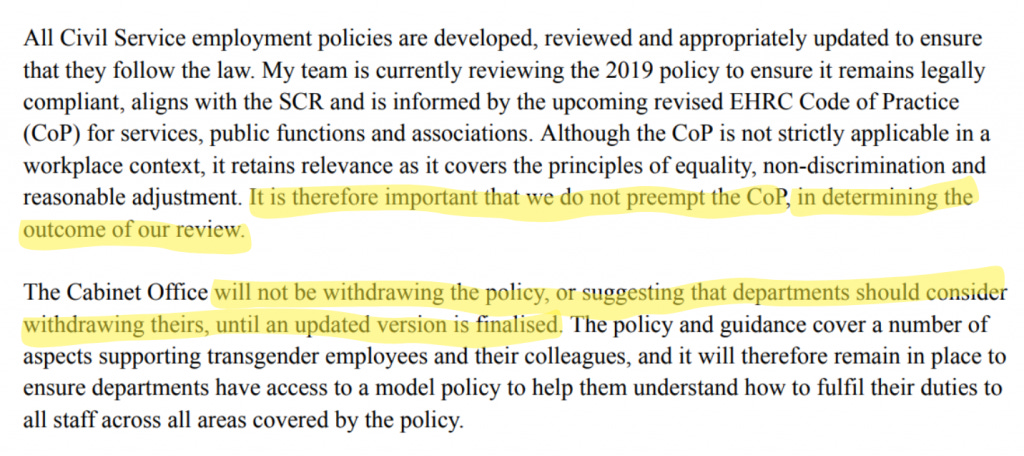
Almost all government employers have a “transitioning at work” policy that is wrong in law, allowing staff to use opposite-sex facilities. It is based on a model policy produced by the Cabinet Office in 2019.
In December, the head of the civil service told us that the Cabinet Office will not withdraw its model policy for employment… until the EHRC’s code of practice for service providers is finalised.
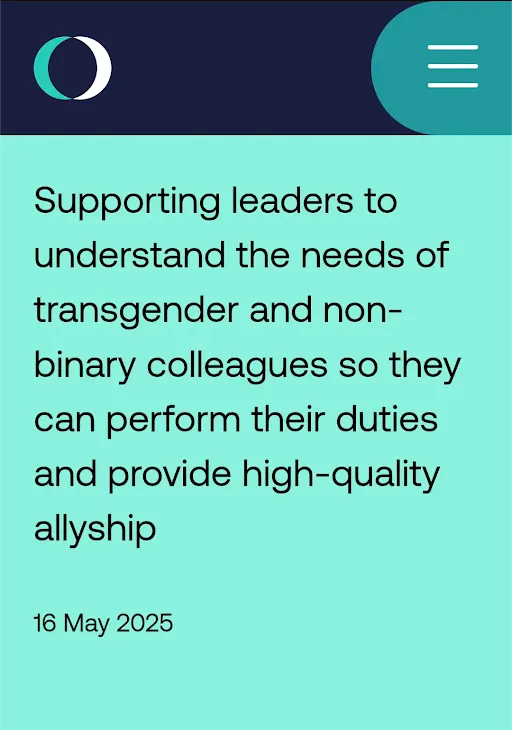
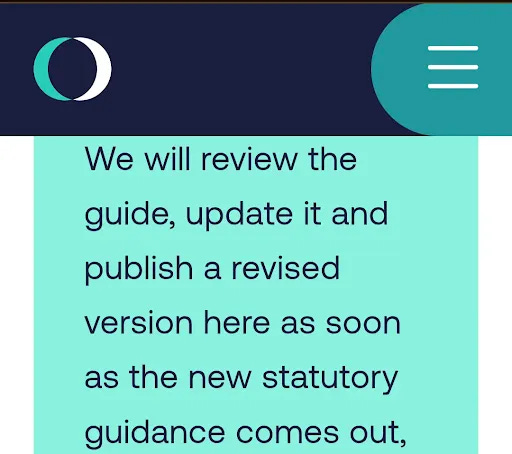
The NHS Confederation (the employers’ organisation for the NHS in England) is also refusing to update its workplace guidance until the EHRC guidance comes out.
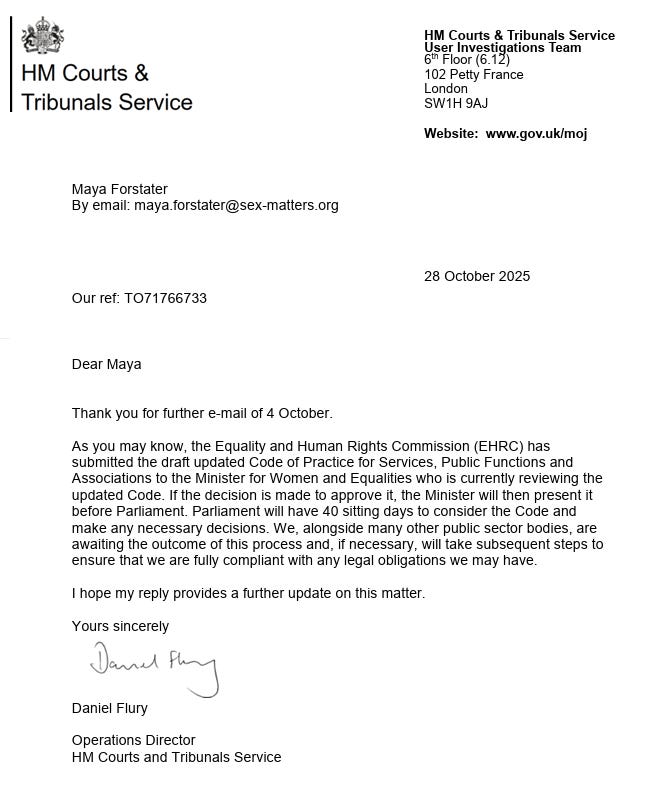
HM Courts and Tribunals, which employs 18,500 staff and provides the working environment for our judges, has also told us that it is waiting for the services guidance before it applies the law in courts and tribunals (where toilets and changing rooms are provided both to staff and the public).
Waiting for the services guidance is an excuse that goes beyond the public sector.
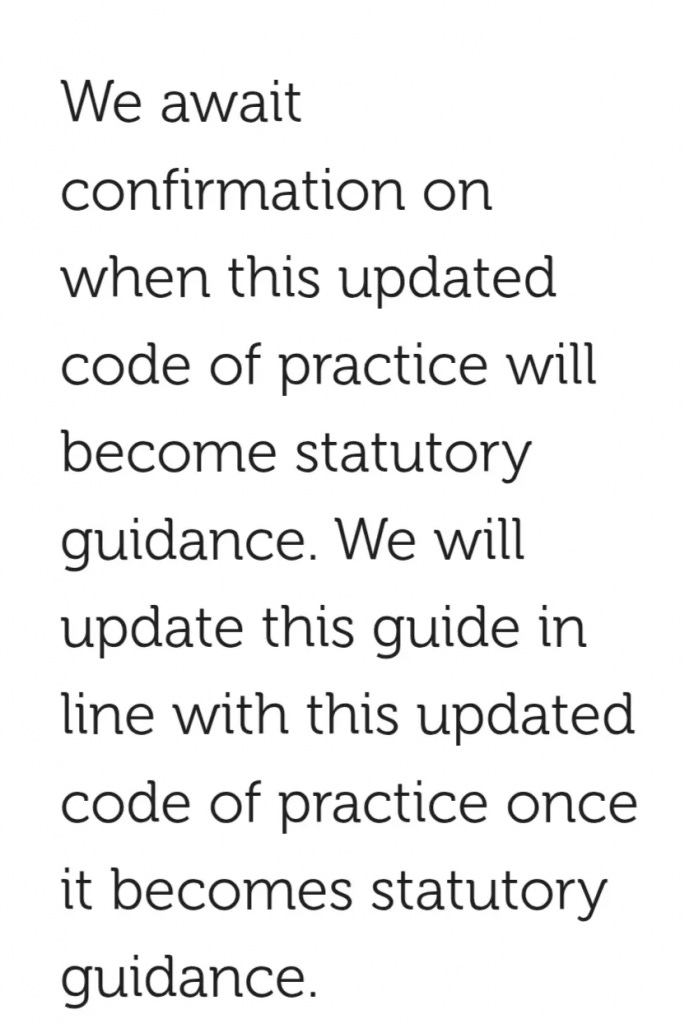
The Chartered Institute of Personnel and Development (CIPD), the professional body for HR and people development, says that it is waiting for the statutory guidance for service providers before it updates its advice for employment.
Are the rules about not using opposite-sex facilities different for service users and employees?
While the Equality Act has different sections for work, services and public functions and education, this does not mean that the meaning of the word “woman” and “man” or the familiar icons are different for service users and employees.
Following the Supreme Court judgment the EHRC published a useful practical explainer for both employers and service providers. It explained that employers are required (by workplace health and safety regulations) to provide “sufficient and suitable” toilets, changing and washing facilities for workers, which means separate-sex facilities with cubicles, or fully enclosed unisex rooms.
Service providers are not in general required to provide any facilities at all to customers (and many shops, for example, do not). If a service provider does provide toilets, changing rooms, showers or other services on a separate-sex basis then they are relying on the single-sex or separate-sex exceptions in the Equality Act. This means that for both employers and service providers offering separate-sex facilities the principles are simple:
“trans women (biological men) should not be permitted to use the women’s facilities and trans men (biological women) should not be permitted to use the men’s facilities, as this will mean that they are no longer single-sex facilities and must be open to all users of the opposite sex
in some circumstances the law also allows trans women (biological men) not to be permitted to use the men’s facilities, and trans men (biological woman) not to be permitted to use the women’s facilities
however where facilities are available to both men and women, trans people should not be put in a position where there are no facilities for them to use
where possible, mixed-sex toilet, washing or changing facilities in addition to sufficient single-sex facilities should be provided.”
This interim guidance was challenged by the Good Law Project and on Friday 13th February the High Court delivered the judgment that this guidance was an accurate statement of the law.
There is absolutely no reason to wait.
I hope everyone here in the US concerned about these issues is paying attention to what you are dealing with in the UK, as it serves as a cautionary tale of what we will face even if we get a clear decision in Hecox—and our laws are not nearly as good as yours on the single-sex exceptions issue. Your work on this is exemplary. I want to thank you also, as I help work on opposition to a “all gender” bathroom bill in New York, for your clear and comprehensive materials on why toilets matter. Though some materials are specific to UK law, the 2022 survey and key findings provide a wealth of user information, and witness statements offered in the GLP case, like that of Elaine Miller, are immensely valuable to anyone trying to bring clarity back to what had been clear until 5 minutes ago. Thank you for all.
I'd like to see the HMCTS taken to judicial review for it's unlawful policy.