

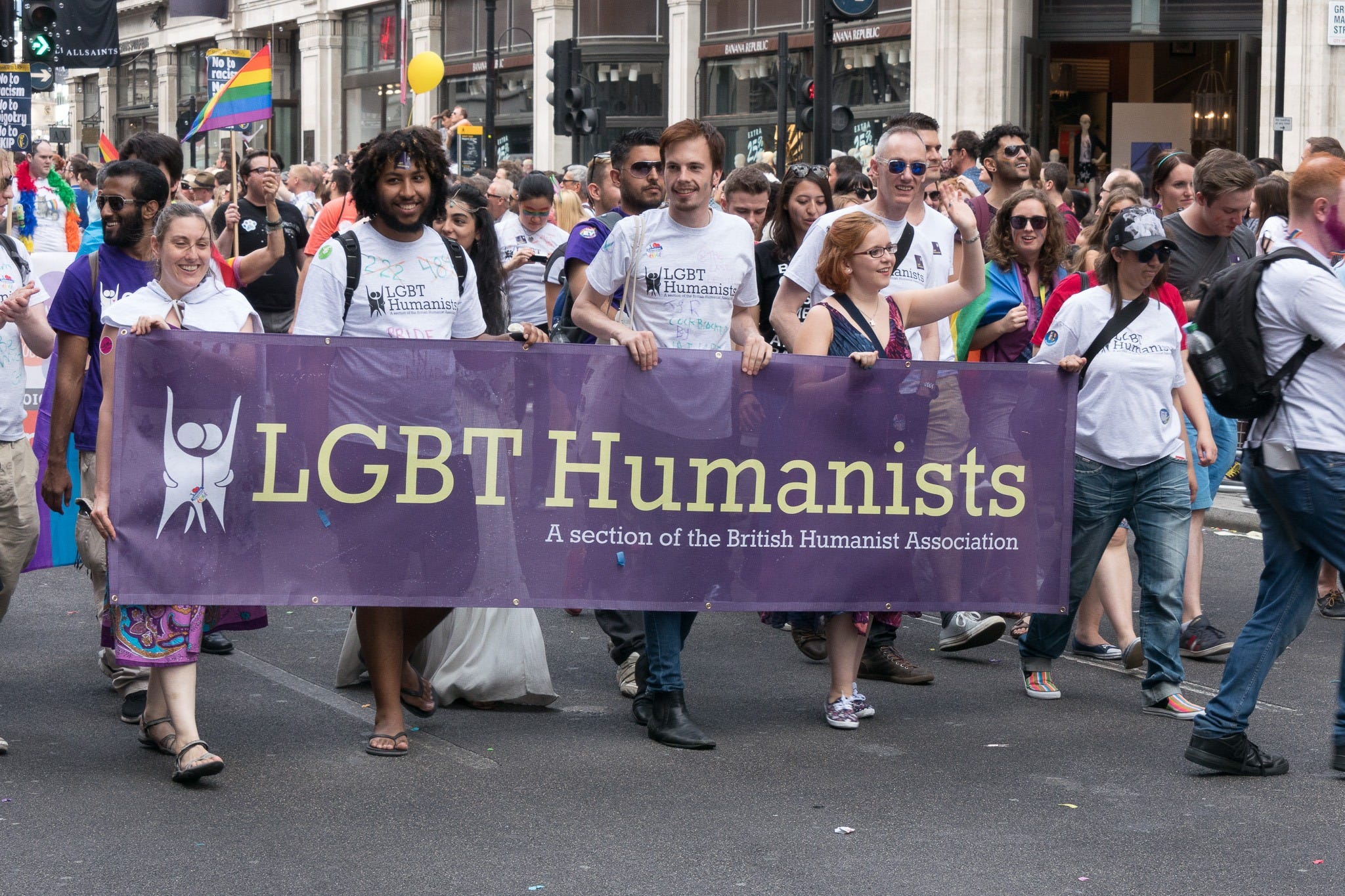
Picture credit: Patrick Devries
Humanists UK, the charity representing and serving the UK’s humanists, is meant to focus on reason and freedom of thought.
Some humanists agree with gender-identity ideology; some don’t. But the organisation has in recent years come down dogmatically on the side of the subjective metaphysical belief in gender identities, led by the LGBT+ Humanists group. It supports the government’s proposal to criminalise “conversion practices” in relation to both sexual orientation and gender identity.
LGBT+ Humanists says that since being founded in 1979, it has “fought for equality for LGBT people”. This isn’t exactly true. It was originally founded as the Gay Humanists, in response to Mary Whitehouse’s private prosecution of Gay News for blasphemous libel when it published the poem The love that dares to speak its name. This featured a Roman centurion having sex with Jesus. It was the UK’s last successful blasphemy prosecution.
That case went all the way to the House of Lords, which held that the law of blasphemy did not require any intent to blaspheme. The crime was simply causing grave offence to the religious feelings of fellow citizens. Lord Scarman said it was necessary for the law not only to respect the “beliefs, feelings and practices” of religious people, but also to “protect them from scurrility, vilification, ridicule and contempt”.
The common law offences of blasphemy and blasphemous libel in England and Wales were thankfully abolished in 2008.
The humanists have long campaigned against gay conversion therapy. But in 2015, like Stonewall, the Gay and Lesbian Humanist Association added the T.
It is now a leading part of the coalition campaigning to criminalise “transgender conversion practices”. This is, in effect, a new blasphemy law to protect transgender identities and those who promote them against disagreement, vilification, ridicule or contempt.
In 2018 and 2020 Humanists UK campaigned for gender self-identification. It argued that gender dysphoria should not be considered a medical disorder and should be depathologised, and said that changing the basis for legal gender recognition would have no impact on the Equality Act. At the same time it said it supported single-sex services. What this meant in practice, it thought, was that “male-to-female trans women who have committed sexual crimes” could be excluded from women-only spaces on a case-by-case basis.
In 2023 it argued against our proposal to clarify the meaning of sex in the Equality Act by means of an amendment.
When the Supreme Court judgment confirmed that the Gender Recognition Act does not change a person’s sex in relation to the Equality Act, and that providing women-only services means excluding all men, not just known rapists, Humanists UK reacted with dismay. It said that the Gender Recognition Act “promised transgender people with Gender Recognition Certificates (GRCs) legal recognition and associated protections based on their legal sex”.
It responded to the draft Code of practice for services from the Equality and Human Rights Commission (EHRC) by declaring it “unworkable”. It said: “If the Code is a true reflection of the current law, then the law itself is failing to uphold the human rights of transgender people.” It has called for parliamentarians to “resolve the tension” between the Gender Recognition Act and the Equality Act “and uphold the principle that inclusion is the starting point, not the exception”.
It recently published Seven facts about banning so-called “conversion therapy”, which it says answers misinformation about the bill. It says debate about the draft Conversion Practices Bill should be informed by evidence and attention to the wording of the bill, rather than fear and misinformation. We agree.
We think its analysis contains errors and omissions, set out below.
What, no evidence?
Humanists UK claims to have concrete evidence that abusive conversion practices are an “acute and growing problem” in the UK.
It runs its own helpline and support service for people leaving religions, which hears from around 1,200 people a year, but has not, as far as we can find, produced any data on “conversion practices”.
It points instead to the report Still not illegal by Galop, an anti-abuse charity. We have written about this report before. Galop was paid hundreds of thousands of pounds of public money starting in 2022 to run the national conversion-therapy helpline, which it expected would receive 10,000–15,000 calls a year. It appears to have received fewer than 29 relevant calls over its first three years.
Going through all the calls and referrals it received between 2022 and 2025, Galop retrospectively identified 371 cases it thought might involve conversion practices and analysed the 195 cases for which it had detailed notes. These cases included:
“father has stated he is banished and stated that Client was ungrateful for their efforts to help him”
“Dad threatened to stop financial support [to young person in the UK as a student] stating that ‘this will make you come back to [location]’.”
Family conflict and estrangement are upsetting, but not necessarily abuse. Parents are not required to house or support their adult children.
Other examples, such as “I was raped by someone at school who wanted to ‘turn me straight’”, are already criminal.
Some examples reflect conflict within families concerning a child’s asserted transgender identity, and a few refer to therapy. Galop says: “Some of these cases involved intentional refusal to use a chosen name or pronouns (repeatedly, or in a derogatory or controlling way).”
“Dad makes frequent comments that ‘[Client] is not trans’ and that he is a woman. […] [Client] disclosed his parents want to take him to counselling to ‘convince him he is a female’. […] …[Mum] is forcing [Client] to cut off all relationship with friends who call him by his chosen name and pronouns.”
“therapist ‘insinuated conversion therapy’ when they ‘suggested that healing trauma could lead to [Client] no longer being transgender’.”
This is exactly the kind of thing that should not be criminalised.
Humanists UK also cites Amnesty International UK’s claim that spending by charities promoting conversion practices rose to nearly £2 million in 2023.
That research ended up in the Like a snowball report in 2026. It accused secular, evidence-based organisations including Genspect, Therapy First, Thoughtful Therapists, the Society for Evidence-Based Gender Medicine and the Clinical Advisory Network on Sex and Gender of undertaking conversion practices, alongside religious groups. Amnesty has already withdrawn this report and apologised for calling gender-critical groups “anti-rights”.
Humanists UK points to a figure from Amnesty that four Christian sexual-ethics counselling charities are spending nearly £2 million a year. At less than £1 per head for every LGB or T person in the country, this really isn’t much money.
In a free society, that people are spending money on something Humanists UK disagrees with is not a good reason to put them in prison.
Mind the gap?
Humanists UK claims that “most conversion practices fall through the gaps between existing offences” and points to the government’s explanatory notes to the bill to support this.
But that is not what the government says.
Being held down in an exorcism, forced into marriage, threatened with violence and being locked in are already covered by existing offences, including assault and actual bodily harm, false imprisonment, forced marriage, harassment and stalking, child cruelty and sexual offences.
The government says that “the UK has a robust legal framework which criminalises a range of abusive acts which cause harm” but “this is not the case for all conversion practices, particularly those which consist of verbal or non-violent physical acts”.
The government has not claimed that most conversion practices fall into a legislative gap. On 1st July Lord Collins of Highbury said in the House of Lords that he thought the pre-legislative scrutiny would be able to identify the gaps.
Meanwhile the Galop report upon which both the government and Humanists UK rely suggests that many of the 50 or so active cases counted per year involvedareas covered by existing criminal law such as domestic abuse (50 percent), “honour-based” abuse, forced marriage or both (14 percent), sexual violence (9 percent) and hate crime (5 percent).
One gap in the law that Humanists UK notes is that the offence of controlling or coercive behaviour does not capture faith leaders, counsellors and community members. But it fails to mention that other offences such as harassment and actual bodily harm cover non-violent abusive behaviour outside families, including psychological injury that results in a recognisable psychiatric illness.
If there is a gap which allows for abuse in religious settings, which cannot already be prosecuted, this should be addressed regardless of whether it relates to sexual orientation or gender identity. This wider issue was recently discussed in Parliament.
Disregarding consent and freedom
When Mary Whitehouse sought to get Gay News editor Denis Lemon sent to prison for publishing a poem that offended Christians, the obvious moral answer was that they didn’t have to read it.
Similarly, if religious people want to teach their entirely conventional principles that only sex within heterosexual marriage is acceptable, others are free to vote with their feet and to disagree, including in robust, disrespectful and upsetting terms.
The internal conflict for those whose religious convictions conflict with their sexual orientation is no doubt deeply distressing, particularly for people who stand to lose their community or family by losing faith. But calling this “abuse” disregards the adult choices involved.
Humanists UK wants there to be no defence of consent, so consensual, non-violent conversations could be prosecuted if a court found them abusive and harmful.
It presents the experience of Nick Baldwin, coordinator of LGBT+ Humanists, as an example of a “gap” in the criminal law it wants closed. Baldwin was previously a Baptist minister. He underwent weekly “prayer counselling” over six months in his 30s because he didn’t want to be gay. He doesn’t describe being beaten, restrained, shouted at or humiliated. Baldwin said he later realised that “being queer and in the evangelical church was incompatible” and he left the church and his wife. No doubt this was a difficult experience, but it is not clear that he was the victim of “abuse” or that those who engaged with him in consensual prayer acts should have faced prison.
Protecting religious freedom?
Humanists UK says: “A ban would protect people from abuse, not stop anyone from practising their religion. Freedom of religion or belief is a human right, and humanists defend it, but religious freedom cannot be used as a shield for abuse.”
This directly contradicts Nick Baldwin’s personal realisation that “being queer and in the evangelical church was incompatible”. Baldwin’s problem was not that he was abused but that he was trying to hold two mutually incompatible beliefs. He resolved the internal turmoil by using his religious freedom to leave the religion in order to realise his sexual orientation.
He suffered a loss of community and of income from the church, but this comes nowhere near what most people think of when Humanists UK says it wants to ban “horrific conversion practices”.
Humanists UK gives eight more examples, all of which involve prayer, religious teaching and family disagreement, not acts that most people would recognise as abuse.
Humanists UK does not say how the police and magistrates are expected to decide when consensual, non-violent communication of religious teachings is religious freedom and when it is “abuse”, but it says it wants the law to have “no loopholes”.
Does the church support this ban?
Humanists UK claims that “the Church of England supports a ban too”. It points to a motion passed by the General Synod in 2017, which cannot have been about this bill.
In fact that motion, advanced by Jayne Ozanne, endorsed a call for a ban on “conversion therapy” in the context of the 2015 Memorandum of Understanding, which concerned medicalised gay cures.
It is not true that the Church of England has agreed to support the current bill, which covers the broader “conversion practices” and which could criminalise prayer and ordinary conversation if a court found them abusive, and which also covers transgender identity. In a statement on 6th November, a spokesperson for the church said the planned law must not “unintentionally criminalise” providing prayer and pastoral support, and that it would be raising concerns with the parliamentary committee scrutinising the bill.
The Catholic Bishops’ Conference of England and Wales has issued a statement on the draft Conversion Practices Bill expressing serious concern.
Punishing parents
Humanists UK says the proposed bill “protects children rather than punishing loving parents”. It says kitchen-table conversations won’t be captured and that parents talking to their children, sharing their beliefs and values, disagreeing with them and setting rules at home are not committing conversion practices.
A conversion practice, it says, involves “deliberate attempts to change or suppress who a child is”.
This is exactly the problem.
If a child of any age says they are “transsexual”, “neither male nor female” or some other transgender identity (the bill’s definition is open-ended, so it would include a child who says they are catgender, neutrois or even a eunuch), perhaps after talking to strangers on the internet, Humanists UK says this is “who the child is”.
If the parents seek to dissuade the child, that can be investigated to decide whether that is a conversion practice.
The vast majority of cases in the Galop report involved family (76 percent) and 63 percent were cases concerning parents. Galop’s examples include:
“father went into client’s room whilst on the phone with [grandparent] and told client to tell Nan that client is not actually a lesbian”
“Kicked out because of sexuality (lesbian) after years of emotional and verbal abuse from mother”
“Client is frequently told by his parents to cut his hair, that his sexuality is just a phase, and [is] pressured to marry a woman or have children”
“Client stated that every time she is alone with her dad he begins questioning her about her sexuality which leads to arguments. [Father] will ask why client doesn’t have a boyfriend and accuses her of being a lesbian and says that being a lesbian is disgusting. [In a later incident] Dad was shouting in client’s face and client was crying […]”
“[Mother] threatened to kill herself if Client went ahead with HRT [hormone replacement therapy]”
These are difficult family relationships. They may be abusive (regardless of sexual orientation or gender identity) or they might just be going through a rocky patch.
Humanists UK wants the police and courts involved as the first port of call. It says: “A ban means children in those homes can get protection, including through new protection orders that can stop conversion practices before they happen. And children shouldn’t have to be seriously harmed before the law can step in.”
This ignores existing systems for child protection, which are much better placed to assess these situations and provide support to families in crisis than a magistrates’ court issuing an ASBO-style order that could force a parent to treat their daughter as their son, against their own assessment of the best interests of their child, on pain of imprisonment.
Humanists UK says the bottom line is that “everyone should be free to live as who they are and love who they love”. Applying this principle without distinction between adults and children, and giving no regard to the rights and responsibilities of parents, is wrong on every level.
Would a ban change the law on gender?
Humanists UK says the proposed ban “doesn’t change the Equality Act, gender recognition, or the law on sex and gender”.
It is true that this bill doesn’t change the words of the Equality Act, but neither did the Supreme Court judgment, which Humanists UK disagreed with and wants the government to unwind.
A criminal law that could imprison people for manifesting beliefs about sexual orientation and gender identity runs counter to legal protections against belief discrimination. It would lead to expressions of gender-critical belief being judged by employers and tribunals to be “objectionable manifestations” which justify discrimination since they could potentially be criminal.
The bill’s open-ended definition of transgender identity, and its creation of a regime of criminal sanctions against those who don’t accept that boys can be girls and girls can be boys, would in practice undo the clarity of the Equality Act and the Supreme Court judgment relating to existing laws, which carefully define the legal provisions in relation to “gender reassignment” and having a gender-recognition certificate.
An offence that turns on intending to cause someone not to have a transgender identity pulls in the opposite direction to laws permitting and sometimes requiring employers, schools, service providers and families to apply sex-based rules that disregard gender identity.
Like the old blasphemy law, the draft Conversion Practices Bill would not require “a guilty mind”, the person would not need to intend harm or to foresee that their conduct might be judged as abusive. A clinician, teacher or parent who tells a gender-distressed girl that she cannot become a boy and that the distress of dysphoria may pass if she focuses on other things may be committing a criminal offence if this conduct is found to be “abusive” (based on an open-ended conception) and to cause serious alarm or distress.
As the examples from Humanists UK and Galop show, interpersonal disagreements about sexual orientation, gender transition, family relationships and religious faith are by their nature intense and distressing.
What Humanists UK is calling for is, in effect, a new blasphemy law, one that protects a belief about gender identity against disrespect, scrutiny, ridicule and disavowal, and that covers not merely poems published in magazines, but words spoken in the privacy of the home.
Related content
The £360,000 helpline that didn’t ring
Draft Conversion Practices Bill threatens parents with jail time