


During the past decade many charities for women or girls, among them the Women’s Institute and Girlguiding, became “trans inclusive”, meaning that they started to admit trans-identifying men and boys, and to regard such men and boys as beneficiaries of their charitable objects.
They did this not by rewriting their membership rules or going through the formal process required to change a charity’s objects, but by simply claiming that the words “girl”, “woman” and “female” included trans-identifying boys and men. This was never lawful. But girls and women who complained directly to charities generally discovered that the boys and men were allowed to stay, that they were subjected to disciplinary action and sometimes excluded – and that the rules were left unchanged. Meanwhile, instead of holding these charities to their objects the Charity Commission deferred to the Equality and Human Rights Commission, which misinterpreted the law.
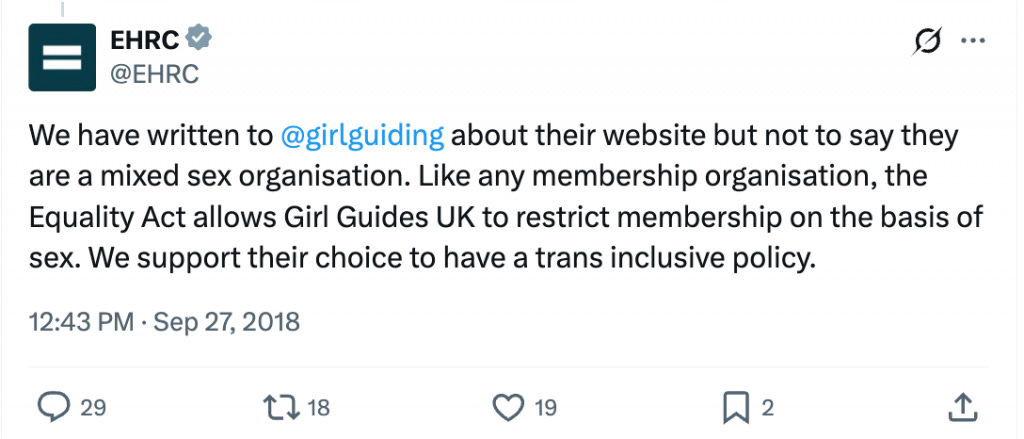
Since the Supreme Court judgment of April 2025 on the meaning of “sex”, many charities and other not-for-profit membership associations are revisiting such decisions.
Both the National Federation of Women’s Institutes and Girlguiding have accepted that they got the law wrong, and are in the process of requiring trans-identifying male members to leave.
KENRIC, the UK’s longest-running social group for lesbians, held a consultation with its members regarding membership criteria and announced in June that it would return to being open only to biological women who identify as lesbian.
Women’s Aid Federation has reaffirmed that it exists “to promote the protection of women and children survivors of domestic abuse”. It has welcomed the EHRC guidance, recognising that some services that are female-only will no longer be able to support “Trans +” survivors of domestic abuse and sexual violence and saying that these survivors may need alternate caring, expert and reliable sources of support into which they can be referred.
Similarly, Rape Crisis England and Wales says its purpose is “is to relieve the trauma and distress of women and girls who have experienced any form of sexual violence and abuse”. Some rape crisis centres offer services to men and boys (including those that identify as trans) while others offer services just to women.
Some of these organisations are now experiencing a backlash. They are coming under pressure, both internally and externally, to become formally “trans inclusive” – that is, to make explicit what had previously been done by linguistic trickery.
Organisations such as the Good Law Project argue that Article 11 of the European Convention on Human Rights, which protects freedom of association, as well as the way the Equality Act is drafted mean that it would be lawful for women’s charities to remain “trans inclusive” (that is, to include trans-identifying men among their beneficiaries).
This is not the case.
As the EHRC Code of practice for services, public functions and associations makes clear, associations can limit membership to particular groups, but beyond that they must not discriminate.
For a single-sex association, becoming “trans inclusive” means changing the admission rules – if it doesn’t do this, it becomes vulnerable to discrimination claims. It may have articles of association that set out how to do this (for example, after consulting members or holding a vote). There is no need to justify the change (or indeed the original admission rules); this reflects the right to freedom of association.
However, this does not mean that single-sex charities can simply decide to become “trans inclusive”. In order to be a charity, an organisation must meet the “public benefit” test, which means it must have charitable objects that ensure it benefits the public and not just a group of individuals. Any restriction of benefits (such as being only for women) established in the charity’s objects must be either to tackle a specific disadvantage shared by that group or a proportionate means to a legitimate aim related to that group.
The Charity Commission has reminded charities that they must be compliant with the Equality Act and the EHRC code, and that “unreasonable delays in taking steps towards compliance may be considered a breach of those responsibilities.”
The rules for charities are stricter than associations because a charity doesn’t exist for its trustees or staff, or as a business for its customers. It exists for its beneficiaries, who are described in its objects. The assets it holds and the money it raises must be used solely in pursuit of those objects. It is fraudulent to raise money to benefit one group and then spend it on another. The fraud isn’t just against beneficiaries and donors, but against taxpayers, since charities receive generous tax breaks.
Charities can change their objects with permission from the Charity Commission, but they must continue to meet the public-interest test and the original beneficiary group must not be disadvantaged by the change. An example is the Scout Association, which went mixed sex in stages between 1976 and 1991. For the Women’s Institute, Girlguiding or any other single-sex charity to go “trans inclusive”, it too would have to show that its objects meet the public benefit test, and that the change is in the interests of its original beneficiaries.
But it is not obvious, to say the least, that men and boys with the protected characteristic of gender reassignment share any of the sorts of interests with women and girls that such charities were set up to meet. Girlguiding, for example, was set up to give girls an independent space away from boys, on the basis that in mixed-sex groups girls are often squeezed to the margins and see boys take up a disproportionate amount of time and airspace. Girl-only spaces give girls somewhere to be confident and outspoken, to gain leadership skills and to escape sexism and harassment. Since “trans girls” are boys, admitting them isn’t just incompatible with the charity’s objects, it undermines them.
As the Supreme Court said:
“The purpose of addressing the particular needs, disadvantages or participation levels of women as a group with the protected characteristic of sex, is undermined if women as a group includes trans women with a GRC (in other words, biological men who are legally female).”
Charities that serve children and vulnerable groups also have safeguarding responsibilities. Admitting boys with the protected characteristic of gender reassignment to Girlguiding, and permitting men with that characteristic to be Guide Leaders, would not only mean using the charity’s resources for a group other than the one it was set up to support; it would also put those girls at heightened risk by giving male people access to spaces that were previously female-only.
Girlguiding’s safeguarding procedures are built around being an organisation for girls. Although some specific volunteer roles can be held by both men and women, guide leaders are female, and toilets, washing facilities and accommodation on overnight trips are female-only. Including some men and boys would require a complete rethink of safeguarding procedures – and would simply be impossible if everyone was required to pretend that those boys and men were in fact female.
Any change to a charity’s objects or beneficiaries that harms the original beneficiaries like this will not be in that group’s interests. Organisations like Girlguiding are right to return to focusing on their purpose.
Sex Matters has published a detailed briefing on sex and the law for associations and charities. Policy analysts Murray Blackburn Mackenzie have also published a report on charities and a legal opinion from Karon Monaghan KC.
Excellent. Plain speaking and clear explanation. Thank you.
Excellent work. May I just ask that you don't refer to them as male people? Men or boys suffices. It's vital that we always use clear and accurate language.