

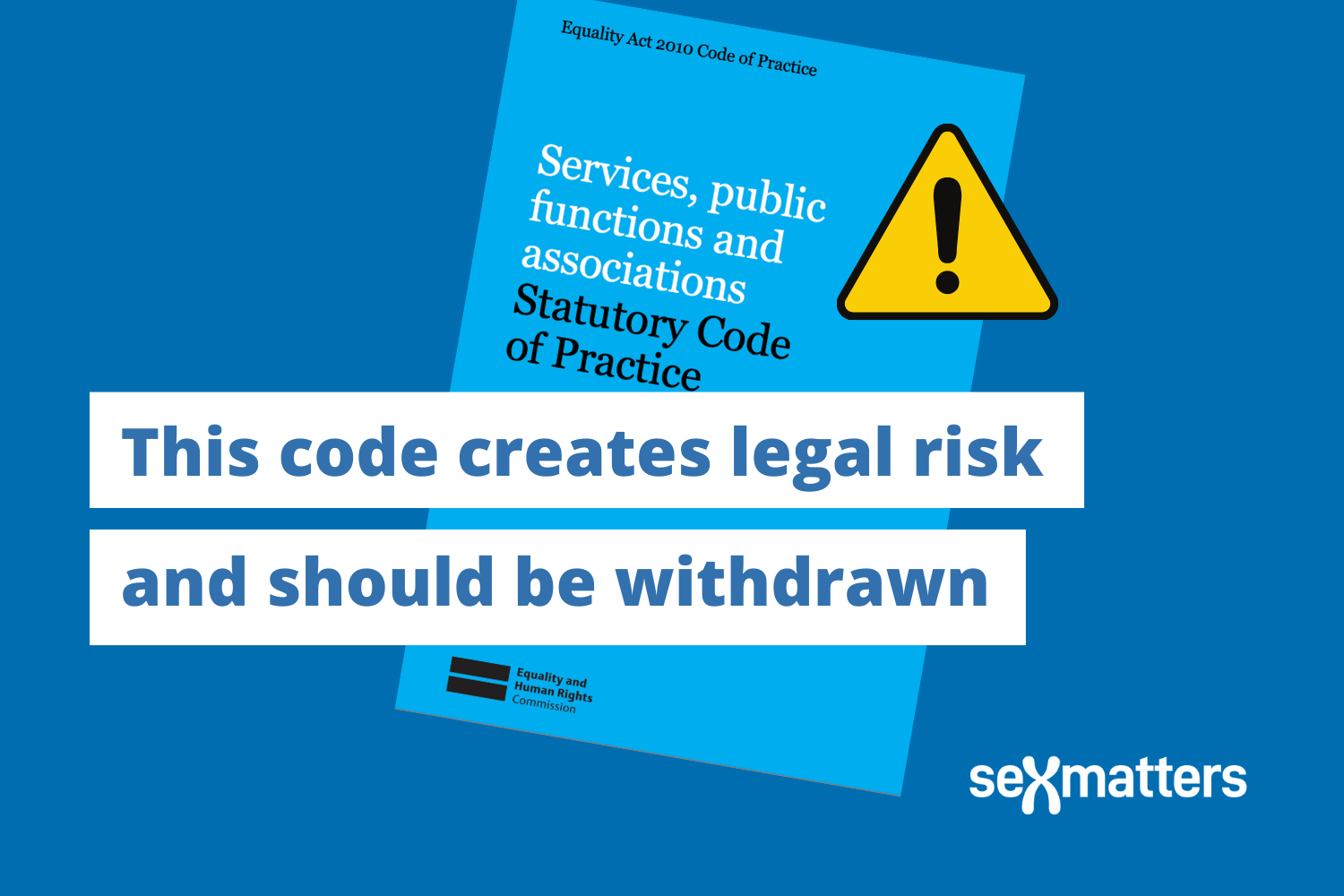
Sex Matters has been calling for the government to deal with misunderstanding and misrepresentation of the Equality Act since 2020. Much of the problem goes back to bad guidance published by the Equality and Human Rights Commission (EHRC) in 2011.
In 2021, 7,893 people joined us in signing a letter to the Committee on Standards in Public Life calling for a public inquiry into the adoption of “Stonewall Law” by public institutions. On 3rd June 2021 the story got into the news. Stonewall defended its approach, saying that it was:
“confident in our advice on the Equality Act which is based on the Equality and Human Rights Commission’s Equality Act Code of Practice.”
Now, finally, following the Supreme Court judgment in the For Women Scotland case, the EHRC has admitted that its code of practice for service providers is wrong in law, and has urged the Minister for Women and Equalities to revoke it before it does any more damage.
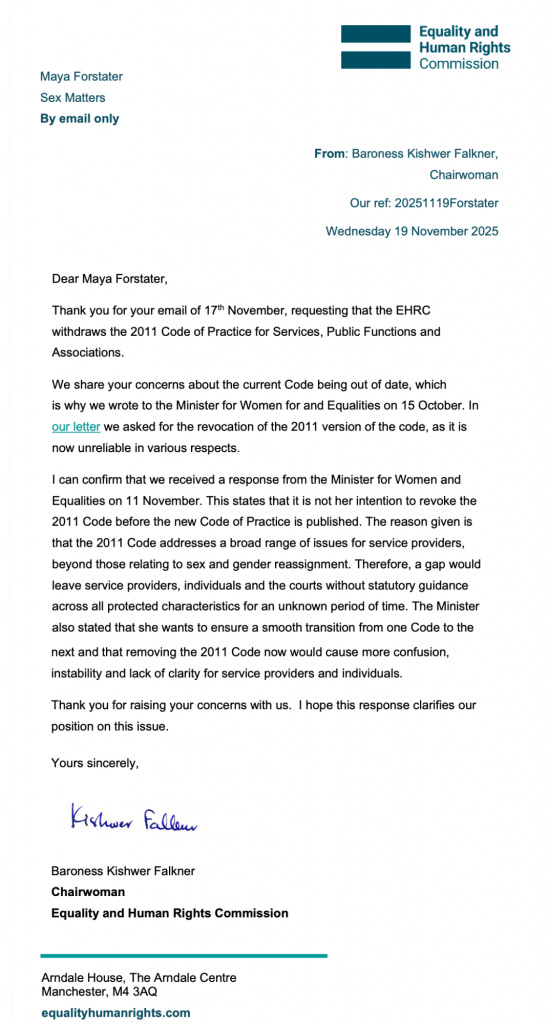
We wrote to Baroness Falkner, chair of the EHRC, to ask why its outdated and legally wrong code had not been withdrawn, following her 16th October letter to the minister. Baroness Falkner replied to us saying that the minister has refused to act:
“I can confirm that we received a response from the Minister for Women and Equalities on 11 November. This states that it is not her intention to revoke the 2011 Code before the new Code of Practice is published. The reason given is that the 2011 Code addresses a broad range of issues for service providers, beyond those relating to sex and gender reassignment. Therefore, a gap would leave service providers, individuals and the courts without statutory guidance across all protected characteristics for an unknown period of time.”
This is an abdication of responsibility. Refusing to revoke this 14-year-old guidance on the basis that some parts of it may remain useful is an absurd excuse.
As we wrote to the minister:
“Duty bearers are required to comply with the law right now. They do not have the option of waiting. As employers they must set policies that are lawful, and communicate them to their staff. If they knowingly or recklessly make a statement which is false or misleading in telling employees and contractors that policies are lawful, they are liable for conviction of a summary offence that carries an unlimited fine (under Equality Act 2010 Section 110 (4) and(5)).
“The question they need to answer to their employees is what is their policy on whether people who identify as transgender are allowed into services provided for the opposite sex, such as toilets, showers, changing rooms, dormitories, sports, mental health wards, and women’s specialist services. It is not a question they can put off or obfuscate. Nor can they tell staff to negotiate it on an individual basis.”
The old code causes confusion and legal risk for duty bearers. It is the minister’s responsibility to put this right.