

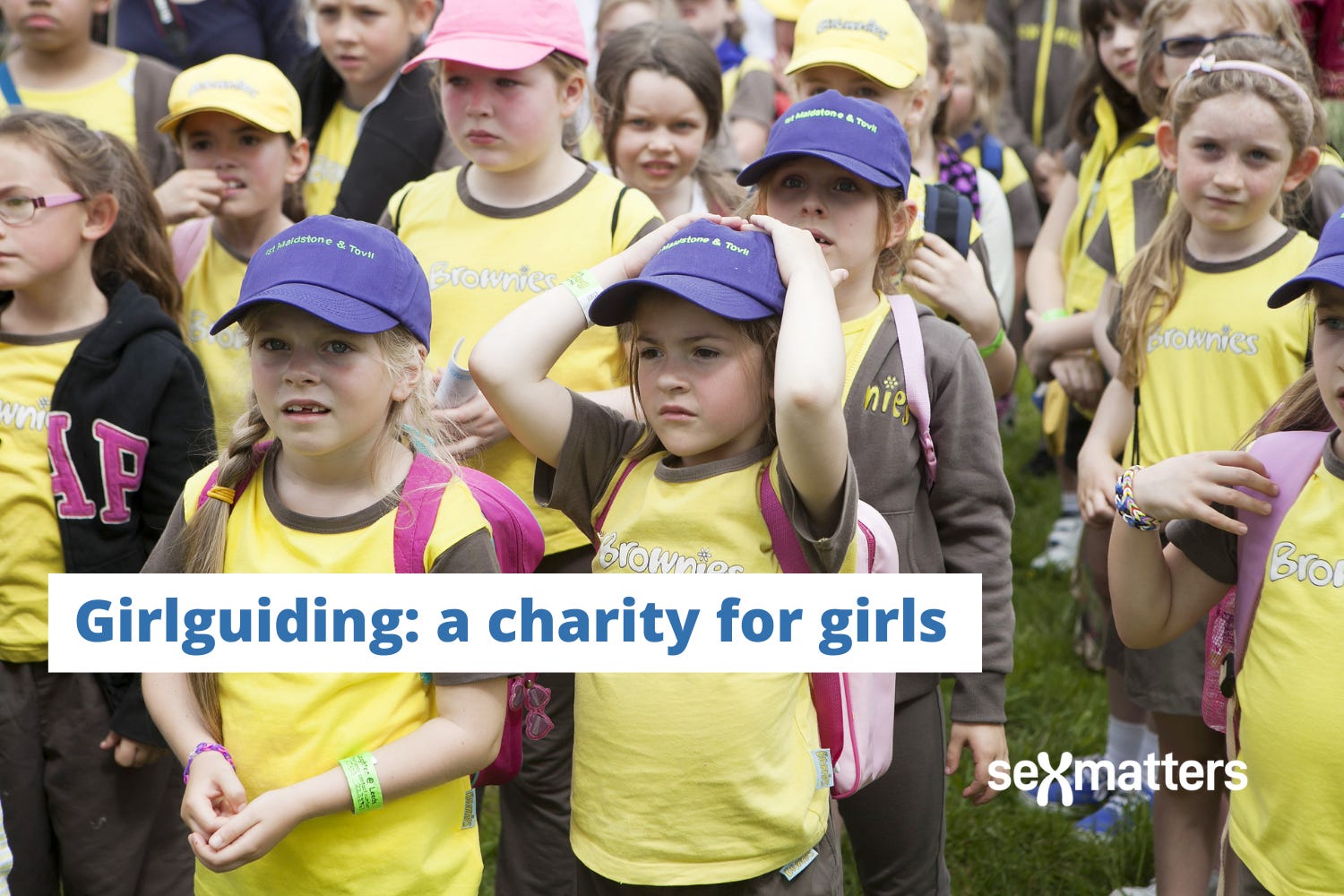
Girlguiding is the UK’s largest youth organisation dedicated to girls. It is a charity registered in England and Wales, and in Scotland, and has a royal charter going back to 1915. The charity’s objects are:
“To promote the education of girls and young women to help them develop emotionally, mentally, physically and spiritually so they can make a positive contribution to their community and the wider world.”
Over 300,000 women and girls are currently involved in Girlguiding and many credit it as a formative experience in their life.
It is and always was an organisation for girls.
Staff and volunteer positions are open to men, but only girls can become young members, and only women can become Guide leaders. The organisation’s operational policies also take into account the particular needs of girls. For example its policy on first aid on residential trips says:
“If the first aider is a man, a woman must be present when a member is being treated. A woman should deal with girls’ personal hygiene queries and needs.”
Diverting from its charitable objects
But in 2017, without consultation and without applying to the Charity Commission to change its charter, the board adopted an “equality and diversity” policy that permitted boys and men to join the association as if they were girls or women.
It required that such “trans girls” and “trans women” should be admitted without having their sex disclosed and should be allowed to use sleeping, washing and toilet facilities alongside girls or women – and that girls’ parents were not to be told about these arrangements.
Girlguiding’s policy said:
“To help us be as inclusive as possible, Girlguiding’s definition of girl and woman includes those who are biologically female (however they identify) and those whose gender is a girl or a woman (trans girls and trans women)” .
This falls into precisely the same error as the Scottish Government’s definition of women for the purpose of counting women on public boards, which was found to be unlawful by the Supreme Court in For Women Scotland.
Guide leaders who complained or disagreed with the policy were disciplined. This is what happened to Guide leaders Katie Alcock and Helen Watts in 2018. They were investigated by Girlguiding, which judged that their “unwillingness to clearly commit to follow all of the Girlguiding Code of Conduct” was incompatible with continued membership. And in 2021 a teacher and mother of three was questioned under caution by Merseyside Police after sending a letter to Girlguiding UK raising safeguarding concerns about a male dominatrix who had been accepted as a Guide leader.
Single-sex charities and the law
Girlguiding’s board of trustees, like those of other charities, is responsible for ensuring that the charity acts in pursuit of its charitable objects, and that it complies with other laws..
Under the Equality Act it would be unlawful sex discrimination to provide a service or run an association that is just for one sex without an express exception. There are specific exceptions for associations (at schedule 16) and charities (at section 193) that allow them to limit their membership and benefits to people who share a protected characteristic.
As the Charity Commission says in its guidance on the law for charities, limiting benefits to people who share a protected characteristic is lawful if:
the charity’s governing document only allows people who share a protected characteristic to benefit, and
the restriction can be justified based either on the charity’s aim to tackle a particular disadvantage faced by people who share a protected characteristic or achievement of a legitimate aim.
The Charity Commission says:
“The commission expects trustees to run their charity in accordance with the legal obligations that are relevant in their circumstances. This includes taking immediate steps to prevent illegal discrimination from continuing.”
The law is clear
On 16th April 2025, the Supreme Court ruled in For Women Scotland v The Scottish Ministers (“FWS”) that the terms “sex”, “woman” and “man” in the Equality Act 2010 (“EA 2010”) refer to biological sex and that a person’s sex for these purposes is not modified by possession of a Gender Recognition Certificate (“GRC”) issued under the Gender Recognition Act 2004 (“GRA 2004”).
Although the FWS judgment only relates to GRC holders, who must be over 18, it made clear that the “gateway conditions” for using the single-sex exceptions are based on biological sex.
On associations and charities (at paragraph 231) it said:
“Schedule 16 [on associations] and section 193(1) [on charities] plainly intend that single-sex associations and charities should be permitted to exist along with other single-characteristic associations. A certificated sex meaning applied to these exceptions would make it impossible for any women’s association or charity – including, for example, a mutual support association for women who are victims of male sexual violence, a lesbian social association, a breast-feeding support charity – to be set up or to pursue a dedicated purpose which is directed at the needs of biological females. To require such associations or charities to reconceive of their objects as targeting a group that does not correspond with their original aims, and to allow trans people with a GRC (of the opposite biological sex) to join would significantly undermine the right to associate on the basis of biological sex (or sexual orientation based on biological sex as we have discussed above).”
This seems to have finally prompted Girlguiding to review its policy and realise that it must comply with the law. Its statement said:
“Girlguiding’s governing charity documents set out that the membership and people who benefit from our organisation are girls and women. The Supreme Court ruled that girls and women are defined in the Equality Act 2010 by their biological sex at birth.”
The action also appears to have been prompted by a legal letter sent in November by a mother of a seven-year-old girl (“Z”) who wanted to join the Guides. The letter set out the relevant legal provisions and said that the mother and daughter would bring a claim or direct or indirect discrimination and harassment against the charity if it did not resolve her concerns and return the charity to its objects of being for girls.
As the letter sets out, Girlguiding relies on the charity exception in order to provide its educational programme for girls. This is a proportionate means of achieving a legitimate aim and is set out in its charitable instrument. However, Girlguiding’s equality and diversity policy was legally inconsistent with this or any other of the Equality Act’s single-sex exceptions.
The legal letter explains that Girlguiding’s policy for deciding who to admit to membership and benefit from its services resulted in direct and indirect discrimination and harassment against Z:
Unlawful direct discrimination by separating her from boys. Not allowing girls to mix with boys is itself sex discrimination. It is only lawful if a single-sex exception is used. Those exceptions must be applied to allow a sex-based rule.
Direct discrimination by offering a service that is inadequate for her needs. By putting Z at risk of having a boy in her Rainbow, Brownie, Guide or Ranger group, Girlguiding was subjecting Z to less favourable treatment related to sex (since Z and her parents had chosen Guides as a single-sex organisation).
Indirect discrimination. The policy of allowing boys and men to self-identify into the organisation puts girls at a substantial disadvantage compared with boys, as they are at greater risk of their privacy, dignity or safety being compromised compared with a boy or man.
Harassment. The policy constitutes and encourages unwanted conduct which violates their dignity or creates an intimidating, hostile, degrading, humiliating or offensive environment for girls. This includes, but is not limited to: sharing toilets, showers or changing facilities with boys, contact sports with boys and sharing accommodation with boys, all without girls’ prior knowledge or consent.
The policy also results in unlawful discrimination towards boys by refusing membership to a (non-trans) boy.
Why did Girlguiding flout the law?
It should be obvious that transsexual men and gender-distressed boys are not part of the group Girlguiding was set up to serve.
Guide leaders are not qualified to offer therapeutic role-play to boys with gender confusion. Girls attending Brownies and Guides should not be required to provide immersive role-play to these boys or to cross-dressing men. This does not benefit their emotional and spiritual development. Many parents object.
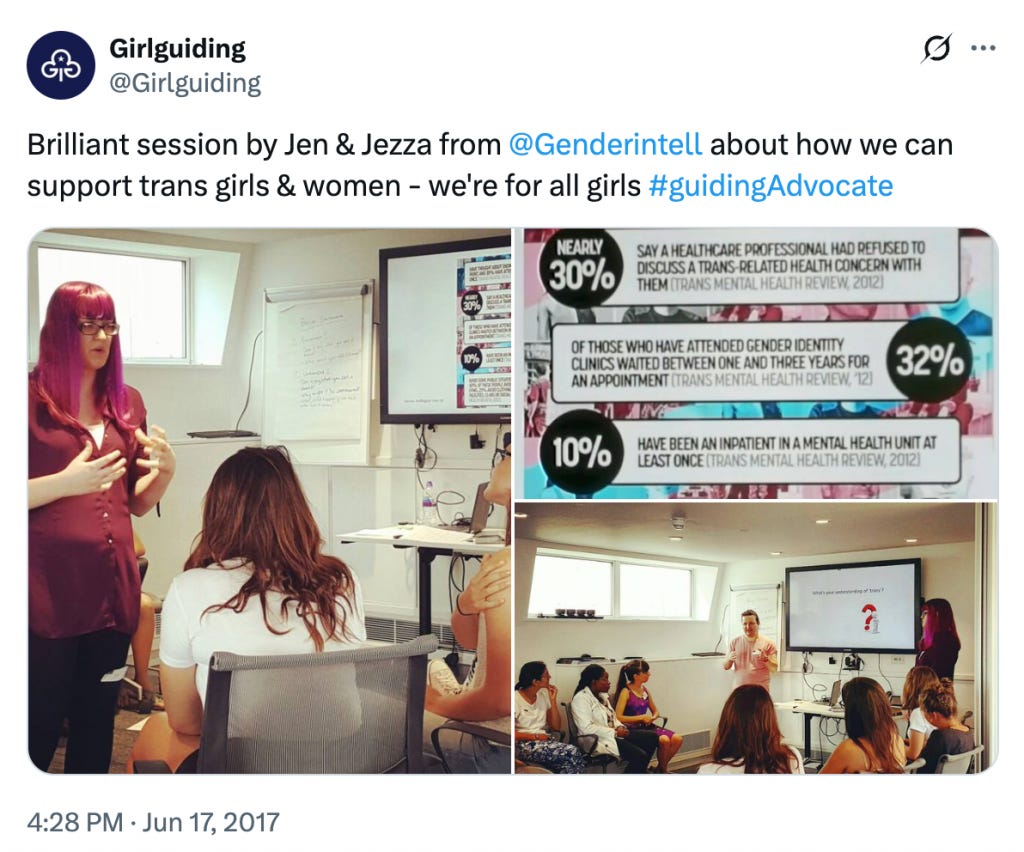
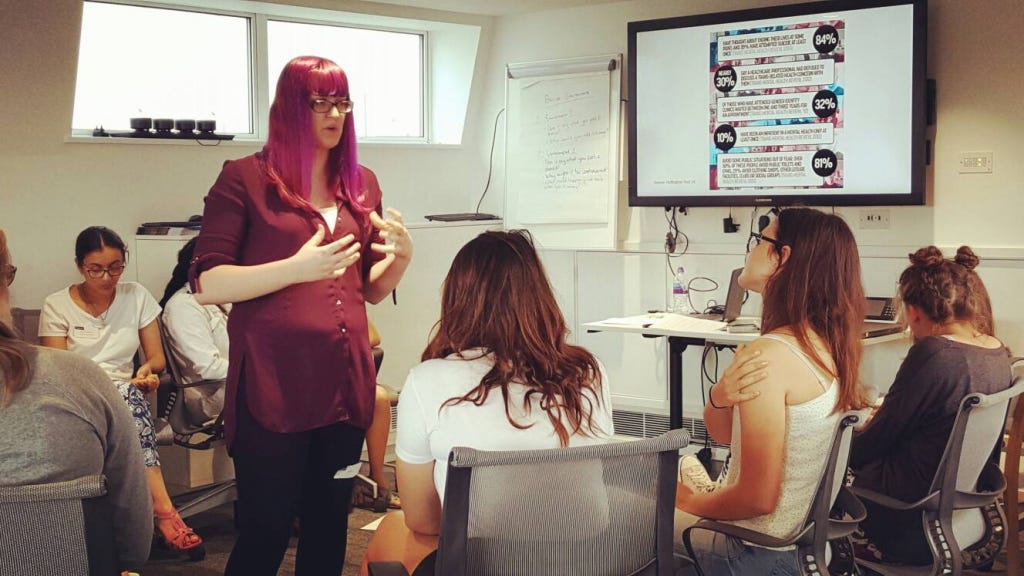
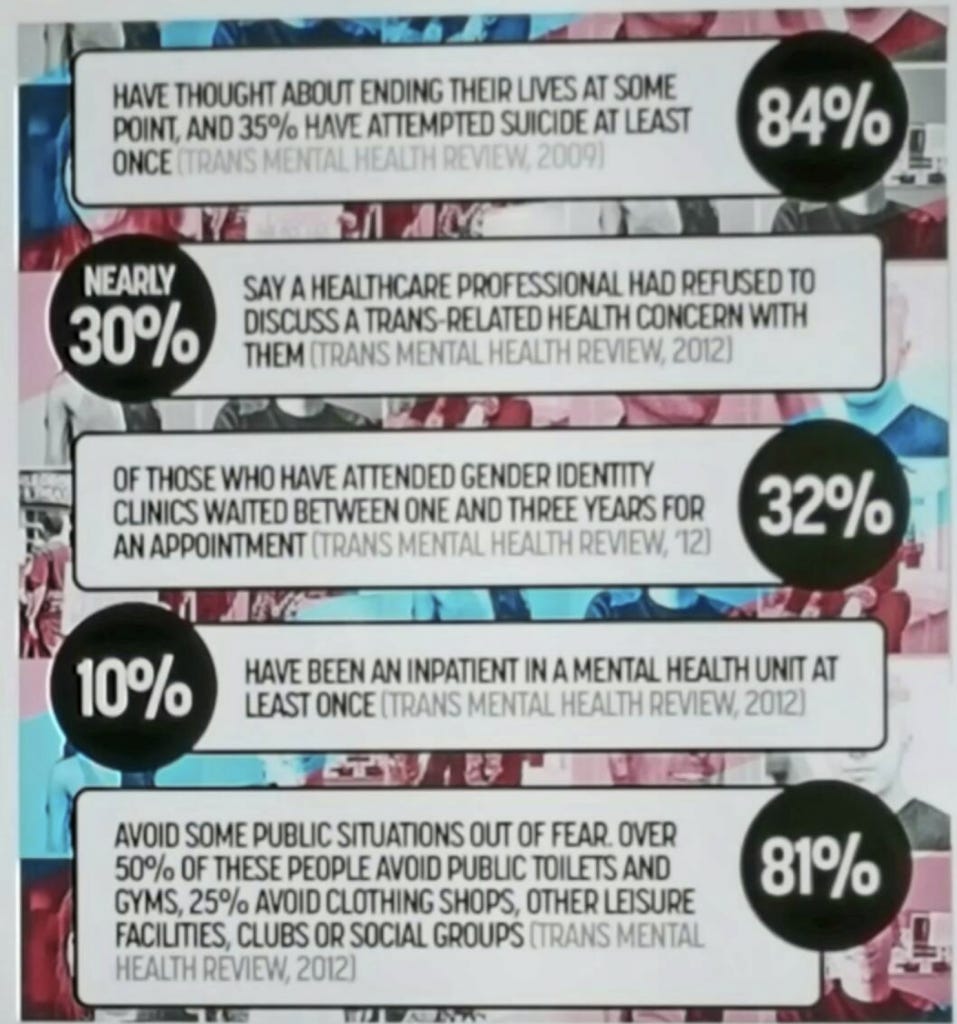
Girlguiding adopted its policy after consulting with Gendered Intelligence. As shown in this tweet featuring trainer Jezza Donnovan, Gendered Intelligence shared the usual suicide scare statistics (read our factsheet on why these are irresponsible myths).
Stonewall also lobbied hard for women’s charities of all kinds to accept men as if they were women, promoting the idea that men should be allowed to self-identity into women’s refuges and rape-crisis centres as well as Guiding.
It told charity leaders:
“Under the [Equality] Act, trans people have the right to access single-sex services in line with their ‘acquired gender’, and they are not required to obtain a Gender Recognition Certificate, or have undergone any form of medical intervention, to be eligible for support in these services”
In 2018 Fair Play For Women raised the issue about Girlguiding’s policy being unlawful and undermining safeguarding. Then the chief executive of Girlguiding, Julie Bentley, made a statement in response. She said:
“We’ve been asked why we don’t simply use exemptions under the law. We continue to review our policies against emerging guidance from organisations like the Equality and Human Rights Commission and, like other organisations working with children and young people, we welcome all guidance that helps us navigate this complex area. However, as a girl-only organisation Girlguiding does not have the right to exclude trans young people from guiding and nor would we wish to.“
This was wrong in law. Girlguiding had the right to exclude boys (whether they identified as transgender or not) and no legal basis for including them. By including boys as if they were girls it was not following its objects, and was undermining safeguarding.
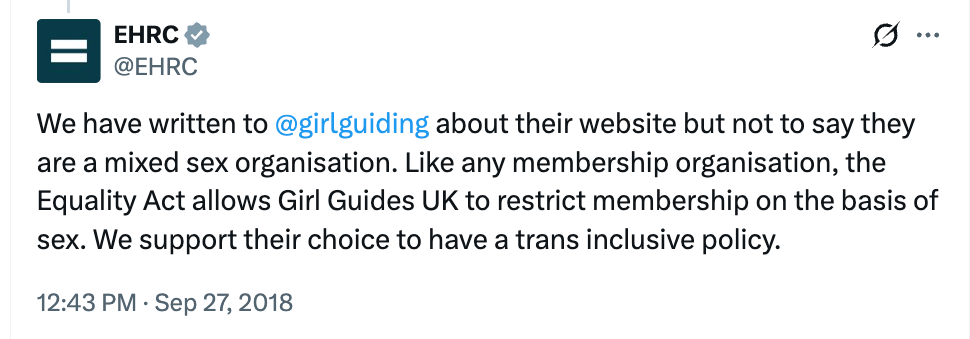
Girlguiding also had bad advice from the Equality and Human Rights Commission, led at the time by ex-Stonewall chair David Isaac with senior staff Melanie Field (who rejects the Supreme Court judgment), Clare Collier (now Rev Grey Collier, pronouns he/him, who went on to be a trustee of Mermaids and part of the Trans Solidarity Alliance), and Elizabeth Procashka (chair of the charity Birthrights which cancelled Milli Hill for saying “women” and not “birthing people”).
Where is the Charity Commission?
The Charity Commission did nothing to stop Girlguiding and other women’s charities redefining the terms “women” and “girls” to include men and boys.
A spokesperson for the Charity Commission has now told the magazine Civil Society that it will only become involved in matters of equality law if a breach of another regulator’s rules indicates a wider failure of governance.
The practice of single sex-charities diverting from their objects is a failure of governance that is widespread across the sector.
Penny Wilson, an “inclusive charity governance consultant” and former CEO at Getting On Board, is typical of many leaders in the voluntary sector. She has written to the regulator imploring it not to take regulatory action against single-sex charities which divert from their objects, but to enable them, in the name of inclusion.
Girlguiding’s communication to its volunteers suggests that members could feel upset or neutral about its shift back to serving girls, not that they might support it. It has also written to them launching a taskforce “to explore new opportunities for trans girls, trans young women and trans women”. As a charity for girls and young women it has no business launching a taskforce for transsexual and cross-dressing men or gender-distressed boys.
The Charity Commission has said it plans to update its Equality Act guidance for charities after the Equality and Human Rights Commission (EHRC) guidance is published. But there is no reason to wait. What it should be doing is making clear that charities must pursue their stated objects.
Girlguiding trustees, staff members or volunteers who don’t support its mission “to promote the education of girls and young women” should find another organisation to join, not be allowed to subvert this one in order to serve the wishes of a different group.
What you can do
If you are a Guide, parent, ex-member or supporter, write to Girlguiding using the form on its website.