

The UK Supreme Court ruling in For Women Scotland v The Scottish Ministers made an unambiguous clarification: the terms “sex”, “woman” and “man” refer to biological sex when it comes to protecting people from sex discrimination and sex-based harassment at work. And they always have.
Duty bearers – including government departments – are legally obliged to comply with this clarified legal position right now. They cannot lawfully continue to operate policies that contradict the Supreme Court’s interpretation, and they cannot use the excuse of waiting for new guidance.
And yet many government departments are still doing exactly that.
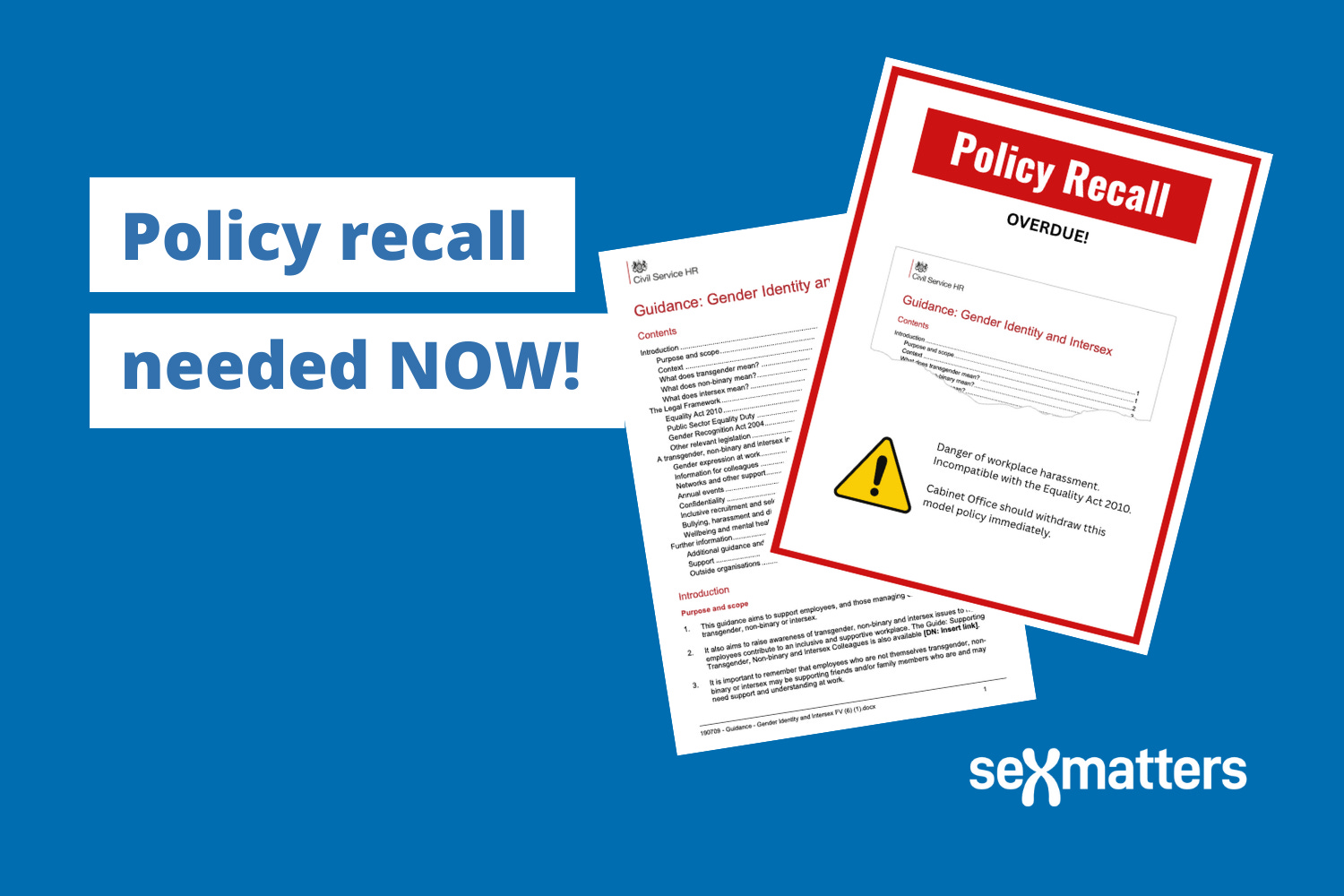
Sex Matters has written to Sir Chris Wormald, Cabinet Secretary and Head of the Civil Service, calling for urgent action to withdraw the Cabinet Office’s model policy, which allows employees to access opposite-sex workplace toilets. We are also writing to all government departments asking them to recall their matching policies.

In 2022 Eleanor Frances, a civil servant at the Department for Culture, Media and Sport (DCMS), raised formal concerns about her department’s policy of allowing colleagues who identify as trans or non-binary to use toilets for the opposite sex. Her concerns were ignored and she was then treated unfairly at work. She brought a claim for discrimination on the grounds of philosophical belief, sex and disability, and received a six-figure payout in December 2024. The permanent secretaries of DCMS and DSIT issued a statement saying that their departments were working together to introduce a new policy which they expected to release by the end of that year. It still hasn’t been published.
DCMS is now pushing responsibility back to the Cabinet Office and the Equality and Human Rights Commission (EHRC). It recently told Denise Fahmy of Freedom in the Arts:
“The revised model policy is being developed by the Cabinet Office in consultation with a range of members of staff.
“… Please note, the revised model policy cannot be finalised until the updated Equality and Human Rights Commission (EHRC) code of practice is available.”
This excuse just won’t do. As an employer, DCMS is responsible for having lawful policies.
The Equality Act is designed to protect individual staff from carrying the liability for actions they take based on their employer’s policies. Under Section 110 employees can escape liability if they are following directions from their employer, and have been given reassurance that the policy is in line with the Equality Act. An employer who makes a false or misleading statement knowingly or recklessly is liable for a criminal conviction and fine.
A policy that actively authorises unlawful conduct
Our letter to Sir Chris asks for the urgent withdrawal of the Cabinet Office’s Gender Identity and Intersex Model Policy Package. This policy instructs civil servants — including managers — to undertake actions that we believe amount to discrimination and harassment based on sex.
The policy was issued under the previous government in 2019 and is still used across Whitehall. Work has been ongoing since 2023 to update the policy but has been confounded by civil-service LGBT+ networks arguing that preventing trans-identifying civil servants from accessing single-sex facilities for the opposite sex would be “completely unacceptable as well as unlawful”.
Key sections of the policy state that:
staff may “use any appropriate single-sex toilets and other facilities” based not on sex but on “gender identity and expression”
an individual is assumed to know “which facilities are the best match for their gender identity”, and managers may not require them to use unisex alternatives
complaints, disagreement, or even ordinary use of sex-based language may be treated as bullying, harassment, or discrimination.
These provisions override sex in favour of self-declared gender identity and impose penalties — including disciplinary processes which could lead to dismissal — on staff who object.
The law is clear
Under the Equality Act 2010:
Employers must not harass employees on grounds of sex or belief (Section 40).
Unwanted conduct creating a hostile, degrading, or offensive environment in relation to a protected characteristic is unlawful harassment (Section 26).
As we say in the letter, it is obvious that “the entry by a man into a toilet or changing room… designated for the use of women is… unwanted conduct related to a protected characteristic (sex)”.
The current policy therefore authorises unlawful behaviour and exposes managers and staff to further liability by instructing them to undertake disciplinary action against those who complain about this.
It is the Supreme Court, not the EHRC, that determines the law. Departments cannot defend unlawful policies by claiming to be awaiting updated guidance. Case law confirms that the EHRC’s role is advisory, not authoritative. (And in any case the updated guidance will be for service providers not employers.)
A call for immediate action from the Cabinet Office
The Women and Equalities Minister has taken a “neutral” position as an interested party in the case by the Good Law Project against the EHRC. But this doesn’t let the government off the hook.
Sex Matters has asked Sir Chris, as head of the civil service, to take responsibility for the cross-government model policy which the Cabinet Office recommended. We have asked him to make a clear choice: either publicly state that the actions authorised by the current policy are lawful; or withdraw the policy immediately and instruct departments to disregard it.
Choosing the first option would require the Cabinet Office to defend policies that allow men to use women’s facilities, prevent managers from requiring trans-identifying staff to use unisex toilets and classify objections as harassment. Given the Supreme Court ruling, defending these actions appears untenable.
Every day that passes with unlawful policies in place puts civil servants at risk of harassment, discrimination and legal wrongdoing.