

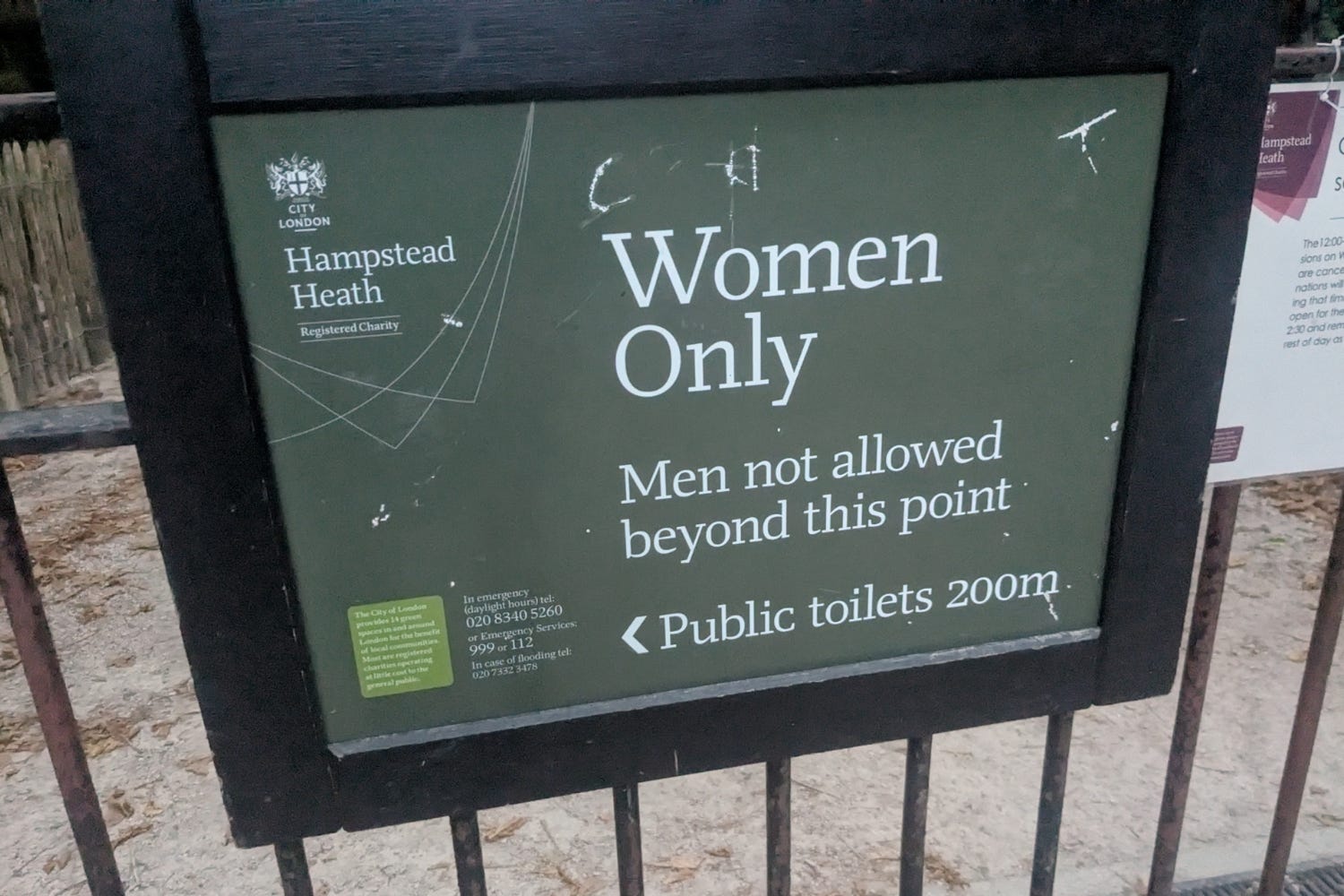
We have received an order in our case against the City of London on the Hampstead ponds. The case will be heard in the autumn. Trans lobby group TransLucent has said it intends to apply to intervene.
Our application for “expedition” – that is, for an early hearing – was turned down. So was the City of London’s application for a “stay” to slow it down. The judge, Mr Justice Bourne, recognised that “there is a real public interest in the issues in this claim”. But he said that the impact of the City of London’s decision-making remains to be seen: it might bring the claim to an end, or require it to be amended.
We don’t think it looks likely that we will end the claim, as the City of London is going full steam ahead in deciding to continue allowing trans-identifying men into the women’s pond, and trans-identifying women into the men’s.
The latest meeting of the Hampstead Heath, Highgate Wood and Queen’s Park Committee, which manages the ponds, was held on 12th May. During it, the proposed policy was voted on and approved by the elected members (it now needs to go forward to a different committee on 4th June). There was much talk about plans to spend £1 million on improvements to the changing areas, but barely any about the fundamental question of whether it is lawful to operate a service in this way in the first place.
One committee member asked about the forthcoming updated code of practice from the Equality and Human Rights Commission, and was told that “there is no version of the EHRC code that we can rely on at the moment”.
So while everyone else has been saying “wait for the guidance”, the City of London has proceeded as if there is no guidance at all. In fact the existing EHRC guidance from 2011 has not been withdrawn, and despite its flaws it explains the basics of the Equality Act that the City of London is trying to skirt around quite adequately (emphasis added):
Definitions
2.55 Sex is a protected characteristic and refers to a male or a female of any age. In relation to a group of people it refers to either men and/or boys, or women and/or girls.
2.56 A comparator for the purposes of showing sex discrimination will be a person of the opposite sex. Sex does not include gender reassignment or sexual orientation.
Direct discrimination
4.3 Direct discrimination occurs when a person treats another less favourably than they treat or would treat others because of a protected characteristic.
4.4 Direct discrimination is generally unlawful. However, it may be lawful in the following circumstances: in relation to the protected characteristic of disability, where a disabled person is treated more favourably than a non-disabled person; where the Act provides an express exception which permits directly discriminatory treatment that would otherwise be unlawful (see Chapters 11 and 13).
4.5 To decide whether a service provider has treated a service user ‘less favourably’, a comparison must be made with how they have treated other service users or would have treated them in similar circumstances. If the service provider’s treatment of the service user puts the service user at a clear disadvantage compared with other service users, then it is more likely that the treatment will be less favourable: for example, where a customer is refused service or a person’s membership of a club is terminated. Less favourable treatment could also involve being deprived of a choice or excluded from an opportunity.
Indirect discrimination
5.4 Indirect discrimination may occur when a service provider applies an apparently neutral provision, criterion or practice which puts persons sharing a protected characteristic at a particular disadvantage.
None of this is difficult or complex.
The City of London’s position is that the men’s and women’s ponds are not single-sex spaces, and that is it therefore is not using the exceptions at Schedule 3 Part 7 of the Equality Act at all. It says:
“Whilst there is a risk of challenge to this option on the basis of direct or indirect sex indirect discrimination, these are again fact-sensitive questions. The City Corporation cannot rely on the exceptions under Schedule 3 to the Equality Act 2010 to resist a claim, because the Men’s Pond and the Ladies’ Pond would not be being operated as single-sex spaces. However, it is unlikely that this would amount to direct sex discrimination, as the relevant criterion for entry would in effect be one of lived gender, not biological sex. In other words, at least some biological men and some biological women would be able to access each of the Men’s Pond and the Ladies’ Pond.”
The committee that waved the policy through did not ask itself whether this analysis aligned with the Equality Act, as explained by the existing code. But even if it fell for such word games, we do not think the High Court will.
I’m one of the witnesses against the corporation’s illegal position. Please let us know when the case comes up as I’d like to attend to support. Thank you, as always, for all that you’re doing
Wonder why khan tried to slow it down ?
I don't think there are many transgender muslims…