

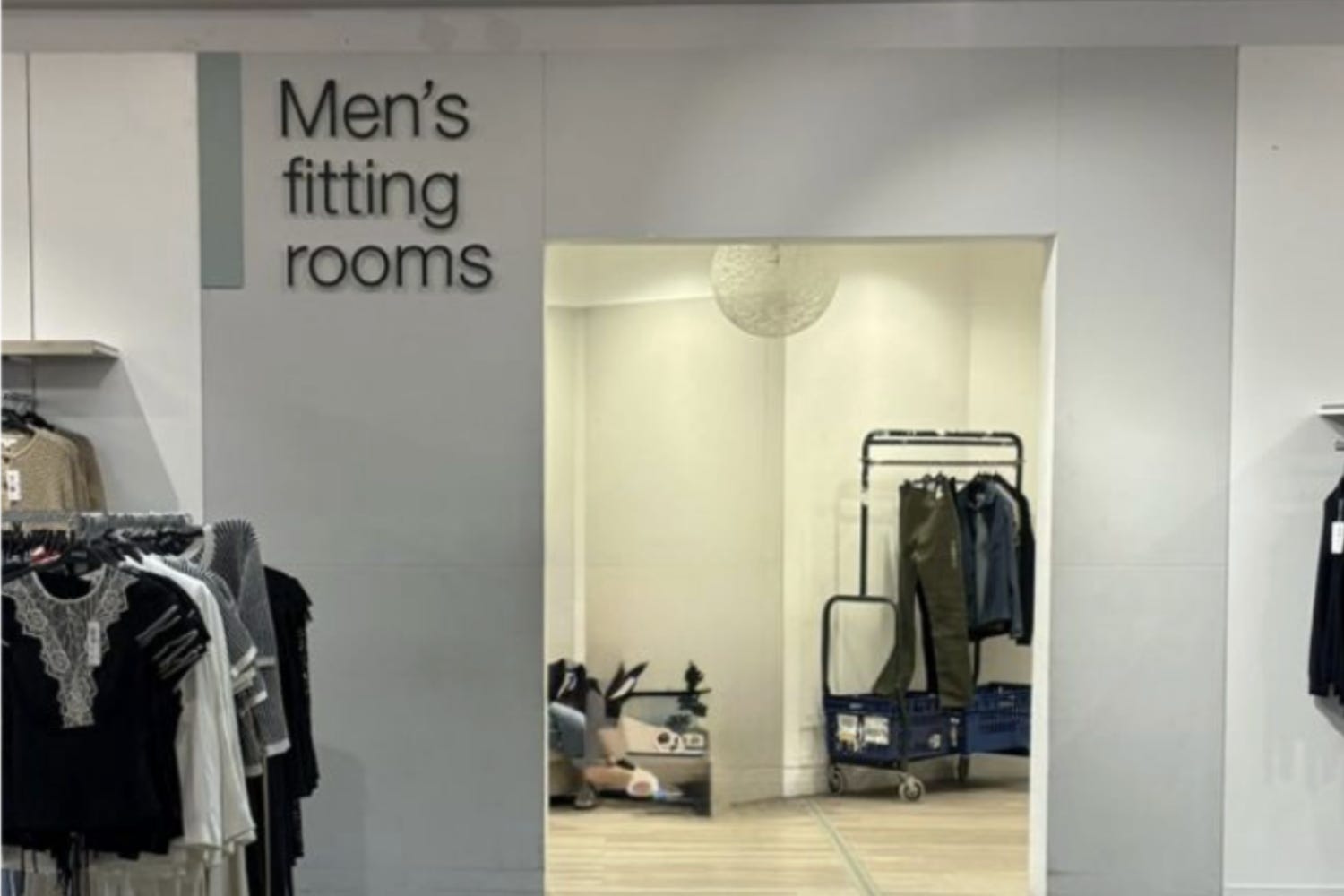
Sex Matters has written to the senior leadership of Marks & Spencer (M&S) to warn the company that its policy of advertising male and female changing rooms but then operating them as mixed-sex facilities could amount to indirect discrimination and harassment towards women. As reported by The Telegraph, our CEO, Maya Forstater, said the policy created a “hostile and humiliating environment” for women.
In one of the latest examples of companies continuing to try to get around the law nearly a year on from the Supreme Court ruling, M&S told Sex Matters that its policies have not changed for many years. Its decision to pretend that it never offered single-sex changing rooms after decades in which it did so illustrates the extent to which employers and service providers are willing to harm all women and girls rather than say No to a tiny number of men who demand to be treated as women.
We wrote to M&S chair Archie Norman, chief executive Stuart Machin and general counsel Nick Folland on 9th March, noting that until recently the company’s clothing stores had clearly labelled male and female fitting rooms but had an unadvertised policy of allowing anyone to use either changing room.
We expressed our disappointment that following judgments by the Supreme Court and the High Court which made clear that separate-sex facilities are lawful, M&S has not returned to a genuinely separate-sex policy, but instead is badging what were labelled men’s and women’s fitting rooms as “trying on” spaces. This makes them less effective, less welcoming and less safe, in particular for women.
“How astonishing that M&S, clothier to Britain’s middle-aged women, has decided that pretending no one needs single-sex changing rooms, after providing them for more than 100 years, is better than possibly having to say no to a man pretending to be a woman.”
Maya Forstater, CEO of Sex Matters
On 12th March, Nick Folland responded, stating that Sex Matters has been “misinformed” about the company’s approach to providing fitting rooms for its customers.
He said that “for many years” M&S has provided unisex spaces in the “vast majority” of its stores. He also said that “most fitting room spaces have long been signposted to customers with a generic ‘Fitting Rooms’ sign and not, as you wrongly suggest, with individual signage for women or men”.
He suggested that the new “Try On” signage is not a change of policy but part of a wider store redesign, and updates signage that used to refer to “Fitting Rooms”.
This is simply not the case.
We wrote back with pictures from several stores showing signs that refer to “Men’s Fitting Rooms” (thanks to supporters for sharing these).
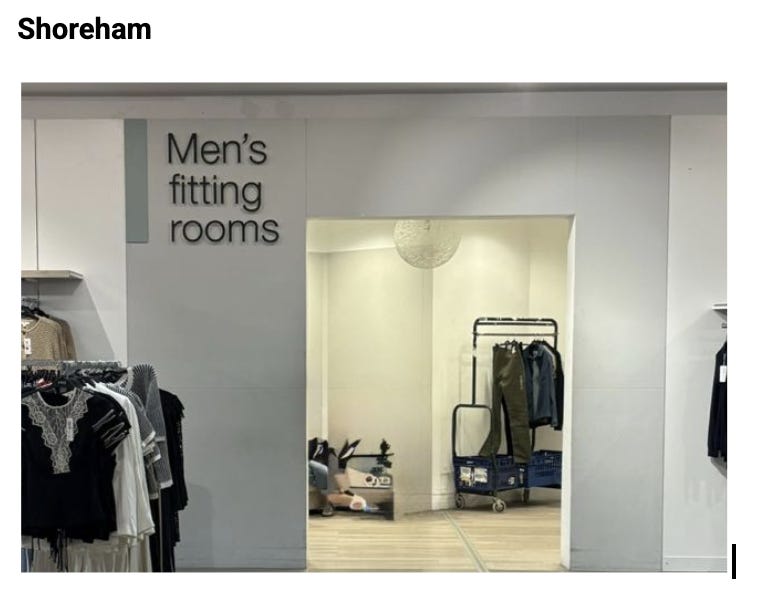
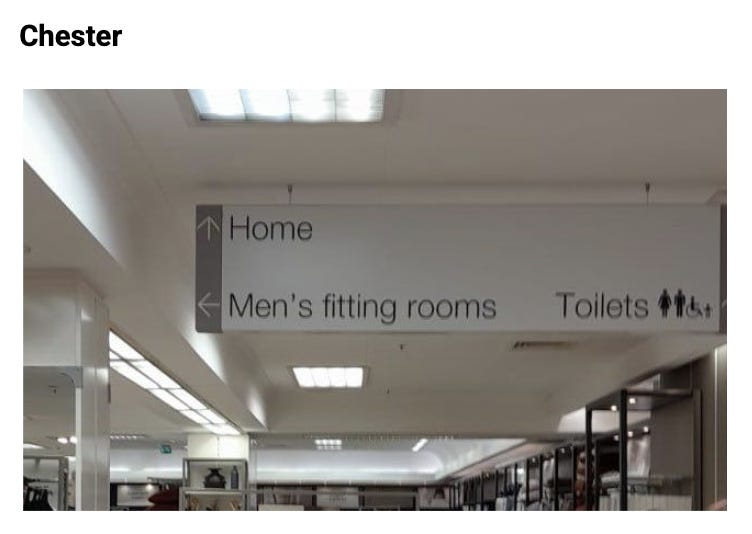
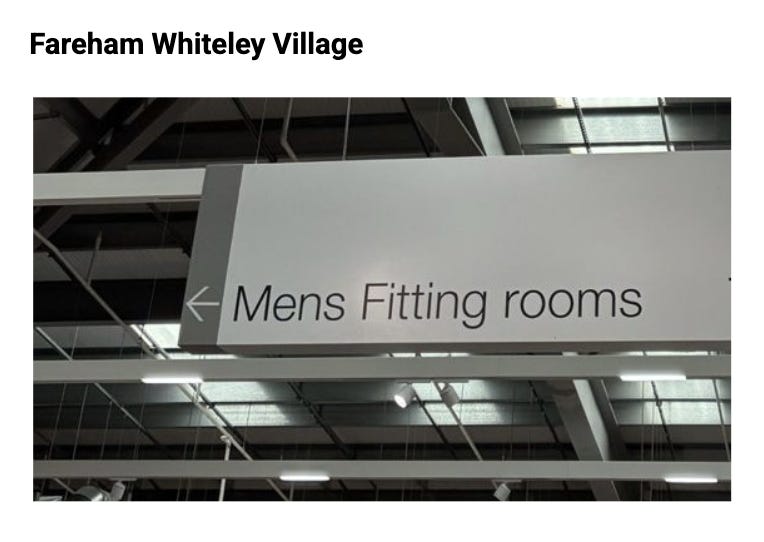
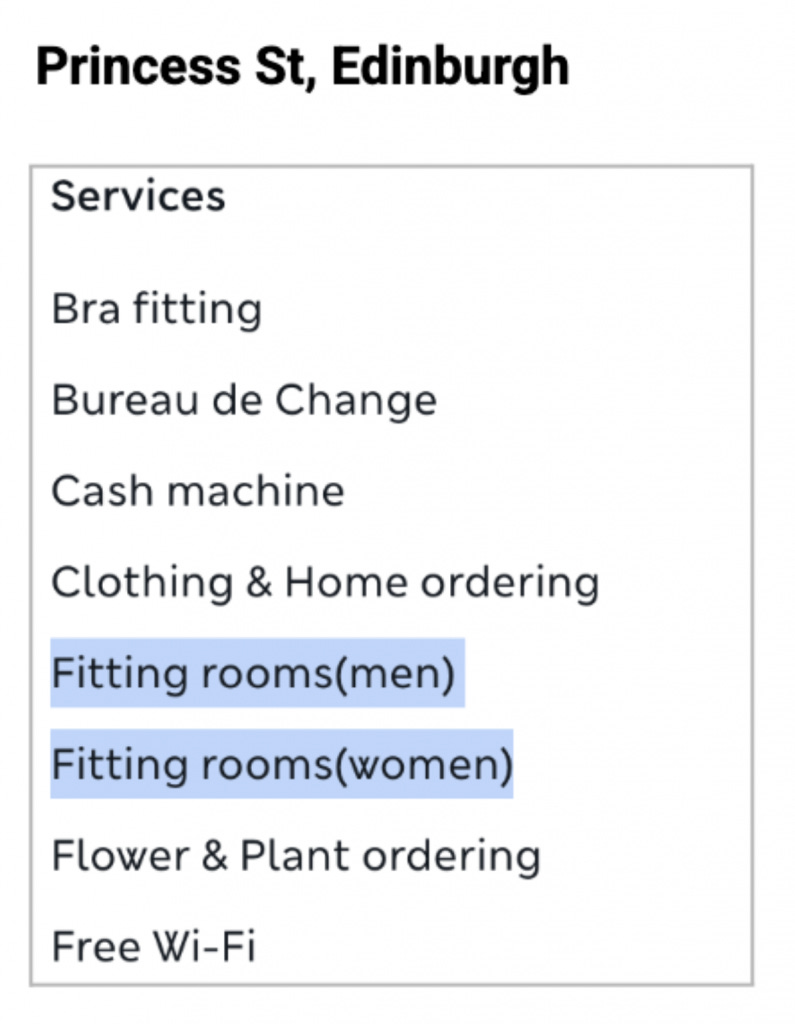
We also provided screenshots of online information for several stores that clearly states that they have men’s and women’s fitting rooms.
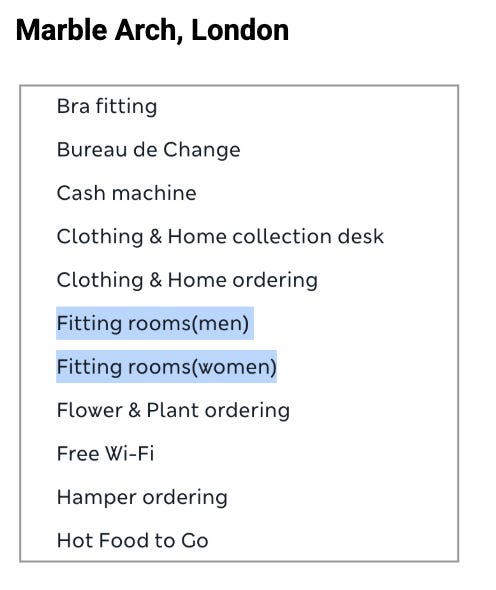
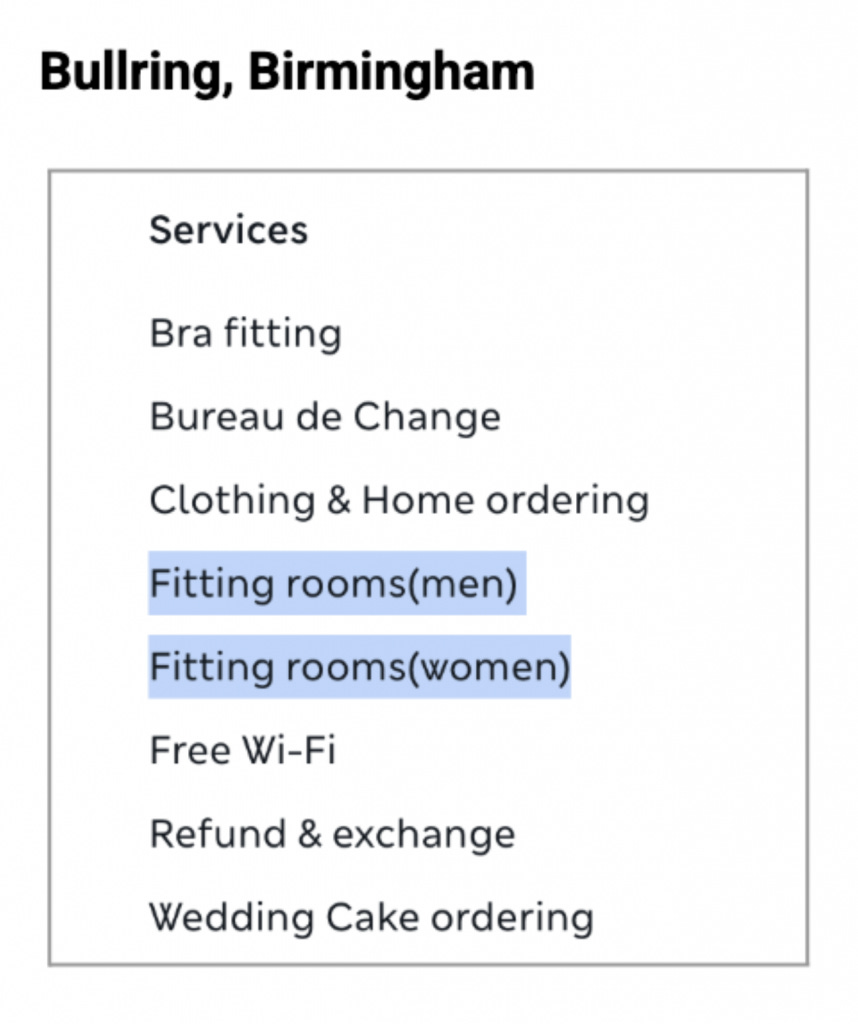
Princes St, Edinburgh (despite this saying Princess St, it is from the online information for M&S’s Princes St store)
Marks & Spencer’s policy of advertising that it has separate-sex fitting rooms but then telling staff to operate them as “unisex” spaces disproportionately disadvantages women. This is because women are subject to greater risks, vulnerability and modesty norms when undressing than men are. M&S’s ambiguous policy is also likely to
The policy also raises questions about whether male staff are deployed to what customers reasonably assume are “women’s fitting rooms”, but which Marks & Spencer views as “unisex”.
We have urged M&S to reconsider its policy, and return its fitting room policies to lawful, clear single-sex provision.
We hope the company is not going to try to get around the question by changing the advertising or signage to “menswear” and “womenswear” fitting rooms. The reason for separate spaces is not because of a difference in clothing but because of issues of propriety, modesty and safety that differ between women and girls on the one hand, and men and boys on the other.
Women and girls who chose to buy from M&S’s men’s or boys’ ranges should not be forced to change with men, or be harassed or discriminated against if they use the women’s fitting room to try clothes on. Similarly, men who chose to buy from the women’s ranges should not be forced to change in the women’s fitting room, or be harassed or discriminated against if they use the men’s fitting room to try clothes on.
People can choose clothing from anywhere in the store. But the fact that there are two sexes, and that sex matters when it comes to undressing, is neither difficult to understand nor controversial.
In English idiom 'trying it on' means "to deceive someone or behave badly, especially in order to discover how much of your bad behaviour will be allowed". So, calling changing rooms "trying on spaces" is uncannily accurate. https://dictionary.cambridge.org/dictionary/english/try-it-on
Isn’t it extraordinary that M&S would prefer a drop in the sale of women’s clothes, rather than get off the fence and have fitting rooms exclusively for women. Talk about being ideologically captured and hugely disappointing - not to say potentially downright dangerous. I won’t be buying any clothes or indeed food from M&S ever again and neither will any of my female friends. Great bit of advertising for a publicly listed company - how arrogant can you get? Doesn’t M&S have a duty of care to its share holders>