

On 5th August, as new statutory guidance on single-sex services was finally published, the leaders of six London councils wrote an open letter to Minister for Women and Equalities Bridget Phillipson saying they did not intend to comply with the Equality Act’s provisions on single-sex spaces and services, as clarified by the Supreme Court last year and detailed in the Equality and Human Rights Commission’s Code of practice for services, public functions and associations.
Describing themselves as “a group of London boroughs with collectively some of the largest Trans+ communities anywhere in the UK”, the six councils – Lambeth, Hackney, Haringey, Lewisham, Southwark and Waltham Forest – wrote:
“We say this to you in no uncertain terms: Trans women are women, trans men are men, and non-binary identities are fundamentally valid.
“It is simply unacceptable that the Code of Practice is harmful to the rights of trans people and will make their exclusion from public life more likely, not less. This will feel like an attack to the countless trans people in our communities who are simply trying to live their lives in safety and wish to be treated with respect.”
When local authorities fail to protect single-sex spaces, their residents suffer. They are responsible for social care, community safety, changing and toilet facilities in places like sports centres, gyms and parks that they own and run, and many state schools. They are also responsible for inspecting health and safety at local businesses.
Research published last year by Women’s Rights Network shows that sexual predation by men against women and children is more common in leisure centres with mixed-sex changing rooms or changing villages, which enable male voyeurism, exhibitionism and assault despite being described as “family friendly”. WRN concluded:
“The safest changing room is a single-sex changing room.”
Councils also play a vital role in safeguarding children through social services and their work with state schools. The six signatories of the open letter are among London’s most deprived boroughs: all have substantial populations suffering domestic violence, addiction and homelessness. Eligibility rules that permit trans-identifying men to access these services harm female users of domestic and homeless refuges and rape crisis services, who have nowhere else to turn.
The Women Only One Stop Hub (WOOSH) run by Haringey council, for example, offers various services including sexual-health advice, support for addiction and other mental and physical health issues and shelter from domestic abuse. But despite the name, WOOSH is not women only: the council describes it as a “safe space for all women, including cis and trans women”. A woman traumatised by male sexual violence who attends a women-only support group or counselling session cannot be sure she won’t be confronted by a man – and one, moreover, she will have to pretend she thinks is a woman. Gaslighting victims of male sexual violence in this manner isn’t just unlawful, it’s cruel.
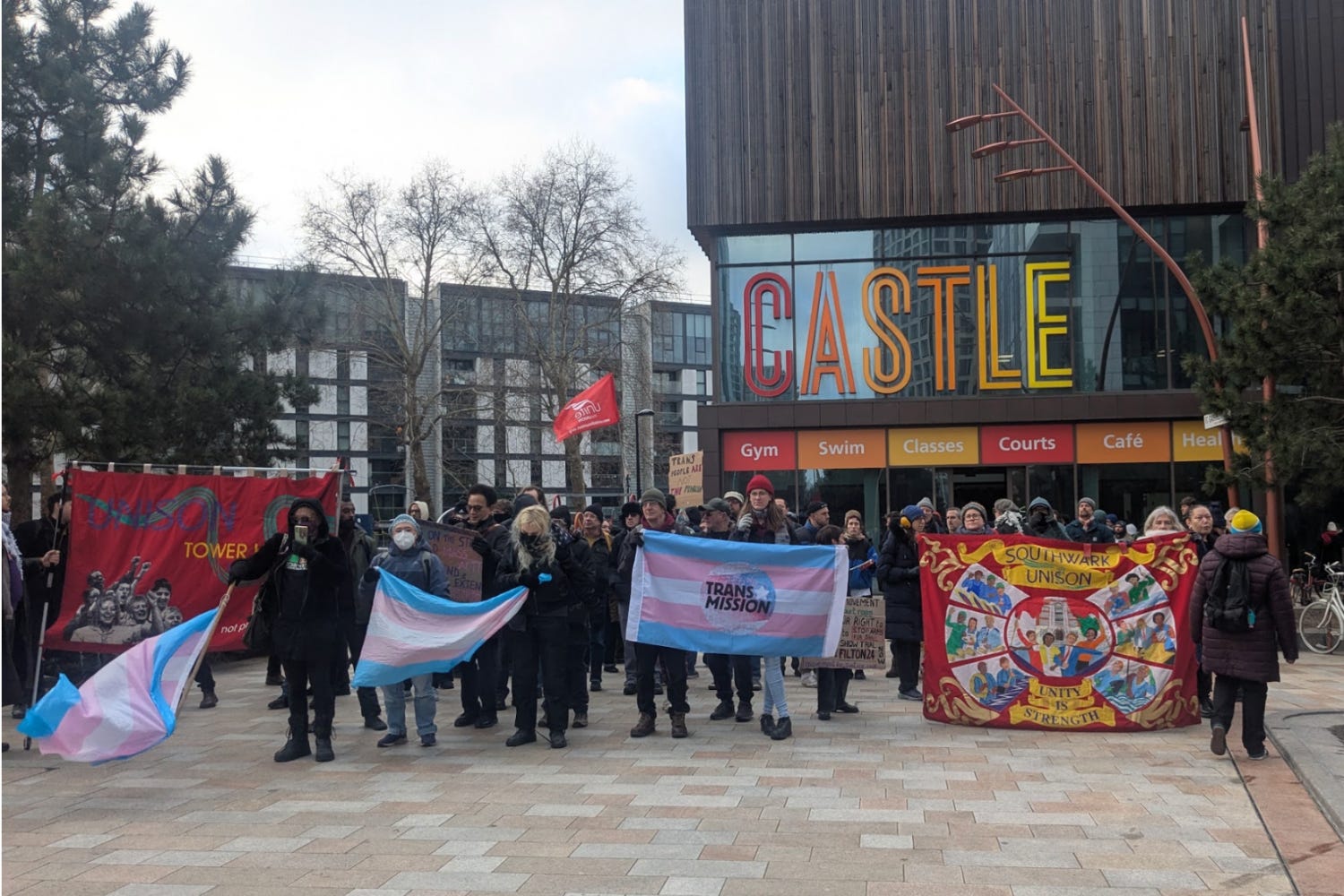
In October 2025 Miranda Newsom, a 60-year-old resident of Southwark, encountered a trans-identifying man using the female changing room in Castle Gym, a council-run leisure centre. Rather than apologising to her and fixing its rules to make clear that no male people may use the female changing room, the council investigated her and then banned her. Sex Matters, Women’s Rights Network and local campaigners demonstrated against the suspension. Miranda has now been allowed back to the gym, but Southwark has not changed its policies. Instead, it has told her that she can use the accessible changing room instead of the women’s changing room if she doesn’t want to risk changing with men. She is continuing to challenge this policy.
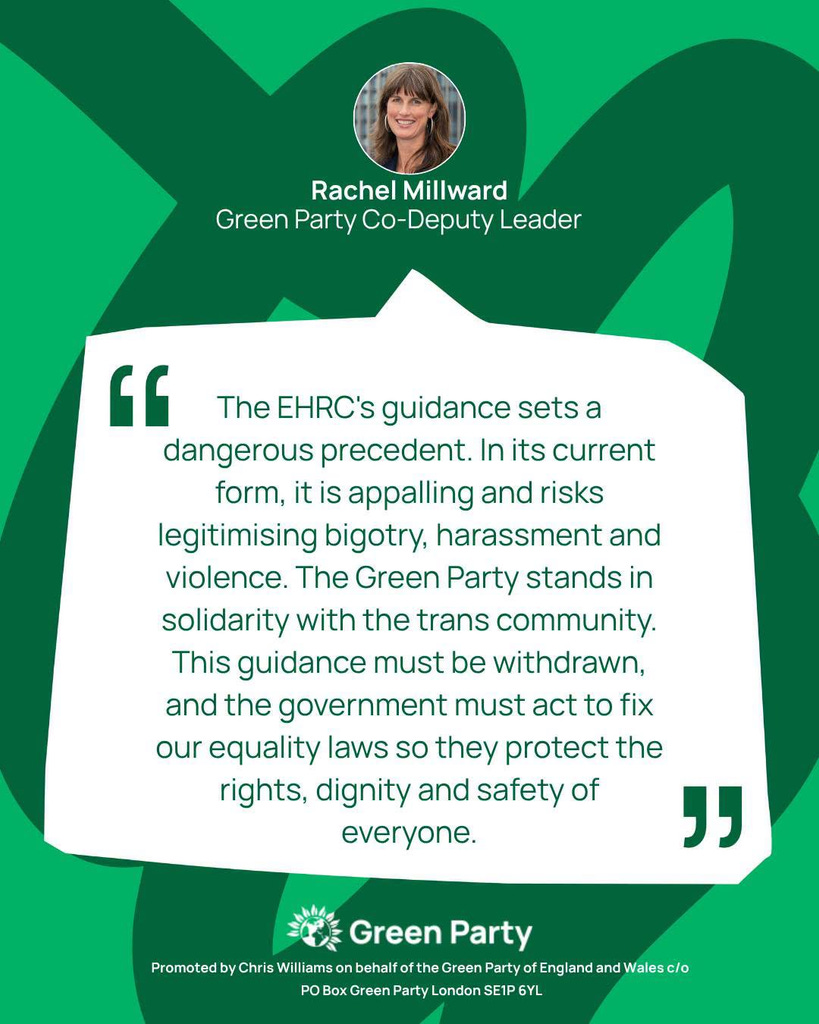
Local authorities are required to follow the law as it is. But some seem to be putting party policy first and taking the opportunity to grandstand. Hackney, Lewisham and Waltham Forest have Green majorities. In Lambeth, Haringey and Southwark, no party has overall control but the Green Party is the largest. Its position is that the EHRC guidance should be withdrawn and the Equality Act reformed to bring in gender self-ID. Hackney’s mayor, a Green, has said that single-sex spaces and services in the borough will remain “trans inclusive” and that she has told council staff not to “police access”.
In contrast the Conservatives have stated that they support single-sex provisions based on biology. On 15th April 2026, the Conservative leader, Kemi Badenoch, said she had asked Conservative-run councils to “adopt and publish clear, lawful policies on single-sex spaces across the services they run and fund”.
An injury to one…
Eight unions, with a combined membership of 3.6 million, have also criticised the EHRC code of practice. After a meeting on 19th August with “trans, non-binary and gender diverse members”, Andrea Egen, Unison’s general secretary, said she would work with them to “change the law for legal gender recognition”. In January, when supporters of Miranda Newsom protested outside Castle Gym against Southwark’s policy of allowing trans-identifying men to use women’s changing rooms, Unison organised a counter-protest (pictured above).
But unions too must follow the Equality Act. Among other things that means not discriminating against their gender-critical members – and three live court cases suggest they are not taking this duty seriously.
The first to come to a hearing will be that of Nurse Sandie Peggie, who took NHS Fife to the employment tribunal last year for allowing a male colleague to use the women’s changing room. She is suing her union, the Royal College of Nursing, alleging that it failed to support her in her dispute with NHS Fife and “contributed to her mistreatment”. The hearing starts in September.
Stephanie Pratt, a biomedical scientist working in the NHS, is suing Unite, the largest union in the UK. She says Unite refused to support her when she raised concerns about self-ID policies in her workplace and shared materials portraying gender-critical people as bigoted.
And Fiona Macdonald, a retired civil servant, is suing the Public and Commercial Services Union, which represents government employees, for not inviting her to its annual conference to be presented with an award she has received – she says because it disapproves of her openly expressing gender-critical beliefs.
The government says it is committed to the Equality Act as clarified by the Supreme Court. On 6th August Yvette Cooper, Andy Burnham’s newly appointed health minister, told Times Radio that “if there are single-sex provisions, then that has to be on the basis of biological sex”. On 14th August Bridget Phillipson, the Minister for Women and Equalities, said on BBC Radio 4’s Today programme that local authorities had been given a “clear direction as to what they need to do” by the EHRC guidance. She did not say, however, what the government planned to do if councils failed to step into line.
Most ordinary people, across the political spectrum, support the Supreme Court ruling that “sex” in the Equality Act means biology:

Having a council that respects the Equality Act and provides single-sex services shouldn’t be a postcode lottery. And people who have paid into their union for years shouldn’t face discrimination.
The anti science, anti biology insanity continues.
Why don’t women’s rights matter any more??